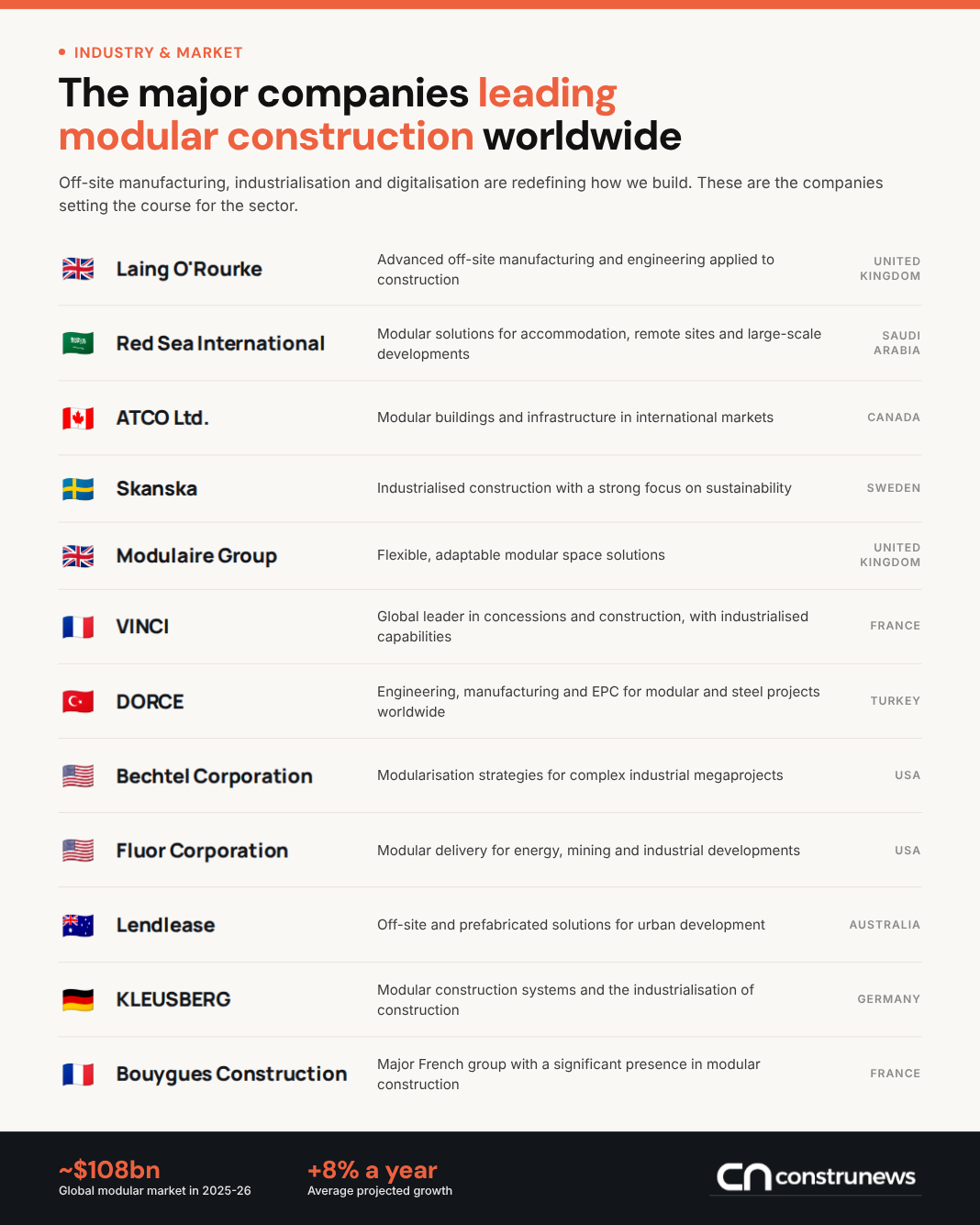

Modular and off-site construction continues to consolidate as a cornerstone in the transformation of the global construction model. Faced with a rapidly expanding market driven by the need to reduce timelines, optimize resources, and overcome the shortage of skilled labor, a detailed analysis of key players reveals how industrialized manufacturing, DfMA design, and digitalization are rapidly shifting activity from traditional construction sites to controlled factory environments.
The building industry is undergoing a structural change that goes beyond a mere methodological adjustment. The transition towards industrialized and modular systems responds to global imperatives of productivity, energy efficiency, and risk control. However, to understand the international competitive landscape, it is essential to properly categorize the companies participating in this value chain, differentiating between pure-play modular manufacturers, large contractors, and world-scale engineering firms.
Modular construction does not seek to replace the conventional model, but rather to radically transform where, how, and who executes the works, moving production to the factory.
In the realm of specialized modular manufacturers and builders, top-tier Asian giants stand out. Notable among them are Daiwa House Industry and Sekisui House in Japan, pioneering firms with a consolidated track record in industrialized housing and automated production systems. Daiwa House operates in Europe through Daiwa House Modular Europe, positioning itself as the largest modular builder in Europe with its own production capacity in Germany. Meanwhile, Sekisui House has accumulated a historical production of over 2.7 million homes.
The industrial and volumetric core on an international scale
Within the high-capacity volumetric segment, CIMC Modular Building Systems (CIMC MBS) represents a key global platform for steel solutions, accounting for over 200 projects in more than 20 countries and delivering landmark infrastructure such as the modular terminal at Foshan Airport in China. In North America and Oceania, firms like Canada’s ATCO Structures, with over 75 years of experience and infrastructure for remote projects, demonstrate that industrial modular building can drastically reduce execution times compared to traditional construction.
In Europe, the market is defined by large-scale specialists like Modulaire Group (operating in 23 countries with a fleet of over 250,000 units and integrating brands like Algeco) and Portakabin, which has three production centers in the UK, France, and Germany totaling 283,900 m², having recently bolstered its healthcare division by acquiring Darwin Group. Likewise, the German company KLEUSBERG excels in modular solutions for education, healthcare, and offices, demonstrating reductions of up to 70% in execution times and up to 80% in waste generation through its industrialized systems.
In Central Europe and the Eurasian region, players like Turkey’s DORCE Prefabricated & Construction integrate EPC capabilities, steel manufacturing, and logistics in more than 60 countries, covering everything from camps to hospitals and data centers. In the Czech Republic, KOMA MODULAR consolidates the presence of permanent modular solutions within the EU, while Germany’s ALHO holds a prominent position in public facilities.
In the US context, the ecosystem ranges from large-format operators like WillScot, with an average of 196,332 rental units, to specialists in multifamily and residential volumetric building such as Guerdon Modular Buildings and Champion Homes. Furthermore, the emergence of ConTech is reflected in companies like Autovol, which combines robotics and automation, Volumetric Building Companies (VBC), and FullStack Modular, focused on high-density residential developments.
Asia-Pacific accounts for nearly 47% of global modular building market revenues, leading in volume and technical capacity in 3D components.
The integration of industrialization in large contractors and EPC firms
A second strategic block consists of major international construction and engineering groups that incorporate off-site processes, DfMA (Design for Manufacture and Assembly) methodology, and modularization into complex megaprojects.
Standing out in this group are corporations like the UK’s Laing O’Rourke, a benchmark in engineering applied to off-site manufacturing, and large European building groups such as VINCI Construction, Bouygues Construction—with hybrid models combining 1D and 2D precast with 3D modules—and Sweden’s Skanska, aligned with high environmental sustainability standards. Joining this group are multinationals like Lendlease (Australia) and Balfour Beatty (UK).
In the heavy engineering and industrial infrastructure sector, global firms like the US-based Bechtel Corporation, Fluor Corporation, and Kiewit, along with India’s Larsen & Toubro, apply modularization on a massive scale in energy, mining, and industrial projects. Meanwhile, in the Middle East context, Red Sea International deploys steel modular systems for large-scale tourism and urban developments in Saudi Arabia and the UAE, with a declared capacity exceeding one million square meters annually.
The global market volume for modular construction stands at around $108 billion, driven by the massive adoption of BIM, AI, and robotics.
Market projections and global macro-trends
Sector reports place the size of the global modular construction market in a range between $95 billion and $108 billion, projecting compound annual growth rates (CAGR) of around 8% by the end of the decade, with forecasts reaching between $160 billion and $175 billion by the 2030-2034 horizon.
This progress is sustained by decisive structural vectors:
- Accelerated timelines: Simultaneous execution of on-site foundations and in-factory modular manufacturing.
- Labor optimization: Mitigating the impact caused by the shortage of skilled labor in developed markets.
- Sustainability and circular economy: Substantial reduction in material waste and exhaustive emission control in a factory environment.
- Advanced digitalization: Integration of BIM environments, industrial automation, robotics, and Artificial Intelligence in the design and production phases.