
The Col·legi d’Arquitectes de Catalunya (COAC), the Catalan association of architects, has issued a statement calling on Aena and the relevant public authorities to stop the transfer of Miró’s mural from Terminal 2 (T2) of Josep Tarradellas Barcelona-El Prat Airport to Terminal 1 (T1) and to keep it in its original location. The association is responding to published reports that the airport operator intends to move the work, and offers its collaboration to find a solution that allows the planned works to go ahead while guaranteeing the visibility and preservation of the piece.
This is not the first time the COAC has spoken out. It reiterates a position it made public when the plan to move the mural to T1 first emerged. In July 2026, when it presented the comprehensive remodelling of T2, with an investment of more than €153 million through 2031, Aena said the mural on the T2B façade would not be affected by those works, but that it still intends to move it to T1, and that specialists are still studying the feasibility of an operation it described as very complex.
A work conceived for a specific building
The association’s first argument is the unity between architecture and artistic intervention. Miró conceived the work in 1970, in collaboration with ceramist Josep Llorens Artigas, to welcome those arriving in Barcelona. He did so, the statement stresses, “in a specific building, in a precise place and with its own proportions and colours”. For the COAC, the mural is part of T2’s identity and cannot be understood apart from the architecture that houses it.
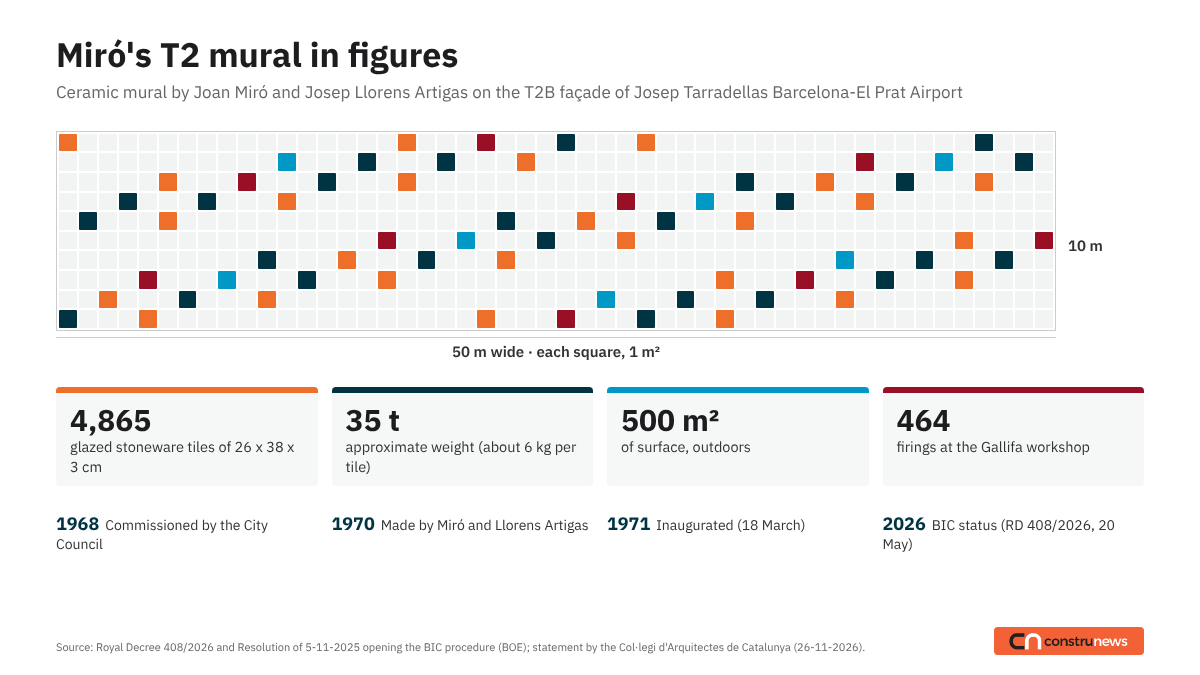
According to the declaration file published in the Spanish Official Gazette (BOE), Barcelona City Council commissioned the mural in 1968, Miró donated it to the city in February 1971 and it was officially inaugurated on 18 March that year.
The mural is part of T2’s identity and cannot be understood apart from the architecture that houses it
Bien de Interés Cultural since May 2026
The second argument concerns heritage. Royal Decree 408/2026 of 20 May declared the airport’s ceramic mural a Bien de Interés Cultural (BIC), in the movable property category, a status the Fundació Joan Miró describes as the highest level of heritage protection in Spain. For the COAC, the declaration reinforces the value of the work and the need to guarantee its conservation.
The association adds that T2 itself, designed by architect Eduardo Aguirre and engineer Vicente Cudós, is included in the DOCOMOMO catalogue (Documentation and Conservation of the Architecture and Urbanism of the Modern Movement) in its highest category, recognising its national and international relevance. In its view, the mural, the structure and the roof of T2 form a heritage ensemble that must be preserved.
4,865 tiles and 35 tonnes: the risk of moving it
The third point is technical and economic. Besides involving a very high cost, according to the COAC, the move is a highly complex operation and a risk to the integrity of the work. The mural measures 50 metres wide by 10 metres high and is made up of 4,865 stoneware tiles, weighing approximately 35 tonnes.
The Royal Decree specifies that each glazed stoneware tile measures 26 x 38 x 3 centimetres and weighs about 6 kilos, and that the pieces came from 464 firings at Llorens Artigas’s workshop in Gallifa. The association also notes that the work is outdoors and requires regular, proactive maintenance to ensure its conservation. “Any intervention must prioritise the preservation of the work and avoid unnecessary risks,” it argues.
Any intervention on the mural must prioritise the preservation of the work and avoid unnecessary risks
Transparency on Aena’s project
The fourth point calls for seeking alternatives that allow T2 to undergo the functional adaptations it needs without altering its essence. The COAC asks Aena to make explicit its overall refurbishment and reorganisation plan for the terminals, the reasons for moving the mural and the alternatives studied to keep it where it is.
The association insists that any intervention on the work must be backed by reports from the competent bodies of Spain’s Ministry of Culture. This is the same condition set out in the BIC declaration file: should the mural have to be moved, a report from that ministry’s competent bodies will be mandatory.
The COAC offers its collaboration to carry out the works while guaranteeing the visibility and preservation of Miró’s mural
The COAC concludes by calling on Aena and the authorities to halt the transfer and keep the mural in its original place, and offers to work on a solution compatible with the terminal’s refurbishment.

