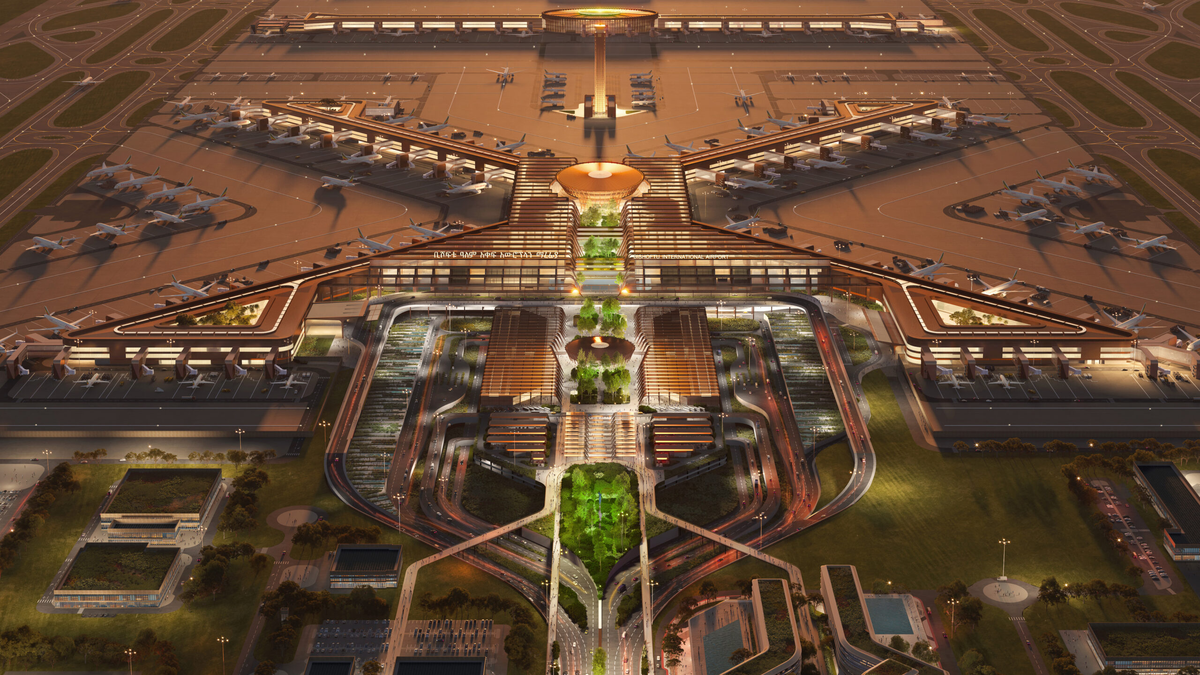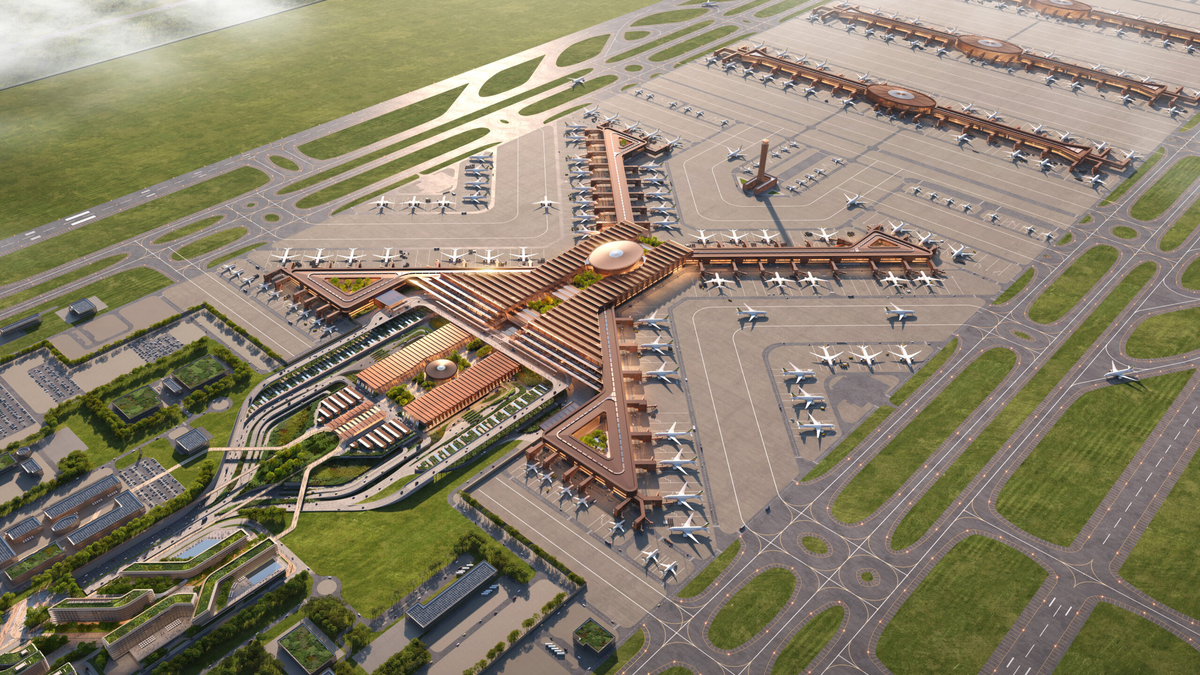

Ethiopia is already building the airport that aims to become the continent’s great transfer hub. Bishoftu International Airport (BIA), promoted by Ethiopian Airlines Group with a terminal designed by Zaha Hadid Architects (ZHA) within a team led by Dar Al-Handasah, will handle 60 million passengers a year in its first phase, due in 2030, and 110 million once complete, which would make it Africa’s largest airport.
Cornerstone laid on 10 January 2026
Works officially began on 10 January 2026 at a ceremony in which Ethiopia’s Prime Minister, Abiy Ahmed, and Ethiopian Airlines Group CEO Mesfin Tasew placed the commencement plaque, according to the airline’s official press release. The airport design was unveiled at the same event, and the resettlement and livelihood restoration programme for affected communities was reported as completed.
Abiy Ahmed described BIA as “the largest aviation infrastructure project in Africa’s history” and called the day a milestone in the country’s modernisation. Mesfin Tasew spoke of “a proud moment for Ethiopian Airlines and for all of Africa”, linking the project to the company’s 80 years of service and to the African Continental Free Trade Area (AfCFTA).
The airport is being built some 40 km from Addis Ababa, on a site ZHA placed in the Abusera area in 2024, and is intended to ease capacity constraints at the current Addis Ababa Bole International Airport. The site lies roughly 400 metres lower than Bole, which, according to the practice, improves aircraft performance and maximum take-off weight, together with longer runways.
Phase one will have a 660,000 m² terminal, two independent parallel runways and capacity for 60 million passengers a year
A terminal built for transfer passengers
Phase one includes a 660,000 m² terminal and two independently operating parallel runways (Code 4E). Later phases will take the airport to 110 million passengers a year, with four runways and parking for 270 aircraft. The facility is planned to operate 24 hours a day, with no curfew.
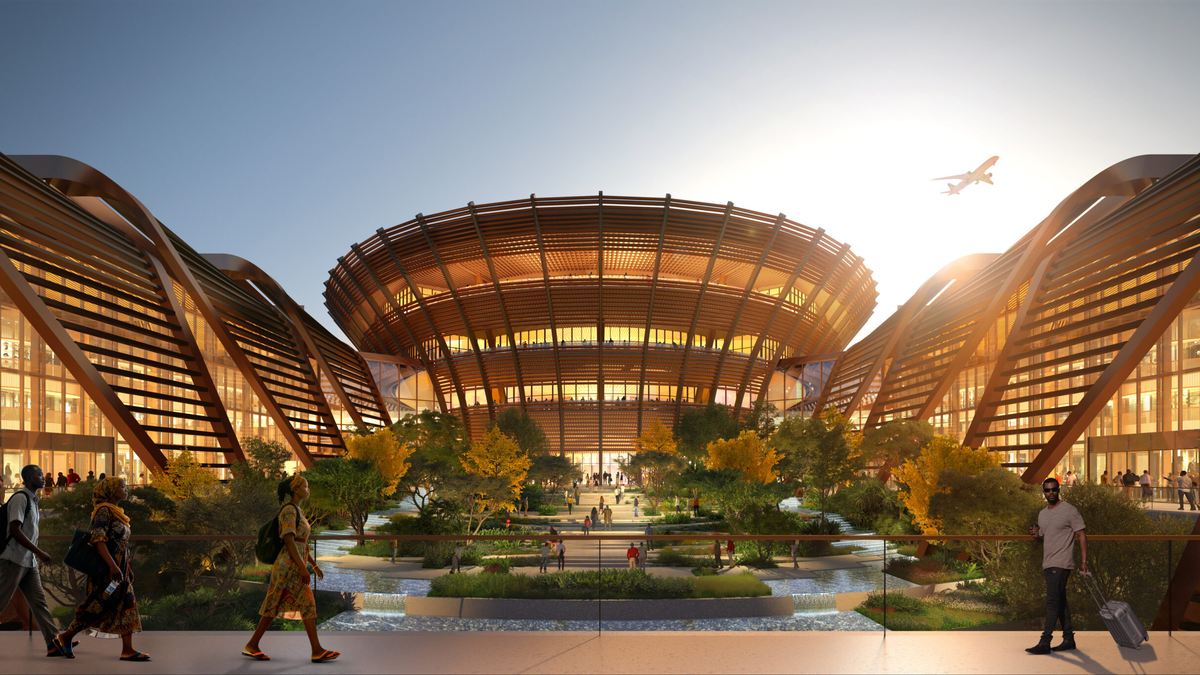
The design responds to Ethiopian Airlines’ future demand and its role as a transfer hub: according to ZHA, up to 80% of passengers will connect without leaving the terminal. For them, the plan provides an airside hotel with 350 guestrooms, dining and entertainment, and outdoor gardens and courtyards.
A single central spine links the terminal with the piers to keep transfer distances short. The layout is inspired by the Great Rift Valley, and each pier has its own interior materials and colour palette referencing Ethiopia’s different regions. Cristiano Ceccato de Sabata, Director of Aviation at ZHA, calls it “a visionary project for Ethiopia and Africa as a whole”.
LEED Gold, natural ventilation and local materials
The passenger terminal is designed to achieve LEED Gold certification. The project combines natural ventilation, solar shading and semi-enclosed outdoor spaces, and construction relies on modular fabrication and locally produced or recycled concrete, aggregates and steel.
Stormwater will be directed to wetlands and bioswales, and photovoltaic arrays will provide on-site energy. The landscaping uses native drought-resistant planting, including resettled trees, with landside parks and airside gardens.
Up to 80% of passengers will transfer without leaving the airport, which will include a 350-room airside hotel
High-speed rail and an Airport City
A high-speed rail link will connect BIA with central Addis Ababa and Bole Airport. The plan also includes an integrated “Airport City” of mixed-use buildings which, according to ZHA, will provide local employment for a population of 80,000.
The project is part of Ethiopian Airlines Group’s Vision 2035 strategy. Founded in 1945, it is Africa’s oldest airline, flies to more than 150 destinations and has over 26,000 employees, according to the Prime Minister. The group runs an Aviation University, which will be joined by a Boeing African centre of excellence. ZHA also cites IATA forecasts of more than 200% growth in East African traffic over the next decade.
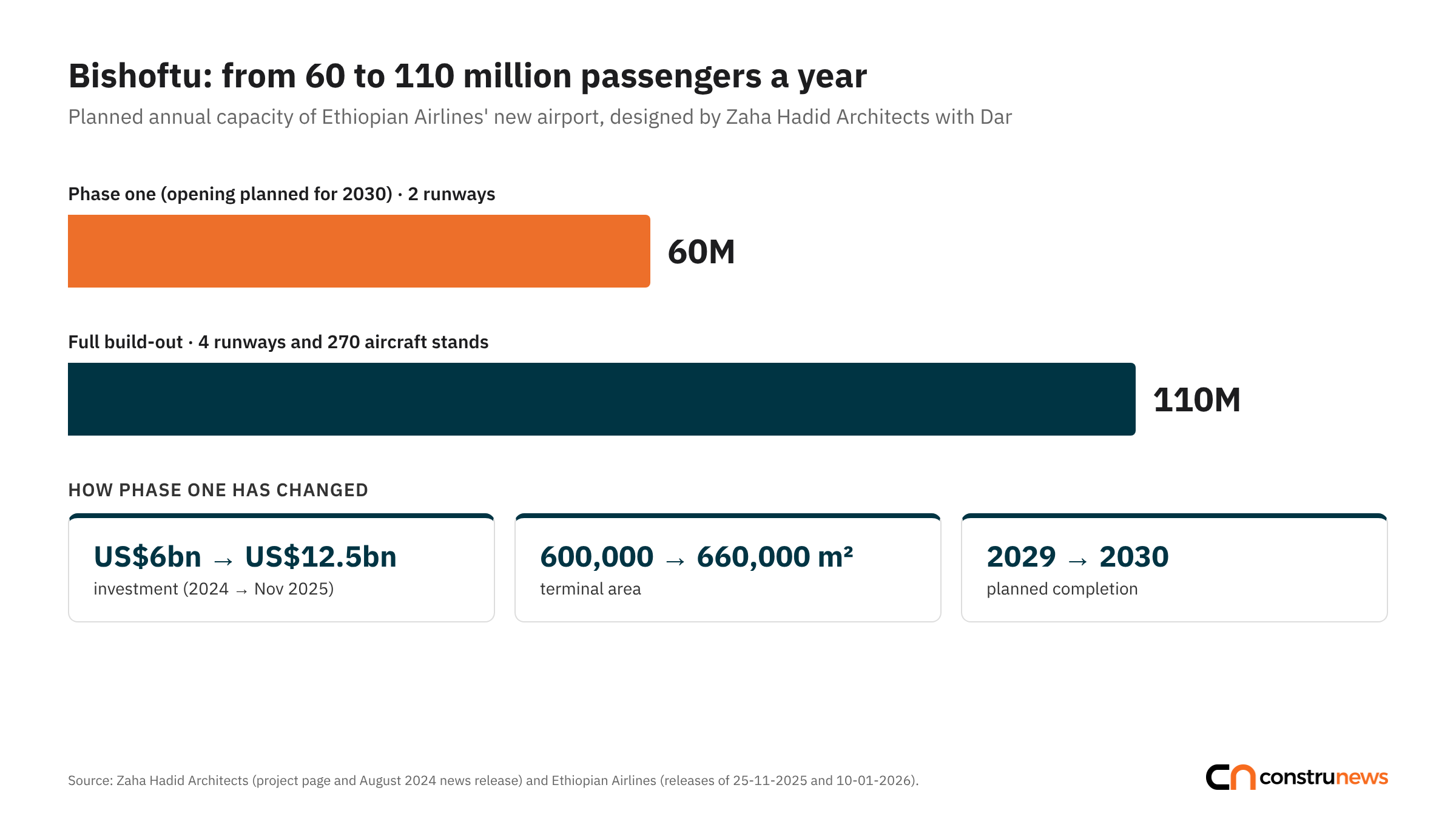
From US$6 billion to US$12.5 billion
The commission dates back to 2024, when Ethiopian Airlines awarded the design consultancy contract to the consortium led by Dar and ZHA. At the time, phase one was valued at US$6 billion, with a 600,000 m² terminal and completion in 2029, on a 35 km² site; phase two was estimated at around one million m² of terminal.
In November 2025, the airline put phase one at approximately US$12.5 billion and its completion in 2030, in the release presenting the project to financiers. Ethiopian Airlines Group is the project sponsor; the African Development Bank (AfDB) is the Initial Mandated Lead Arranger; Dar is technical advisor, KPMG financial advisor and Clyde & Co legal advisor. Mesfin Tasew said the airport “marks a historic leap in Africa’s aviation journey” and invited financiers worldwide to join.
Ethiopian Airlines values phase one at US$12.5 billion, up from the US$6 billion estimated in 2024
Project data
| Project | Bishoftu International Airport (BIA) |
| Location | Bishoftu, some 40 km from Addis Ababa (Ethiopia) |
| Client | Ethiopian Airlines (Federal Government of Ethiopia) |
| Status | Under construction (groundbreaking: 10 January 2026) |
| Planned opening | 2030 (phase one) |
| Capacity | 60 million passengers/year (phase one); 110 million (full build-out) |
| Terminal area | 660,000 m² (phase one) |
| Runways | 2 independent parallel, Code 4E (phase one); 4 (full build-out) |
| Aircraft stands | 270 (full build-out) |
| Investment | Approximately US$12.5 billion (phase one) |
| Sustainability | Terminal designed for LEED Gold |
| Lead Consultant, Airport Planner and Executive Architect | DAR (Dar Al-Handasah) |
| Terminal Planner and Design Architect | Zaha Hadid Architects (ZHA) |
| Airport Master Planner | DAR + ZHA |
| ZHA project leadership | Cristiano Ceccato de Sabata (Project Director), Paul Brislin (Project Manager), Clara Martins (Project Leader) |
| ZHA Board Oversight | Charles Walker, Mouzhan Majidi |
| ZHA Project Architects | Leo Alves (Planning), Sai Prateik Bhasgi (Design), Electra Mikelides (Airport City) |
| Contractors | Beijing Urban Construction Group (Enabling Works); China Communications Construction Company (Infrastructure) |
| Executive Interiors Architect | Pascall + Watson |
| Structural, geotechnical, MEP, VHT, fire, acoustic, ICT, security, wayfinding, cost and sustainability | DAR |
| Landscape Consultant | DAR UK |
| Façade Engineering | Maffeis |
| Architectural Lighting Design | Spectrum |
| Baggage Handling System | BNP Associates, Inc. |
| Retail Planning & Analytics | Portland Design |
| Airfield and Apron Planning | Landrum & Brown |
| Airfield City Planner | SPADA Ltd. |
| Financing advisors | AfDB (Initial Mandated Lead Arranger), Dar (technical), KPMG (financial), Clyde & Co (legal) |
Sources: Zaha Hadid Architects and Ethiopian Airlines. Images: Render by X-Universe (Zaha Hadid Architects).