
61.2% of respondents list winning new contracts or tenders among the main benefits of innovating, compared with 24.5% who point to better operating margins and cost optimisation. The figure comes from the first sector barometer produced by Ayming and the Spanish Construction Technology Platform, presented today in Madrid.
Innovation is helping to create new business opportunities in the construction sector, although organisations are less likely to recognise its benefits for economic efficiency. That is the main finding of the I Barómetro de la Innovación en la Construcción 2026 (1st Construction Innovation Barometer 2026, in Spanish), produced jointly by the Plataforma Tecnológica Española de Construcción (PTEC) and Ayming, a company specialising in innovation funding and corporate taxation.
The gap between the two indicators comes at a time when 98% of the construction companies surveyed believe innovation has improved their competitiveness. The report combines economic and sector indicators from official sources with a survey of a qualified sample of 49 respondents, including companies and start-ups, technology centres, universities and research centres, and clusters, associations and foundations. The document itself warns that its results are not a statistical estimate that can be extrapolated to every company in the sector.
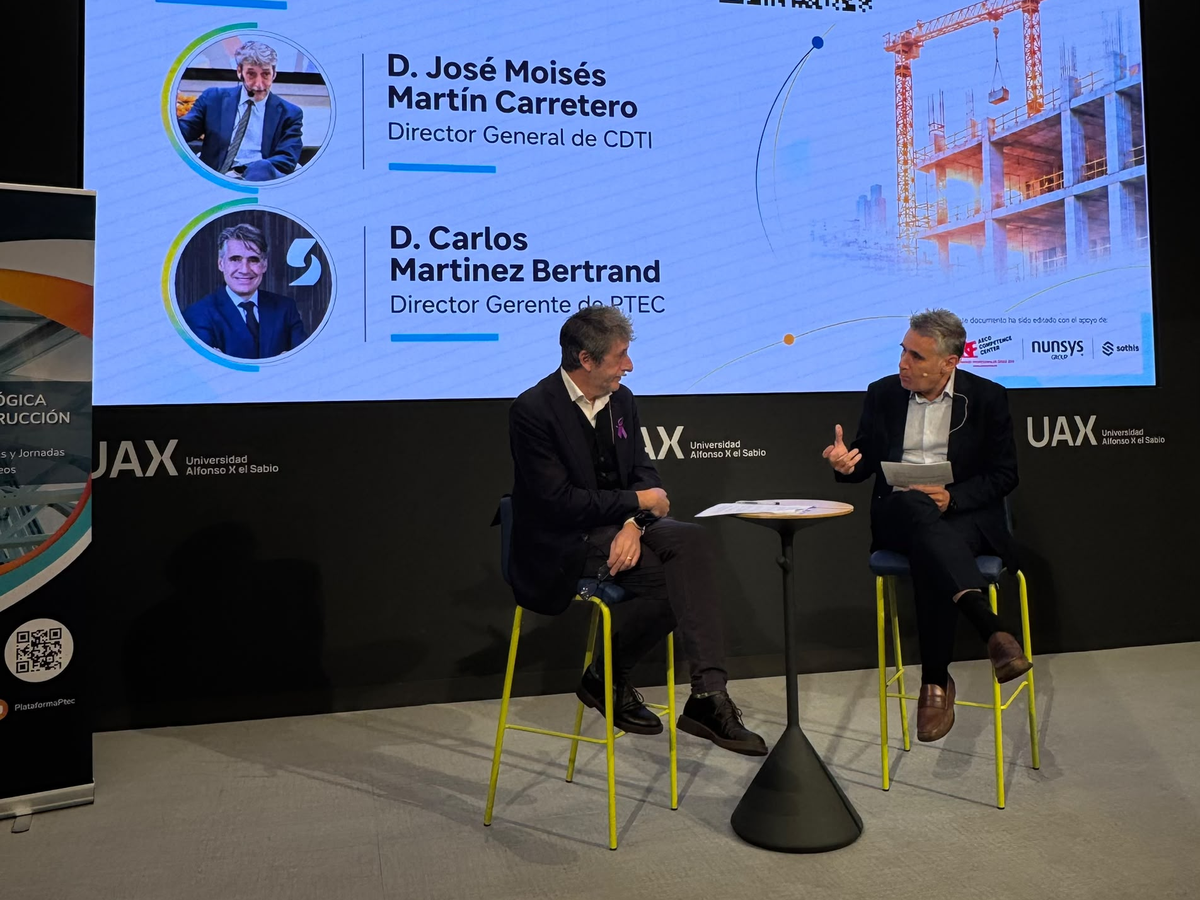
The barometer was presented on 25 November at the Chamberí campus of Universidad Alfonso X el Sabio (UAX), at an event attended by José Moisés Martín Carretero, director general del CDTI; María Ángeles Ferré, subdirectora de Programas Temáticos of the Agencia Estatal de Investigación (State Research Agency); and Pedro Fernández Alén, presidente of the Confederación Nacional de la Construcción (CNC) and of PTEC.
From technological progress to day-to-day work
“The incorporation of artificial intelligence, digital tools, new materials and construction methods opens up opportunities to transform the way projects are designed, executed and managed. However, the real challenge is to bring these technological advances into organisations’ everyday activity and make them last,” said Ignacio Vázquez, responsable de Estrategia y Sector Público of Ayming España.
Carlos Martínez Bertrand, director gerente of PTEC, said that “the Barometer results confirm that the sector believes in innovation, but also that it faces a major execution challenge. The renovation of the building stock, driven by the new European Energy Performance of Buildings Directive (EPBD), and the generational handover of an increasingly ageing workforce force us to speed up projects. This reality means that innovating is no longer an option but a necessity.”
98% of the construction companies surveyed believe innovation has improved their competitiveness, but only 24.5% see it in margins and costs
The sector keeps investing
Better reputation and brand image (69.4%), winning new contracts or tenders (61.2%), access to new markets (49%) and higher productivity (49%) stand out among the main benefits of innovation identified by organisations.
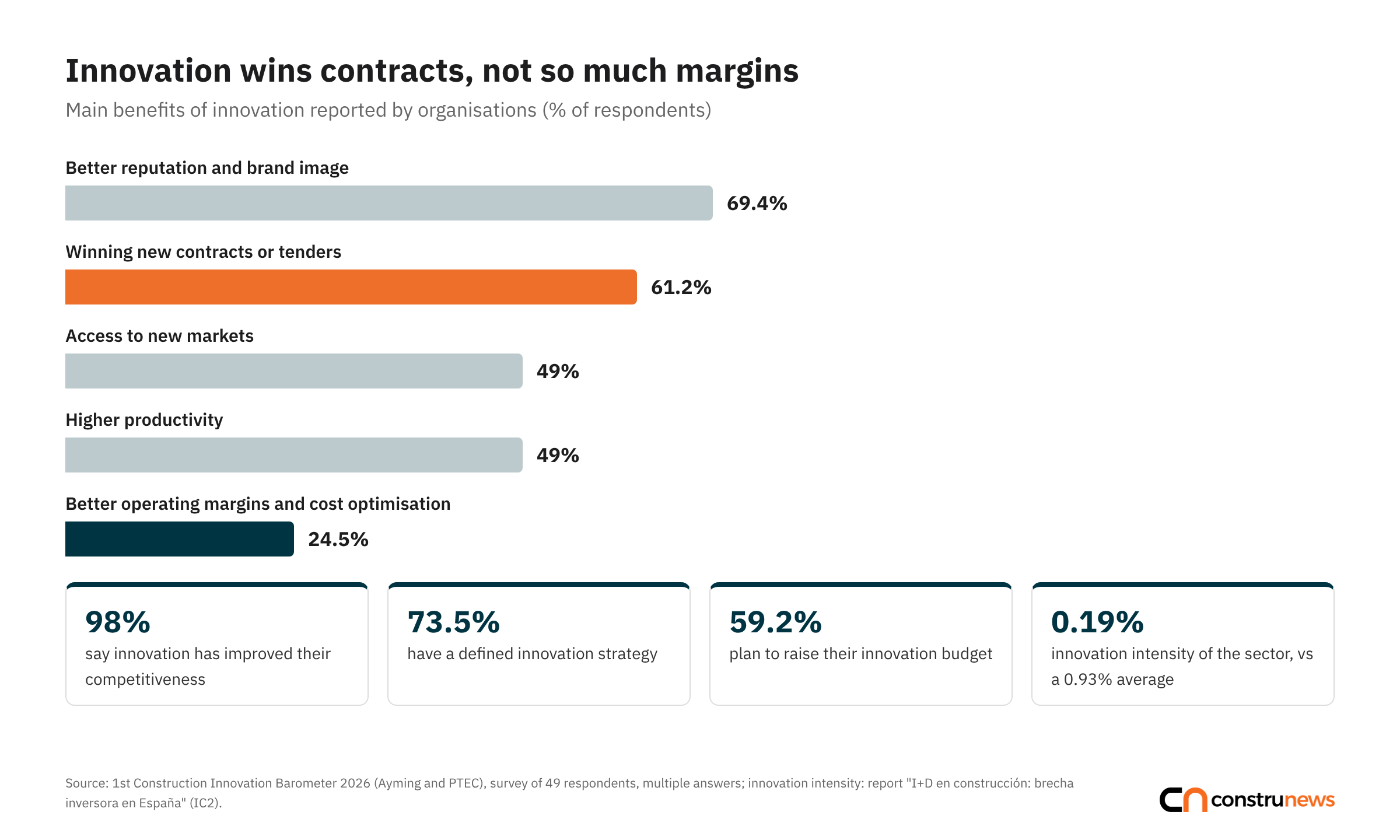
This positive view translates into investment: 73.5% of respondents have a defined innovation strategy and 59.2% plan to increase their budget next year, while the remaining 40.8% expect to keep it unchanged.
Developing new products and processes (73.5%), innovation in construction methods (67.3%) and improving sustainability and energy efficiency (67.3%) are the main priorities.
An investment gap of around €486 million a year
The barometer complements the findings of the report I+D en construcción: brecha inversora en España (R&D in construction: Spain’s investment gap), written by economist Javier Santacruz Cano for the first edition of the International Congress on Innovation in Construction, Building, Infrastructure and Concessions (IC2) (in Spanish), held last June in Santander.
According to that study, the construction sector’s innovation intensity stands at 0.19%, compared with 0.93% for Spanish businesses as a whole. To reach that level, the sector would need to increase its innovation investment by €485.7 million a year, an estimated additional effort of close to €2 billion up to 2030.
Construction would need to invest €485.7 million more a year to match the average innovation intensity of Spanish businesses
Both reports offer complementary views of the sector: there is growing corporate awareness of the value of innovation, but also a need to step up investment, ease access to funding and speed up technology transfer to improve productivity and competitiveness.
Artificial intelligence leads technology adoption
Artificial intelligence, including generative AI, is the technology most widely reported for optimising construction processes (71.4%), followed by BIM tools (57.1%), advanced materials and digital twins (46.9% each).
However, only 32.7% of respondents report habitual, structured use of digital tools in their innovation processes. Cultural resistance to change on site (55.1%), the cost of developing solutions (46.9%) and teams’ lack of knowledge or training (38.8%) are the main barriers to digitalisation.
Only 32.7% of organisations use digital tools habitually and in a structured way in their innovation processes
Red tape and a lack of incentives hold back sustainable innovation
75.5% of the organisations surveyed have a circular economy strategy or plan that is operational or in development, although only 44.9% have already implemented it.
Regulatory or administrative constraints (61.2%), the absence of tax incentives or benefits (44.9%) and the cost of circular materials or processes (38.8%) stand out among the main obstacles to more sustainable construction models.
The barometer highlights the importance of strengthening public-private collaboration, easing access to funding, boosting technology adoption and overcoming regulatory barriers to extend the benefits of innovation to the whole sector.

