
Catalonia is the first Spanish region with a specific law to eradicate asbestos. In force since 3 October, it turns into an obligation the removal of a material banned since 2001 that still covers more than 120,000 Catalan roofs. Its roll-out coincides with Spain’s new royal decree on worker protection and with a global market that has not gone away.
Barcelona, November 2026. The Llei 8/2026, de 2 de juliol, de l’erradicació de l’amiant (Asbestos Eradication Act) has now been applied for a month and a half. Passed unanimously by the Parliament of Catalonia on 17 June, with 133 votes in favour and the support of every group, it was published in the Official Journal of the Generalitat (DOGC no. 9449) on 3 July and came into force on 3 October 2026, except for its specific penalty regime, which will apply once the implementing decree is approved.
The Catalan Government describes it as a pioneering law in Spain. Its starting point is set out in the preamble: the 2001 ban allowed installed materials to remain in place until the end of their service life and, until now, there was no legal obligation to remove them before that point.
How much asbestos remains in Catalonia
According to the law’s preamble, Catalonia holds millions of tonnes of asbestos cement and between 6,000 and 30,000 tonnes of sprayed coatings and thermal insulation, mostly installed between the mid-1960s and the late 1980s, so they have reached or are reaching the end of their service life.
On 4 November, at a hearing in Parliament, Sílvia Paneque, consellera de Territori, Habitatge i Transició Ecològica, recalled that the first mapping survey by the Institut Cartogràfic i Geològic de Catalunya (ICGC), published in April 2024, identified 122,460 asbestos cement roofs: some 40 square kilometres and around 700,000 tonnes of material across 945 municipalities. The Generalitat estimates that nearly one million tonnes remain to be removed, and the national plan expects more than 85% of that material to be past its service life by 2030.
The ICGC survey identified 122,460 asbestos cement roofs in 945 municipalities, some 40 km² and 700,000 tonnes of material
What the law requires
The law assigns rights and duties to public authorities, citizens, removal companies and property managers, and creates five instruments:
- The Comissió Catalana d’Erradicació de l’Amiant, the body leading the process.
- The Cens català de materials que contenen amiant, a public register kept by the Generalitat and fed by municipal registers. Until a town council has its own, the Catalan register serves in its place.
- The Fons per a l’Erradicació de l’Amiant de Catalunya, with its own funding line for local authorities and special attention to rural municipalities.
- The register of qualified companies and professionals, which the Government must launch within six months of entry into force.
- The register of mesotheliomas and asbestos-related diseases, for health surveillance.
Public authorities must identify and remove asbestos from their property, giving priority to schools, health centres, community facilities and sports venues. The law asks the Government to draw up a specific plan for those buildings within three years, and Paneque set 2028 as the deadline for public property. Penalties range from €100 to €3,000 (minor), €3,001 to €30,000 (serious) and €30,001 to €100,000 (very serious), plus coercive fines of €150 to €3,000.
Since 3 October, selling or renting a property in Catalonia requires a certificate stating whether asbestos is present
The measure with the most immediate impact on the property market is the asbestos presence or absence certificate, which must be provided in every sale and rental. Until regulations are adopted, it must at least report visible asbestos, its condition and the risk it poses. The Generalitat has agreed a basic model with notaries, land registrars, architects, technical architects, engineers and property managers. The law also amends the Catalan Civil Code to include asbestos fibres among unlawful nuisances between neighbours.
The first month of application
At the hearing, Paneque outlined the launch of the Oficina d’Erradicació de l’Amiant, with an initial staff of 13, and announced €20 million in grants for removal, transport and waste treatment, to be carried out by companies listed in the official register. Public consultation on the implementing regulations opens this November, and the roof map will be updated in 2027-2028. “Every year that passes without removing asbestos makes the problem more complex,” the consellera warned.
The law also pays special recognition to Cerdanyola del Vallès, Ripollet and Badia del Vallès, towns affected by ninety years of activity at the Uralita factory.
Spain: pending municipal registers and a new royal decree
Across Spain, the framework is set by Law 7/2022 on waste and contaminated soils for a circular economy. Its fourteenth additional provision required town councils to draw up, within one year, a register of installations and sites containing asbestos with a public removal timetable, prioritising hazard and exposure of the most vulnerable population. The highest-risk public installations must be dealt with before 2028. Unlike Catalonia’s law, the national law creates no specific fund, certificate or penalty regime for asbestos.
On the occupational side, Royal Decree 847/2026 of 21 October, published in the Official State Gazette (BOE) on 23 October, repeals the long-standing Royal Decree 396/2006 and transposes the EU directive. The exposure limit falls from 0.1 to 0.01 fibres per cubic centimetre (eight-hour average) and, from 2029, counts must also include the thinnest fibres, below 0.2 microns. It requires asbestos to be identified before any works in buildings that predate the ban, limits the use of respiratory protective equipment to four hours a day and sets renewable three-year listings in the Register of Companies at Risk from Asbestos (RERA).
Spain’s ban on marketing asbestos was adopted by the Order of 7 December 2001. Construnews keeps a guide to the legal framework on asbestos (in Spanish) in its Construpedia.
Europe: banned since 2005, with tighter limits
In the European Union, Directive 1999/77/EC required Member States to ban the marketing and use of asbestos by 1 January 2005 at the latest. Directive (EU) 2023/2668 lowered the limit to 0.01 fibres/cm³ until 20 December 2029 and, from then on, to 0.002 fibres/cm³ when counting fibres between 0.2 and 3 microns wide, or 0.01 when fibres thinner than 0.2 microns are included. The transposition deadline was 21 December 2025, so Spain has adopted it some ten months late.
The Catalan law itself cites the goal set by the European Economic and Social Committee in 2015: to have removed all asbestos by the end of 2032, with public buildings recommended to be cleared before 2028.
The world: more than 200,000 deaths a year
Outside Europe, asbestos is still mined. According to the US Geological Survey (USGS) Mineral Commodity Summaries 2026, world mine production reached about 960,000 tonnes in 2025: Russia leads with 310,000 t, followed by Kazakhstan and China (250,000 t each) and Brazil (150,000 t). World fibre consumption stood at about 930,000 tonnes, almost 55% less than the roughly 2 million tonnes of 2000.
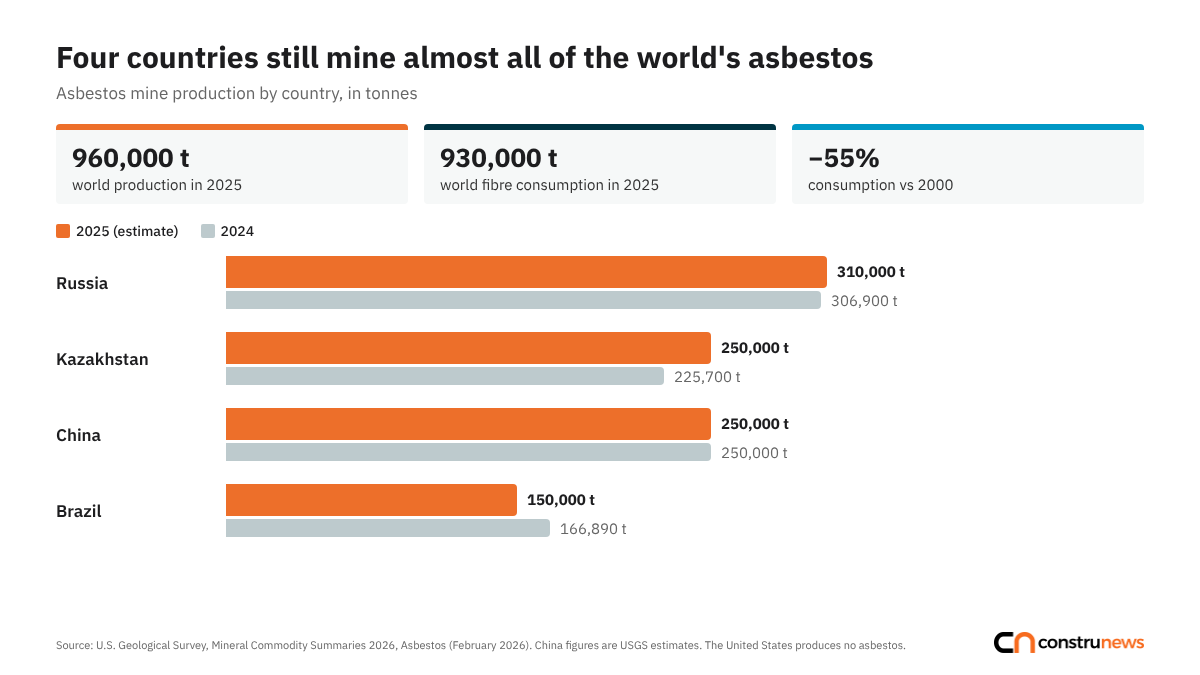
Russia, Kazakhstan, China and Brazil produced about 960,000 tonnes of asbestos in 2025, according to the US Geological Survey
In Brazil, the Supreme Court ruled the mining, sale and use of asbestos unconstitutional, but an August 2024 law in the state of Goiás gives five years to wind down activity from a mine closure agreement that did not yet exist in September 2025. The United States, which produces no asbestos, fully banned imports of asbestos fibre in May 2024 under an EPA rule that sets deadlines up to 2037 for the last industrial uses.
The World Health Organization (WHO) attributes more than 200,000 deaths a year to occupational asbestos exposure, over 70% of deaths from work-related cancers, and counts more than 50 Member States that have banned its use.
A known problem with a timetable ahead
With the law in force, Catalonia moves from recommending to requiring. Its effectiveness will depend on the regulations, whose public consultation is just starting, on the size of the fund and on town councils’ ability to complete registers that national law has required since 2023. The European 2032 horizon is six years away.

