

As part of Construnews’ housing monograph, built on a ten-question survey based on data from the INE, building permits, Eurostat, the Urban Information System, protected housing certifications, public spending, costs, the Land Registry and prices, Marta Vall-llossera Ferran, presidenta del Consejo Superior de los Colegios de Arquitectos de España (CSCAE), answers every question one by one and offers the Architects’ Associations’ collaboration to the Administrations to speed up procedures.
How many homes are missing
The INE projects more, and smaller, households until 2041. Comparing that projection with new-build permits, what is the real shortfall, where is it most severe and what kind of housing is needed?
Data from the Bank of Spain point to an accumulated housing shortfall of 750,000 homes between 2021 and 2025 which, unless it is corrected with short-, medium- and long-term measures launched right now, could rise to one million between 2026 and 2028. The National Statistics Institute (INE) projects 2,184,048 additional households until 2041. This pace of household formation contrasts with the number of homes approved for new build which, according to the statistics of the Architects’ Associations, stood last year at 122,122, plus 55,558 for major renovation.
Against this backdrop, supply and demand need to be balanced by establishing measures that are stable over time, based on broad consensus, including public-private partnership and the sector’s professionals. Comprehensive measures are needed that address, on the one hand, territorial planning in order to contain and reverse current imbalances, backing a network of medium-sized cities to guarantee people’s quality of life, and, on the other, the reality of new households. Spanish society in the 21st century is not the same as in the 1980s and 1990s. Not only is more housing needed, mainly affordable, but this housing must be optimally adapted to people’s needs and to the different stages of their lives, starting from care, as set out in the publication Cuchara, geranio, palique. Espacios para nuevas maneras de habitar. Nuevos significados, published by the CSCAE Observatory.
In this strategy, it is essential to accelerate the deep transformation of the building stock because it can bring to light housing that is currently empty or does not adequately meet people’s needs, and also to align the pace of housing renovation with the targets set by the EU for a decarbonised and more competitive economy in 2050.
From permit to keys
In light of permits and of open-market homes started and completed, where does the process get stuck today: licences, financing, labour or construction times?
Following the order of the building process, the first bottleneck is the granting of building or major renovation licences. There are no official data, as local administrations do not provide this information, but in a good number of cases they exceed the three-month time limit set by law (according to Asprima, the average is around twelve months) and in some councils they take up to two years, with consequences not only in terms of the resulting increase in the final price of housing, but also because there are expectations and life plans behind them and, in the case of developers, this holds back initiatives, reducing the number of properties coming onto the market.
It is the obligation and responsibility of Public Administrations to equip themselves with adequate and sufficient technical and human resources to comply with the regulations without undermining their citizens’ legal certainty. To help speed up procedures, and without neglecting the Administration’s supervision, which is essential, the Architects’ Associations can collaborate by helping to clean up files, verifying documentation, the professional’s authorisation and the integrity of the project through the visado (professional endorsement), with traceability and certified time limits, thus drawing on proven experience.
As for labour, the figures stating that some 700,000 workers are needed are not vacancies. They represent an accumulated need for new entrants over several years. The sector employs around 1.6 million people in Spain. The problem we face is one of generational renewal and also of essential trades, such as electricians. The average age in the sector is 45 and 22% of workforces are over 55. Finally, with regard to financing, it needs to be stimulated, linked to sustainability and quality parameters.
The figures stating that some 700,000 workers are needed are not vacancies. They represent an accumulated need for new entrants over several years
Spain compared with Europe
How do you read our position in residential building permits compared with the rest of the EU Member States? Which policy from another country would you import?
According to the Bank of Spain, using OECD data, the public rental housing stock barely accounts for 1.5% of the total, whereas in France this rate rises to 14%; to 21.3% in Denmark; to 21.3% in Austria; and even to 34.1% in the Netherlands. If private homes or those owned by non-governmental/financial entities that are used for social or affordable purposes are included, the percentage rises to 3.3%, the figure used by the Ministry, but even so it remains far from the European average of 8%.
That said, in Europe it is increasingly difficult to find quality, affordable housing. According to Eurostat, between 2015 and 2024 prices rose by 53% on average, and almost 10% of households in urban areas and 6.3% in rural areas already spend more than 40% of their income on housing costs. The causes are many and depend on local realities that also vary within the same territory, but the same pattern is repeated in every country: sale and rental prices are rising faster than wages, reducing people’s capacity to save; housing creation is not keeping pace with the growth in households; and all this threatens the competitiveness of the economy and the well-being of citizens, and erodes the principles and values on which the European project is built.
The most frequently cited model is the Austrian model of limited-profit housing, since more than half of the rental market is public or cooperative and thus acts as a price regulator.
There are two more models worth looking at. Denmark, which combines a public and social stock of around 20% with a collaborative and associative housing model that helps maintain a balanced, stable and accessible residential sector. And Article 55 of the French SRU Act (Solidarity and Urban Renewal), which requires certain municipalities to reach 20% or 25% social housing, so that affordable housing is not concentrated in the municipalities with the fewest resources. Housing cannot be created without thinking about the city we want: inclusive cities, balanced in all their facilities and opportunities.
In any case, none of these models is in good shape today. That is why policy to guarantee housing affordability has become a European priority.
Land
The Urban Information System shows how much non-consolidated urban land and developable land remains to be developed. Is land the main bottleneck? What would you change in urban land management?
The Ministry of Housing and Urban Agenda study on residential sectors in Spain in 2025, which analyses 400 municipalities and sectors of 1,000 or more homes, identifies 1,069 sectors, 86,280 hectares and 2,466,922 planned homes. Of these, 2,244,472 are still pending. The degree of urbanisation of these sectors is 30.2% and the degree of building, 9.3%. Only 489,186 pending homes are in the 276 sectors that already have urbanised land available. The average time to complete a development is 18.5 years, to which must be added a prior planning procedure that is not even measured.
The territorial mismatch makes the problem worse. Murcia has the largest zoned area in the country. Catalonia, Madrid, the Basque Country and the Balearic Islands, the most stressed markets, together account for around 17%. There is land, but much of it is located where demand is not.
What needs to be improved, therefore, is the management and coordination of the Administrations along four lines: 1) fixed, verifiable time limits for each phase, with definite consequences when the administration fails to meet them; 2) integrated processing, allowing urbanisation and land readjustment to overlap rather than follow one another; 3) effective coordination between environmental assessment, which is duplicated at different stages and involves lengthy procedures, and planning, which is currently the main source of delays and of subsequent court annulments; and 4) up-to-date planning: 69.1% of the municipalities in the Urban Information System have a general plan that is fifteen or more years old.
Classifying more land without solving these problems would not shorten the process by a single month.
There is land, but much of it is located where demand is not
Apart from this, in the reality that affects access to housing, and although there are no public statistics breaking down the final price of housing into land, construction and taxes, the weight of land prices cannot be ignored. The Ministry’s urban land price statistics put it at 207.8 euros per square metre in the second quarter of 2026, 15.3% higher than a year earlier and above 200 euros for the first time in fifteen years. And there is another factor that cannot be ignored: for land that is going to be urbanised, the Administration and utility companies demand disproportionate investments that the developer must bear, and which they are forced to pass on to the cost of housing.
Protected housing
Looking at final certifications by regime, developer and tenure, what model does Spain need: affordable rental, public development, public-private partnership, cooperatives…?
Spain needs affordable housing with permanent protection, both for rent and for ownership. What best explains why it does not have it is not production, but declassification: as we pointed out in the report Diagnóstico y propuestas para resolver el problema de la vivienda en España, prepared by the CSCAE Housing Working Group, for decades protected housing was built that, once its protection period ended, returned to the open market. The public effort evaporated within a generation.
Over the last two decades, we have practically witnessed the abandonment of housing policies and today, without a strong productive fabric because it has not recovered from the effects of the 2008 crisis, with an acute labour shortage and without broad consensus to shape a national strategy, the reality is insufficient production of protected housing: according to data from the Annual Bulletin of the Housing and Land Observatory, 11,104 final certifications were granted in 2025, which represents 16% of the 68,587 in 2008 and 12.1% of completed housing.
On top of this, territorial concentration is extreme. According to official data, Catalonia and Madrid account for 73.8% of certifications in the first half of this year, while between January and March six regions and the two autonomous cities registered no final certifications at all. In this respect, two statistical gaps hamper the debate. State statistics do not break down the concerted regime or identify cooperatives as developers; they are included within private development. And the State inventory of the public housing stock required by Law 12/2023 has still not been published, so the best available figure comes from a survey from November 2023. It is hard to design a public housing policy without knowing what stock is available.
As for what model Spain needs, starting from the fact that access to decent and adequate housing is a constitutional right, it would be a mistake to frame it in mutually exclusive terms: direct public development is irreplaceable where there is municipal land and management capacity; public-private partnership on land granted through surface rights mobilises capital without disposing of public assets; cooperatives under the right-of-use model provide permanence and a lower cost of access (it should not be forgotten that the land available to councils comes from the transfer by developers of 10% of the development rights on urbanised land, and the Administration has a duty to use it for housing); and protected owner-occupied housing, with permanent protection and a capped resale price, remains the route to access for those who want to build up family assets.
What all protected housing should have in common is permanent protection and a standard of architectural quality, in line with European regulations, as a guarantee of safety, health, overall well-being and equity in the face of, for example, energy poverty. The 2026-2030 State Plan gets both things right: it subjects housing financed with its funds to permanent and indefinite protection and ensures that at least 40% of resources go towards increasing supply.
Public money
Is housing spending by the State, the regions and local councils sufficient? Is it well distributed between administrations, and is the budget actually spent?
It is neither sufficient nor well distributed. And the problem of execution weighs as heavily as the problem of the amount.
In 2024, cross-referencing data from the Ministry of Finance and Eurostat, the Administrations allocated 7,613 million euros to housing and community amenities: 0.5% of GDP, compared with an EU-27 average of 0.7%. The comparison is consistent, because both figures use the same functional classification. That division also includes water and public lighting, so it overestimates strictly residential spending.
Housing spending is almost entirely executed by the regions and local councils: of those 7,613 million, the central Administration directly executed 195. The State acts mainly as a funder, through transfers that the functional classification records in another division, so these amounts show who spends, not who pays. Even so, the distribution matters, because it shows where the bottleneck lies: execution falls to the Administration closest to the citizen and, often, the one with the fewest technical resources. And then there is budget execution, which is the other half of the problem. Payment of these transfers depends on documentary justification, which explains why the amounts committed and those actually paid diverge. But when that gap persists year after year, it stops being an accounting mismatch and becomes a problem of management capacity.
Executing a housing budget requires teams capable of drafting, tendering, managing and justifying. That capacity has been thinned out in many Administrations, especially local ones, after fifteen years of restrictions on replacing staff. Without strengthening the technical civil service, more credit will produce more unspent balances, not more homes. The Architects’ Associations can collaborate on training, model tender specifications and pools of technical staff, supporting Public Administrations.
Costs
How does the trend in material prices affect the viability of developments? Can industrialisation contain costs and timescales?
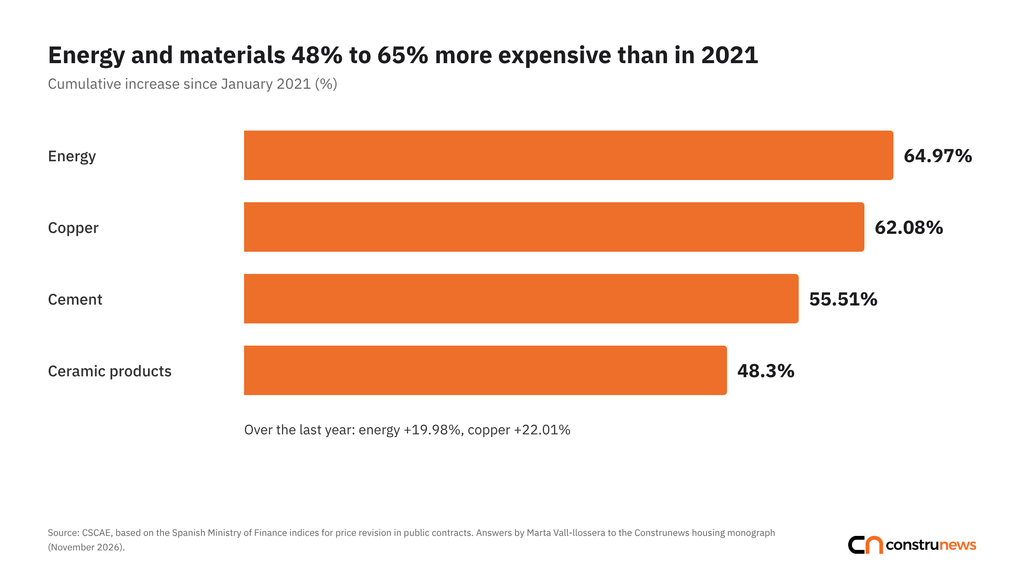
The cost problem today is, to a large extent, an energy and industrial one. According to the data we use, based on the Ministry of Finance indices for price revision in public contracts, energy has become 19.98% more expensive in one year and 64.97% more expensive since January 2021; copper, 22.01% year on year and 62.08% since 2021. The cost of cement has risen by 55.51% since 2021 and ceramic products by 48.3%. In any case, these increases do not affect all items equally. Electro-intensive chapters weigh more heavily in multi-family housing, which is where production is concentrated. In addition, private works rarely include revision clauses comparable to those in public works: the price risk is passed on to the builder and, through a risk premium, to the buyer, making access to housing more difficult.
Industrialisation can be part of the solution, and it is worth sizing the starting point: the sector estimates the penetration of advanced construction at between 1% and 3% of completed housing. It is a lever with potential, but it does not correct the shortfall in the short term and, although it could speed up on-site work, there are not sufficient or reliable data on time reductions and cost savings.
Existing stock
With Land Registry data on the number and floor area of homes and with permits for refurbishment and extension, what role should renovation, change of use and densification play?
Renovation is not a complement to housing policy. It is half of the solution to the problem and, probably, the one that can bear fruit in the shortest time, since it acts on buildings that already exist and that, according to the European Commission, 85-95% of which will still be standing in 2050.
Spain has one of the oldest building stocks on the continent: 49% was built before the first Spanish standard setting minimum energy efficiency requirements. On top of insulation problems, which translate into homes lacking adequate thermal comfort, damp problems that can affect health and high electricity and gas bills, if not increasingly widespread energy poverty, there are necessary improvements in conservation, accessibility and functionality, because, as we mentioned earlier, Spain has changed from a socio-demographic point of view.
That said, activity in the renovation sector has grown strongly in recent years thanks, above all, to the boost from the Next Generation EU funds. In 2025, the Architects’ Associations approved 55,558 homes for major renovation, compared with 25,554 in 2019. But it is not enough. The 55,558 approved homes fall far short of the 96,000 that the PNIEC (National Integrated Energy and Climate Plan) envisaged for that year to meet European targets. In addition, the Energy Performance of Buildings Directive (EPBD) requires average primary energy use in the residential stock to be reduced by at least 16% by 2030 and by between 20% and 22% by 2035, compared with 2020. At least 55% of that reduction must come from renovating the 43% of worst-performing buildings.
The European funds leave two lessons. One on transparency: there is no consolidated official account of homes actually renovated compared with the 510,000 committed. Another on quality: the European Court of Auditors concluded in its Special Report 20/2026 that mainly medium-depth renovations were financed and that progress is measured in homes or floor area, not in energy saved. That is why we insist so much on the importance of technical support. The Architects’ Associations’ Network of Renovation Support Offices, with 39 service points, reached 30,354 homes in 2025: 63% professional enquiries and 37% from private individuals.
Buildings do not renovate themselves. They need diagnosis, design, alignment with available grants and support in what is a collective decision. When the funding disappears but the office remains, activity continues. When both disappear, the structure is lost and has to be rebuilt in the next cycle. The Recovery Plan grants required work to be completed before 30 June 2026. In these five years we have made great progress, given the virtual absence of a renovation culture, and every effort must be made to maintain a momentum that benefits people’s well-being.
As for change of use and densification, they should add up, but always with planning criteria and not as a shortcut. Converting obsolete tertiary buildings is reasonable where habitability, sunlight, ventilation and accessibility equivalent to new build can be guaranteed. It is not if it requires lowering those standards. Densification makes sense where networks, facilities and public space can absorb it. And the problem should not be confused with empty housing. 14.4% of the stock is empty, but 33.3% of those homes are concentrated in municipalities with fewer than 1,000 inhabitants and only 7.5% in those with more than 250,000. Where housing is lacking, there are hardly any empty homes. That is why it is crucial to respond to the housing problem through territorial planning, and this is linked to a broader economic strategy.
Prices
Transactions and appraised values make it possible to compare new and second-hand housing. What explains the difference and how does it affect access, especially for young people?
The difference between new and second-hand housing exists, but it is stable and does not explain the access problem. According to statistics from the Ministry of Housing and Urban Agenda, in the second quarter of 2026 the average appraised value of open-market housing was 2,355 euros per square metre: 2,737 for homes up to five years old and 2,343 for those over five. The gap is 16.8% and has been between 16% and 17% for years. In the last quarter, second-hand housing even rose in price slightly faster than new housing.
What is decisive is something else: new build accounts for barely 9% of sales formalised before a notary, compared with 59.1% in 2008. With so little new supply, it is the second-hand market that sets the price.
The price record is nominal. The previous peak in appraised value was reached in 2007. Adjusted for inflation, the current level is still around 20% lower. The territorial gap, on the other hand, has widened: Madrid exceeds 4,089 euros per square metre and Extremadura does not reach 1,000.
The effect on access has been measured. According to the Bank of Spain, the theoretical effort to buy a home stood at 38% of the gross disposable income of the median household in the second quarter of 2026, above the 35% that the Bank of Spain itself uses as a benchmark for households’ financial capacity. The price-to-gross-disposable-income ratio stands at 8.4 years.
For young people, the effect is severe. The emancipation rate is 14.5%, the lowest percentage in the series that began in 2006. The average age of leaving the family home is 30.2, compared with a European average of 26.3. 67.1% of people aged 18 to 34 lived with at least one parent in 2025, and almost half of those aged 26 to 34 attribute this to not being able to afford to rent or buy.
The aggregate figure also hides what happens to those who do leave home. Renting a whole home costs on average 1,176 euros a month, 98.7% of the average salary of a young employee, so the only realistic option is to share: the median price of a room is 400 euros, around a third of that salary, and the supply of rooms has grown by 85.4% since 2022. Leaving home today means, for most, paying the price of a room. And buying offers no way out either: on an average price of 223,000 euros, the down payment and costs amount to 66,900 euros, the equivalent of 4.7 years of gross salary. Those who spend almost all their income on rent cannot save that amount, so access to housing now depends on family wealth and not on work. All this is deepening the social divide and the risk of housing exclusion in Spain, which, as various studies warn, could drag on for decades if no action is taken.
Leaving home today means, for most, paying the price of a room
One measure
If you could apply a single measure in 2027 to increase the supply of affordable housing, what would it be and why?
The housing problem is complex and, therefore, reducing the solution to a single measure to increase the supply of affordable housing would be to ignore the scale of the crisis. As we have been insisting, what is needed is a strategy that is stable over time, with short-, medium- and long-term measures, not applied successively, as a sequence of decisions, but activated in parallel. We cannot waste time. Among those measures, the one with the most immediate effect would be to clear the backlog of all licence applications for housing projects that have already received the visado. It would be the most effective because it does not require classifying land, planning or urbanisation. The project is drafted, endorsed and paid for, and all that is missing is an administrative decision. What is more, the cost of not issuing it has been quantified: according to Asprima, each year of delay increases the final cost of a home by around 13,000 euros. As I mentioned in a previous answer, this is where the Architects’ Associations offer our experience to help local Administrations with document verification, without undermining the supervisory tasks that are theirs to guarantee citizens’ rights.
At the same time, this measure can be combined with the mobilisation of already urbanised public land to build up a sufficient and permanent stock of affordable rental housing and, of course, not a minute can be lost in the transformation of the existing stock. Buildings urgently need to be renovated to meet the targets set by Europe and to restore their capacity to adequately meet the needs of their occupants.
Vall-llossera contrasts the 2.18 million households projected by the INE until 2041 with the 122,122 new-build homes approved last year, and places the first bottleneck in permits that take around twelve months against the legal three. Her immediate measure: resolve permits for projects already endorsed, since each year of delay adds about 13,000 euros to the cost of a home.

 analyses with data Spain's housing shortfall, permits, land, renovation and young people's access to housing)