

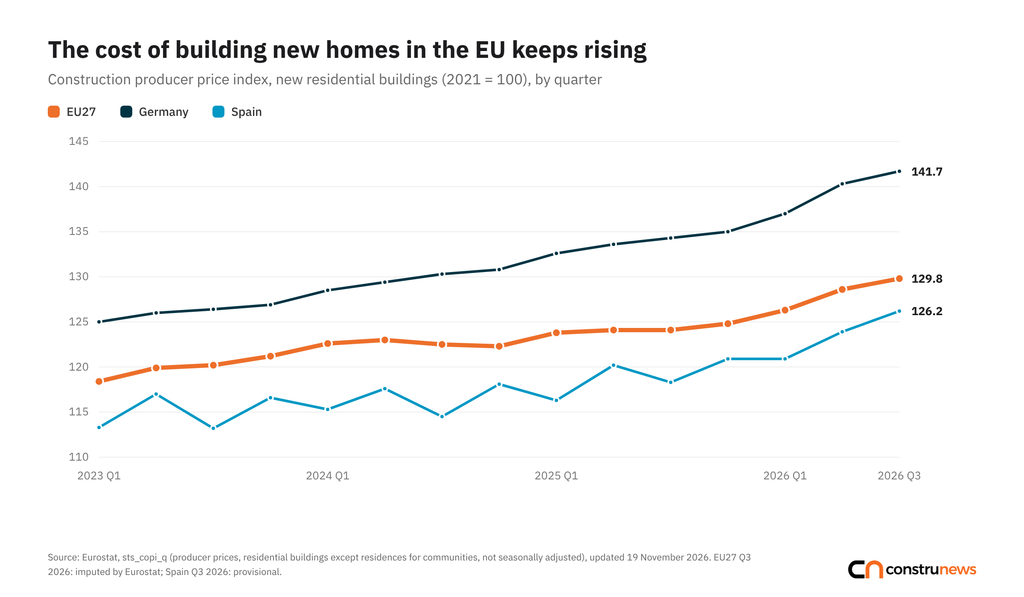
Building a new home in the European Union now costs almost 30% more than in 2021. The latest Eurostat data, updated on 19 November, show that quarterly growth eased over the summer, but the annual rate accelerated to 4.6%, the highest since at least 2024, in a year in which prices have come under renewed pressure.
The construction producer price index for new residential buildings compiled by Eurostat stood at 129.8 points in the third quarter of 2026 for the EU27 as a whole (2021 = 100). This is an increase of 0.9% on the second quarter, when the index stood at 128.6 points. The rise is half the one recorded between April and June, when the indicator grew by 1.8%, the largest quarterly increase in the period analysed since 2023.
The quarterly slowdown does not change the underlying trend. Compared with the third quarter of 2025 (124.1 points), the European index is up 4.6% year on year, against 1.3% a year earlier. Over the first three quarters of 2026 the indicator has risen by 4%, from 124.8 points at the end of 2025 to 129.8 now. Eurostat flags the EU figure for the third quarter as an imputed value, so it may be revised in future updates.
What the index measures
The indicator reflects the prices that clients pay to contractors for the construction of new residential buildings, excluding residences for communities. In other words, it tracks the price of the works from the builder’s point of view, not the final sale price of the home or the value of the land. This makes it a direct reference for developers, contractors, architecture practices and engineering firms when budgeting and reviewing contracts.
Building new homes in the EU costs 29.8% more than in 2021, according to Eurostat’s producer price index
Spain: +1.9% in the quarter and +6.7% in a year
Eurostat also publishes the series for Spain, which reached 126.2 points in the third quarter of 2026, a figure that is still provisional. Compared with the previous quarter (123.9 points), the increase is 1.9%, twice the European average. Year on year, the Spanish index is up 6.7% from 118.3 points in the third quarter of 2025, also above the EU27’s 4.6%.
The Spanish series does, however, show sharp swings from one quarter to the next: in 2023, 2024 and 2025 the index fell in every third quarter before recovering in the fourth, and many of the values between 2023 and early 2026 are flagged as imputed by Eurostat. This year, by contrast, the third quarter breaks that pattern with an increase. Since 2021, the cost of building new homes in Spain has risen by 26.2%, below the European average.
The Spanish residential construction price index is up 6.7% year on year, above the EU27 average of 4.6%
Germany, well above the average
Germany, the EU’s largest economy, sits well above the average: its index reaches 141.7 points, up 1% on the quarter and 5.5% year on year. The country has recorded increases in every quarter since 2023 and is 41.7% above its 2021 level.
A decade of rising costs
The quarterly data confirm a long-term trend. According to Eurostat’s news item of 25 June 2026, construction prices for new residential buildings rose by 48.2% in the EU between 2015 and 2025. Increases were particularly steep in 2021 (+5.8%), 2022 (+12.2%) and 2023 (+6.9%), amid soaring energy and materials costs, before easing in 2024 (+2.3%) and 2025 (+1.3%).
By country, the largest increases over the past decade were recorded in Bulgaria (+166.1%), Hungary (+155.4%) and Romania (+130.7%), and the smallest in Italy (+17%), Greece (+17.3%) and Finland (+22.1%).
Between 2015 and 2025, the price of building new homes rose 48.2% in the EU, led by Bulgaria (+166.1%)
A rebound that weighs on supply
The 2026 figures suggest that the moderation of 2024 and 2025 is over: the annual rate of the European index has climbed from 1.3% in the third quarter of 2025 to 4.6% now. For the AECO sector, the data come at a time when the shortage of affordable housing is at the top of the European and Spanish political agenda, and when construction costs are one of the variables that determine whether new developments are viable. Fourth-quarter figures, which Eurostat will publish in 2027, will show whether the summer slowdown holds or whether prices return to the pace of the first half of the year.

