
Spain now builds a fraction of what it did before the 2008 crisis, and at a pace that falls short of keeping up with population growth. The Spanish Statistical Office (INE) projects around 146,000 more households each year until 2041, but only around 94,000 homes were completed in 2025, counting both open-market and subsidised housing. Building approvals remain 77% below their 2005 peak, the country has slipped towards the bottom of the European table and the housing stock is growing slowly, while one- and two-person households multiply. It is not for lack of land: urban plans still have 7.1 million homes pending, more than three times the number needed, although they are scarce in some of the areas where demand is tightest, such as Madrid, the Balearic Islands and Catalonia.
Meanwhile, the market has picked up mainly through second-hand homes, which account for more than 90% of sales, and appraised values already exceed 2008 levels in current euros. Building, on the other hand, is 57% more expensive than in 2005, above inflation and driven mainly by materials, which squeezes the sector’s margins. The public response has come through European funds, but subsidised housing, which exceeded 85,000 completed homes in 1997, has stalled at around 9,500 a year over the last decade. As these figures show, the challenges facing the sector are enormous, and this special report sets out to break down all the data to better understand its current situation and outlook.
77% fewer building approvals, especially for new builds
Construction work collapsed after the property and financial bubble burst in 2007-08. Strikingly, in 2025 works were approved on 59,301 residential buildings, 77% fewer than at the 2005 peak. That is more than the low of 36,866 recorded in 2013, but a long way from the 261,994 of 2005.
Most clearly, it is new construction that has plummeted, from 209,752 buildings in 2006 to just 32,137 in 2025. Renovations, by contrast, have remained fairly stable throughout this century, usually at around 25,000 a year, so their relative weight has risen and they now account for 41% of works, almost four times more than two decades ago. This also explains the sharp fall in the budget of approved projects. The drop has been steep, 65% (in current euros), from €51,673 million in 2006 to €18,310 million in 2025.
Even so, the trend is not uniform across Spain. Madrid is the region furthest from its peak, and the Balearic Islands the one that has held up best. In four regions (Asturias, the Basque Country, Cantabria and Aragon), renovations already account for more than 60% of approved buildings.
Some upturn in new open-market housing, though far from peak levels
Logically, the trend in completed homes closely mirrors that of building approvals. In 2025, 80,792 open-market homes were completed, the equivalent of 13.5% of the figure for 2006, the record year. Even so, there is a slight recovery: last year 121,827 were started, some 41,000 more than were completed, the highest figure since 2008.
To put the scale of the change in trend since the crisis into perspective, beyond the annual figures, it is very telling that one million open-market homes were started over the last twelve years (2014-2025). In just the five years between 2003 and 2007, three times as many were started: three million.
Once again, regional differences are marked, and the regions that have recovered most (though still far from the boom years) are the Balearic Islands (31% of their record) and Madrid (29%), well above Murcia (10%) or Castile-La Mancha (12%). Madrid’s figure may come as a surprise given the gap between current approvals and those before the crisis, but approvals cover whole buildings and Madrid builds large blocks (a single approval allows a building with many homes to be built).
Near the bottom of the table for housebuilding in Europe
The crisis also hit the construction sector across the European Union as a whole, but much less than in Spain. In 2006, Spain was a powerhouse of housebuilding, granting permits for 2,660 square metres of residential building work per 1,000 inhabitants. That was three times the European average, and behind only Cyprus and Malta.
The situation has since changed considerably: since 2010, Spain has been below the European average in building permits and now ranks 22nd out of 27. Malta and Cyprus remain at the top, while Germany and Italy bring up the rear. After the property boom, housebuilding fell by 61% in the European Union, but far more in Spain, by 95% (measured in square metres per inhabitant).
Almost 25 million homes, and ever larger
Spain’s housing stock has kept growing, though at a moderate pace. According to Cadastre data, there are currently 24.2 million homes (excluding the Basque Country and Navarre, which have their own cadastres), 1.7 million more than in 2013. This increase has not been linear: a third of the new homes are concentrated in 2013-2014, reflecting the last throes of the previous boom and also register regularisations that brought large numbers of properties to light in some areas.
In terms of size, homes are now larger than in 2013. The average floor area has risen from 140 to 147 square metres, mainly thanks to the increase in single-family homes (houses), which have grown from 214 to 230 square metres, although multi-family homes have also gained a little space (from 106 to 109 square metres).
By type, more than two-thirds are multi-family homes, although with large differences. This share rises to 87% in Madrid and 82.7% in the province of Barcelona, but stands at 43% in Castile-La Mancha and Extremadura, where houses are more common. Nor has the growth in properties been uniform: while the city of Madrid has added 94,397 homes since 2013, 856 municipalities now have fewer than they did then. You can look up all the municipal data in the following chart.
Time to speed up: 11% more households will be needed in 15 years
This overall increase in housing will have to continue over the coming years. The Spanish Statistical Office (INE) projects 2.2 million more households than the current 19.8 million (the statistics refer to main residences, which is why the figure is lower than in the previous chart, which also includes second homes, for example). 94% of this increase is concentrated in one- and two-person households. In fact, single-person households will grow by 20% and by 2041 will be the most common type (30.6%), while households of four or more people will decline.
The INE projection implies that 146,000 homes should be completed every year, but in 2025 the keys to only 94,000 new homes were handed over (open-market and subsidised combined). Construction needs to speed up to keep pace. And needs are expected to grow in every region, especially Murcia (+21%), the Valencian Community (+16%), the Balearic Islands (+15%) and Madrid (+14%). Demand will be lowest in Asturias and Extremadura (+3%).
Plenty of land still available for building, but not always where demand is highest
On paper, current urban plans allow for those 2.2 million homes and many more. Specifically, they provide for 9.6 million on non-consolidated urban land and delimited developable land (that is, in new growth areas, beyond the vacant plots available within municipalities). Of these, according to a Ministry of Housing study based on aerial photographs, 7.1 million are still pending. That is more than three times the number needed until 2041.
Even so, land is not always most available where household demand is highest. In Murcia and Castile-La Mancha, urban plans provide for more than 400 homes still pending per 1,000 inhabitants, but this ratio falls sharply in the Basque Country (47), Madrid (62), the Balearic Islands (64) and Catalonia (65). Moreover, two out of three plans were approved before 2008, and 29% even date from before 2000, so the land available and the needs they were based on may not reflect today’s reality.
Home values recover, and accelerate in recent years
The bursting of the property bubble affected not only the pace of construction but also home values. The appraised value fell from €2,071 per square metre in 2008 to €1,459 in 2014. It has slowly recovered to €2,335 in 2025, now above the pre-crisis level, although only in current euros, without taking inflation into account. In real terms, it is still 18% below 2008.
The rise in appraised values has been slow, but has accelerated in recent years, with an increase of 11.2% in 2025 and 9.8% in the first half of 2026 alone. Values are highest in Madrid (€4,069/m²) and the Balearic Islands (€3,933/m²), well above regions such as Extremadura (€984/m²). These are also the two areas where values have risen most, +63% in the Balearic Islands and +36% in Madrid, while in six regions homes are still valued below 2008 levels, especially in Castile-La Mancha and Murcia (−16%).
Home buying returns, but new builds account for only 9% of the total
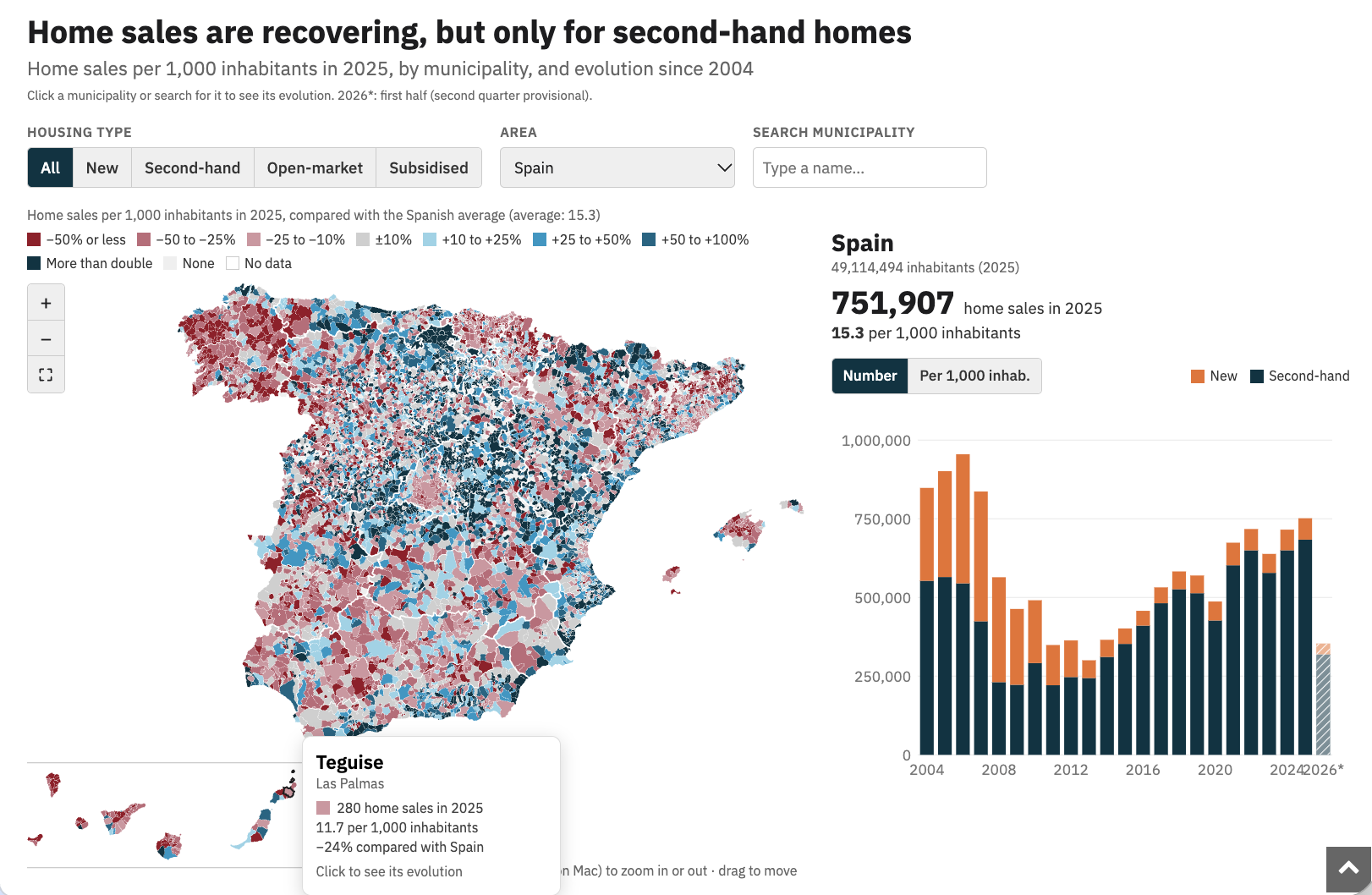
The sector’s renewed momentum can also be seen in the rise in home sales. There were 751,907 such transactions in 2025, a figure still 21% lower than in 2006, but double that of 2013.
The vast majority are sales of second-hand properties, in line with the small number of homes being completed. New builds now account for just 9% of transactions, compared with close to 50% in 2006-2007. In fact, more second-hand homes were bought in 2025 than ever before, even more than before the crisis.
By region, the Valencian Community is the most active, with 21.2 sales per 1,000 inhabitants. At the bottom are Galicia (11.3), the Canary Islands and Madrid (11.8). The following map lets you explore all the data in full detail, including by province and municipality.
Materials have driven up construction costs since 2020
The sector’s margins are narrowing, especially in recent years. As seen above, home values remain below pre-crisis levels in real terms, but the cost of building these properties has risen faster than inflation. Building is now 57% more expensive than in 2005, while cumulative inflation over this period is 52%. And this gap is not due to labour costs (+50%), but above all to the rise in the price of building materials (+66%).
General prices and construction prices moved fairly closely until 2020, but the latter broke away from that year onwards. Specifically, the cost of cement and concrete has risen by 46% since 2021. And overall since 2005, the cost of copper pipes (+205%) and electric cables (+154%) has soared, while only electronics (−8.8%) and door entry systems, aerials and PA systems (−18%) have become cheaper.
Public investment recovers with European funds
The financial crisis brought a period of budget cuts across public administrations that, among other areas, shrank investment in housing, deepening the sector’s crisis. Only with the arrival of European funds during the Covid pandemic did spending in this area soar, with central government spending up to twice the amount it had allocated in 2009, its previous record, to encourage the construction and renovation of properties.
This investment fell again once the aid came to an end, and by 2024 it was back on a par with pre-crisis spending. In real terms it is clearly a lower amount, but it represents a clear upturn from 2019, when it had bottomed out.
Regional investment in housing has followed a similar path to central government spending in many regions, although some have followed their own course. Madrid, for example, reached its peak spending in 2015, and the Balearic Islands in 2018. Moreover, the resources devoted to this area vary widely, from a high of €171 per inhabitant in Navarre in 2025 to €24 in Murcia.
Nine times less subsidised housing than in the record year
The fall in public investment in housing also took a heavy toll on subsidised housing. The series of completed subsidised homes peaked in 1997, with 85,028, and a good pace was also maintained between 2005 and 2011, with close to 60,000 homes a year. The subsequent collapse was very steep and, since 2015, more than 10,000 subsidised homes have been completed in hardly any year. The exception was 2024, when the figure reached 14,371, slightly more than the 12,858 of 2025.
These latest figures represent an increase and, in fact, 14% of all homes completed in 2025 were subsidised. But they are still a long way from pre-crisis levels. Between 2014 and 2025, around 9,500 subsidised homes were built each year, nine times fewer than in the record year of 1997.
Once again, regional differences are marked. Between 2023 and 2025, the Madrid region accounted for 12,782 subsidised homes, 35% of the Spanish total, followed by Catalonia (7,653) and Andalusia (4,512). In terms of homes per inhabitant, the provinces of Álava, with 11.6 subsidised homes a year per 10,000 inhabitants, and Guadalajara, with 8.7, stand out in these years, well above the national average of 2.5.
The profile of subsidised housing is changing
The slight recovery in subsidised housing has also come with a change in its characteristics. Between the homes completed in 2014-2016 and those of 2023-2025, the share of rental homes without a purchase option rose from 11% to 29%, while rental homes with a purchase option almost disappeared and owner-occupied homes fell (from 79% to 44%). Likewise, other tenure types have gained ground and now account for 27%.
Subsidised housing is not synonymous with the public sector. Public administrations build part of it and encourage its growth with grants and incentives, but most developments come from private developers. Less and less so, though: their share has fallen from 78% of all subsidised homes ten years ago to 72% in the latest period.
The following chart lets you analyse all the details of subsidised homes completed since 2014, by tenure type and type of developer, across Spain and in each region and province. It shows, for example, that private development carries much more weight in Madrid, while in Barcelona public and private initiatives are more evenly matched.

