
Brussels faces a decisive week for construction. The European Construction Industry Federation (FIEC) and Build Europe have sent an open letter to MEPs ahead of the plenary vote on the Regulation on speeding up environmental assessments, while the Council of the EU and the European Parliament have reached agreement on the 2027 annual budget, the last under the current multiannual financial framework.
Both items, featured in FIEC’s newsletter of 17 November, point to the same goal: that the Union should have both predictable rules for processing projects and sufficient resources to fund them. For the European federation, without both it will be hard to turn plans for affordable housing, water and energy renovation into actual construction work.
An open letter to MEPs on environmental assessments
FIEC and Build Europe, the European federation of housing developers and builders, have sent an open letter, dated 12 November, to Members of the European Parliament ahead of the plenary vote on the Regulation on speeding up environmental assessments. Their core argument is that predictable environmental assessments are central to tackling the housing crisis: when their outcome and timing are uncertain, projects stall and costs rise.
When the outcome and timing of environmental assessments are uncertain, projects stall and costs rise
The two organisations call on MEPs to reinstate the substantial preclusion rule (Article 6) in Parliament’s position before entering inter-institutional negotiations with Member States in the Council. As they point out, the Council’s general approach keeps the provisions proposed by the European Commission, with important safeguards for effective public participation and judicial protection.
The letter also urges MEPs to include new and renovated residential dwellings and their infrastructure among the strategic sectors in Article 14 of the Regulation. That article provides a specific regime for strategic projects which the rapporteur in Parliament’s Environment Committee, Emma Wiesner (Renew Europe), proposed deleting in June, while the Commission argued for keeping it.
The request is in line with the position FIEC has already set out on the European affordable housing plan, in which it called on Brussels for urgent regulatory simplification to unlock housing construction.
The last annual budget of the 2021-2027 framework
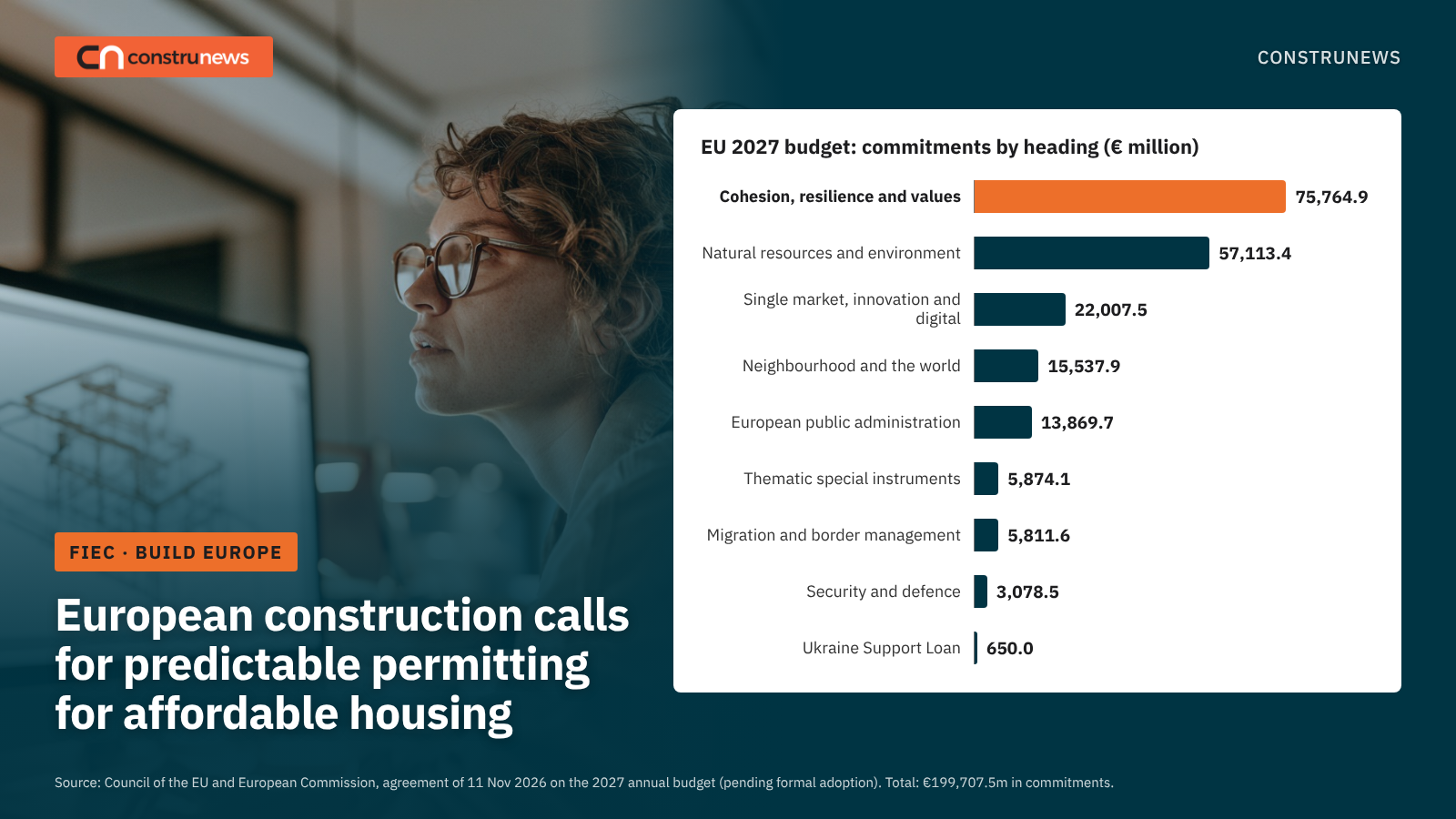
On 11 November, the Council of the EU and the European Parliament reached an agreement on the 2027 annual budget, with €199.7 billion in commitments and €211.5 billion in payments. It is the seventh and final annual budget of the current 2021-2027 Multiannual Financial Framework (MFF) and is pending formal adoption: the Council is expected to endorse it on 23 November and Parliament’s plenary vote is scheduled for 24 November.
Commitments amount to 0.99% of EU gross national income and payments to 1.05%. The agreement leaves €710.1 million unallocated under the expenditure ceilings for unforeseen needs and is slightly below the Commission’s draft, which proposed €199.9 billion in commitments and €212 billion in payments. On the Council side, negotiations were led by Simon Harris, Tánaiste and Minister for Finance of Ireland, which holds the rotating presidency.
The 2027 budget totals €199.7 billion in commitments and €211.5 billion in payments, almost 5% more in payments than in 2026
The European Commission highlights that the budget includes targeted funding for affordable housing, water resilience and the energy transition, as well as competitiveness and defence, although it does not give specific amounts for those three priorities. “The timely agreement reached between the European Parliament and the Council allows us to maintain continuity,” said Piotr Serafin, Commissioner for Budget, Anti-Fraud and Public Administration.
Cohesion, infrastructure and innovation: where the money goes
The largest heading is Cohesion, resilience and values, with €75,764.9 million in commitments, followed by Natural resources and environment, with €57,113.4 million. According to the questions and answers published by the Commission, cohesion policy totals around €58 billion: €44 billion for regional development and cohesion and €14.5 billion for ESF+. Total payments are almost 5% higher than in 2026, as cohesion programmes are running at full speed.
Also relevant for construction are the €3.1 billion for the Connecting Europe Facility (CEF), €12.8 billion for Horizon Europe, €855 million for the LIFE programme and €1.3 billion for the Just Transition Fund. The Ukraine Facility receives €4 billion in non-repayable support and €2.2 billion in loans.
FIEC calls for sufficient and predictable resources for cohesion, affordable housing, energy-efficient building renovation and water infrastructure
FIEC already looks ahead to the 2028-2034 framework
For FIEC, the 2027 budget is particularly relevant to the sector given the reinforced focus on affordable housing, water resilience and the energy transition, priorities closely linked to its role in delivering sustainable buildings, modern infrastructure and more resilient communities. The federation stresses the importance of maintaining strong EU support for cohesion investment, affordable housing, energy-efficient building renovation and water infrastructure, an area on which it has already set out its position on water resilience in Europe (in Spanish).
The debate now moves to the 2028-2034 Multiannual Financial Framework, which EU leaders will discuss at a special European Council on 26 and 27 November. FIEC wants the new framework to safeguard cohesion investment, ring-fence funding for affordable housing and ensure predictable support for energy renovation and water. “An ambitious and well-structured EU budget is essential to mobilise investment, strengthen Europe’s competitiveness and resilience, and deliver the infrastructure and buildings needed for Europe’s future,” said Domenico Campogrande, Director General of FIEC.

