
Germany wants a federal affordable housing company up and running in 2027, according to the business daily Handelsblatt on 13 November, citing a document from the Construction and Finance ministries. The move comes as much of Europe looks for public tools to curb soaring prices. Data from Housing Europe and the OECD help answer the underlying question: who is best equipped to manage the housing problem?
The German government has decided to move from funding housing to commissioning it directly. The Bundesministerium für Wohnen, Stadtentwicklung und Bauwesen (BMWSB) confirmed on 13 November that the new federal construction company will be founded in 2027 and that next year’s budget allocates it €920 million in multi-year funds. According to the ministry, its role will be to bundle construction orders and order housing in large numbers, so that the state acts as a major client to cut costs and speed up delivery.
What the German federal company will look like
Handelsblatt, citing sources at the Federal Ministry of Finance, reports that the company will initially be set up as a limited company (GmbH) with around 30 employees and that it will not build itself, but award construction contracts. The total financing plan amounts to €18 billion: €1.8 billion in equity and €16.2 billion in loans that the federal government intends to guarantee in full. In the long term, the company should finance itself from rents and its holdings.
Of the €920 million earmarked, €320 million is for 2027 and €600 million are commitment appropriations for the following two years. The money, however, is blocked: the Bundestag’s budget committee will only release the first €20 million once the government submits a structured, detailed concept for the project. The initiative is driven by Verena Hubertz, Bundesministerin für Wohnen, Stadtentwicklung und Bauwesen, and Lars Klingbeil, Bundesminister der Finanzen.
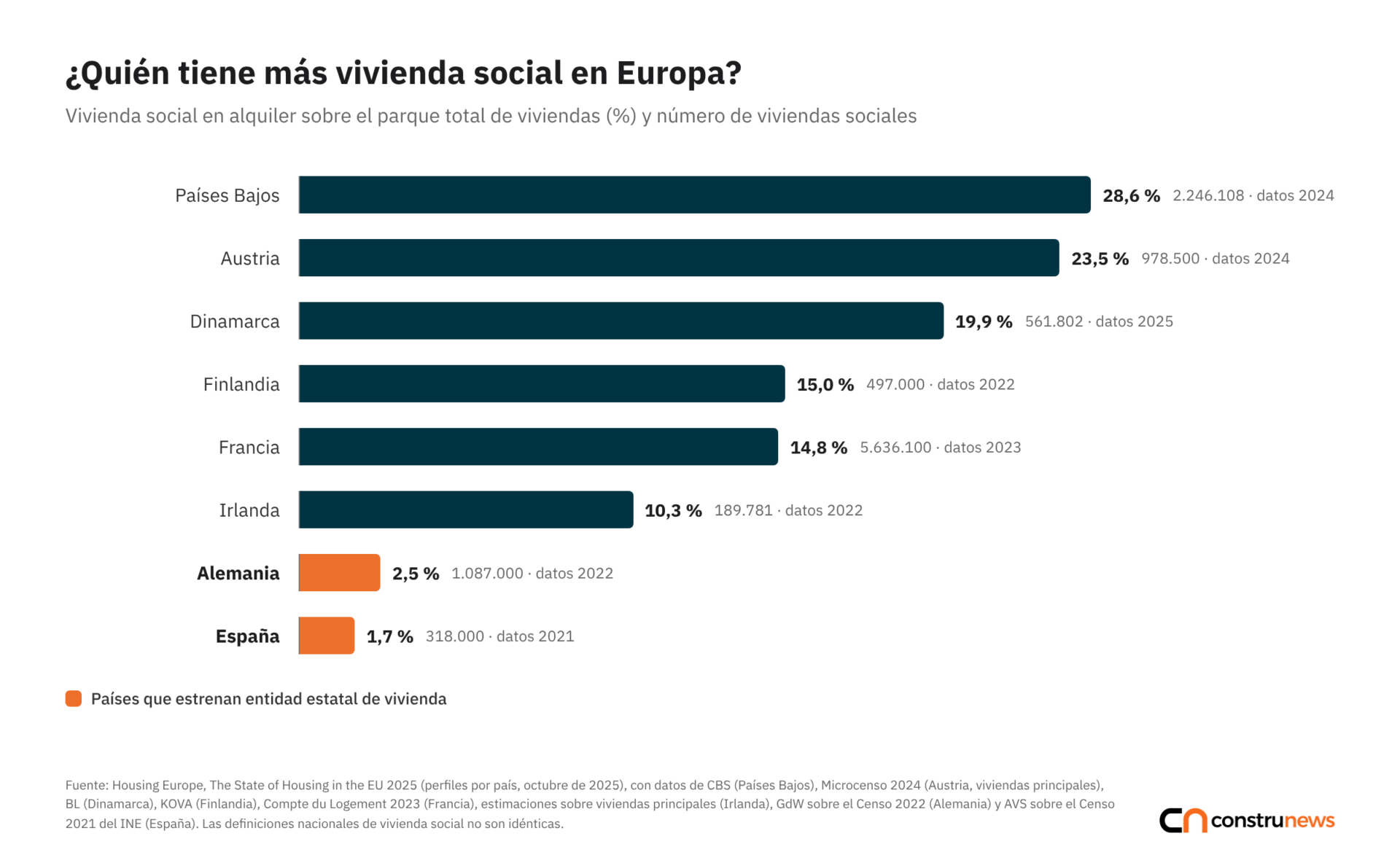
Germany has 1,087,000 social homes, only 2.5% of a stock of 43 million dwellings
The company is part of a wider budget effort. According to the BMWSB, the 2027 budget allocates €5 billion to social housing (up from €4 billion in 2026), of which €1 billion goes to the Junges Wohnen programme for students and trainees, and €1.2 billion to Städtebauförderung, Germany’s urban regeneration funding. The ministry’s direct investment in construction comes to around €8.5 billion.
The data explain the urgency. According to the Germany profile in Housing Europe‘s The State of Housing in the EU 2025 report (Housing Europe is the European federation of public, cooperative and social housing), the country has 1,087,000 social homes, 2.5% of a stock of 43.1 million, based on estimates by the GdW housing association on the 2022 Census. German social housing is subject to a limited lock-in period: when it expires, the homes move to the open market. New social homes completed fell from 32,128 in 2022 to an estimated 22,900 in 2024.
The best prepared: the Netherlands, Austria and Denmark
The OECD Affordable Housing Database places only three countries with more than 20% of their stock in social rental housing: the Netherlands, Austria and Denmark. The OECD average is 7% and the EU average 8%. All three share one feature: they do not rely on an agency created for the emergency, but on non-profit bodies built up over decades, with revolving finance and cost-based rents.
In the Netherlands, the woningcorporaties (housing associations) manage 2.4 million rental homes housing 4 million people, around one third of the stock. Housing Europe puts social housing at 2,246,108 homes, 28.6% of the total (2024 data). The associations have agreed to build more than 270,000 social homes between 2025 and 2034, a target the report itself describes as uncertain after the elections.
In Austria, social housing amounts to 978,500 homes, 23.5% of main residences (2024 Microcensus), split between limited-profit housing associations (16.7%) and municipal housing (6.8%). Vienna is the benchmark: according to the City of Vienna, the city owns 220,000 municipal flats and has 200,000 subsidised flats, so around 50% of Viennese live in subsidised housing. The city has never sold off its municipal stock.
Only the Netherlands, Austria and Denmark exceed 20% social housing; the EU average is 8%
In Denmark, almen housing is home to 967,500 people. It is run on a non-profit basis with cost-based rents, and municipalities allocate one in every four homes that become vacant. Housing Europe puts it at 561,802 homes, 19.9% of the stock as of 1 January 2025, plus 197,750 cooperative homes (7%). The system has a national fund, Landsbyggefonden, a self-governing institution set up by the housing organisations themselves.
France and Finland: volume and a change of model
France has the largest social stock in absolute terms: 5,636,100 homes, 14.8% of the total (18% of main residences), with an HLM sector adding between 70,000 and 75,000 homes a year and investing €11.9 billion in new-build in 2023. But demand outstrips supply: 2.77 million households were on waiting lists in 2024, against only 385,000 allocations.
Finland has 497,000 state-supported affordable rental homes, 15% of the stock, 75-80% of them managed by municipal companies. The country has just reorganised its model: the ARA agency was dissolved in March 2025 and replaced by Varke, the Centre for State-Subsidised Housing Construction, within the Ministry of the Environment. Interest-subsidy loan authorisations fell from €2.25 billion in 2024 to €1.75 billion in 2025.
In the United Kingdom, the English Housing Survey 2024-25 puts the share of households in England living in social rented housing at 16%. The public agency Homes England runs the new Social and Affordable Homes Programme, worth £39 billion.
Spain and Germany at the bottom, with newly created bodies
Spain shares the bottom of the table with Germany. According to Housing Europe, the public social rental stock stands at 318,000 homes, 1.7% of the total (estimate by AVS, the association of public housing managers, on the 2021 Census), although the government puts protected housing as a whole at 3.4%. Public spending on housing is below 0.4% of GDP and between 180,000 and 250,000 households are on social housing waiting lists.
Spain’s response has been CASA 47, the state housing entity created by the Council of Ministers on 9 December 2025 by transforming the former SEPES. Its goal is a public stock of at least 8% of the total, with planned investment of €13 billion over ten years, leases of up to 75 years and rents that do not exceed 30% of income. Its portfolio starts from Sareb assets (more than 40,000 properties and 2,400 plots with capacity for another 55,000 homes) and land from the Defence and Interior ministries, such as Madrid’s Operación Campamento, with 10,700 homes. Construnews has already analysed this new entity (in Spanish).
The difference in approach matters: CASA 47 will operate across the whole cycle, from land to rental management, whereas the German company is conceived as a large buyer of industrialised construction in series.
Not even the best prepared are safe
A large social stock is no immunity against the crisis. According to data.europa.eu, using 2024 Eurostat data, 14.6% of Denmark’s population spends more than 40% of disposable income on housing, almost double the EU average (8%). In Austria, limited-profit associations completed 14,000 homes in 2024, against the usual 15,000-16,000, and leading indicators point to 11,000-12,000, a multi-decade low.
The European context is also adding pressure. The European Commission estimates that the EU needs more than 7 million additional homes by 2035 and extra investment of €150 billion a year, as Construnews reported when analysing the European Affordable Housing Plan (in Spanish).
The data point to a clear conclusion: the best-prepared countries are those that built up their public stock decades ago and never sold it. Germany and Spain are now trying to catch up with new state entities, but they start from less than 3% social housing, and their success will depend on sustaining funding beyond a single budget cycle.

