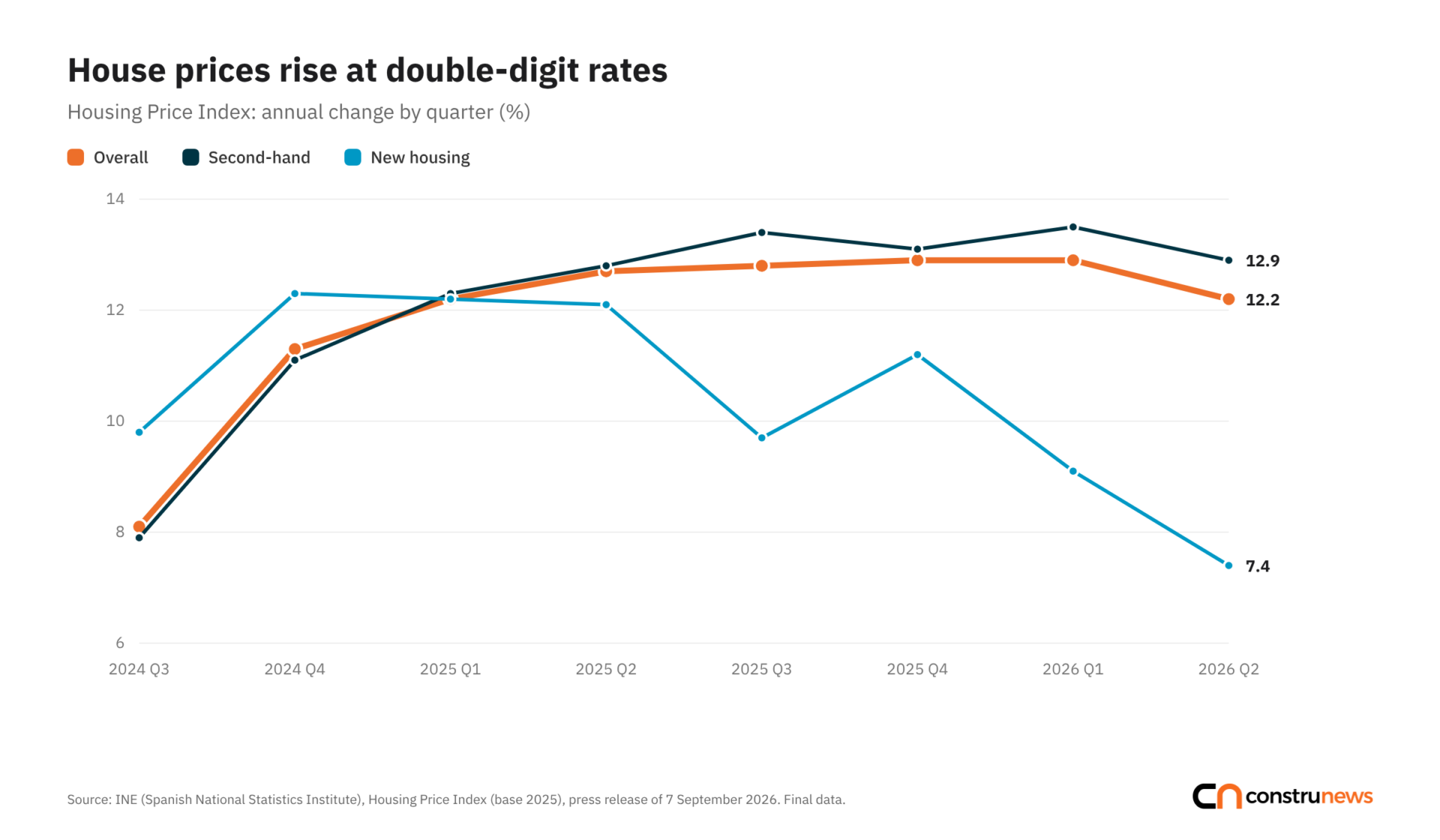

The European Commission’s Autumn 2026 Economic Forecast, published on 17 November, improves the growth outlook for Spain but singles out bottlenecks in the housing market as the main risk to the scenario. Data from INE and the Banco de España back up the diagnosis: prices are rising at double-digit rates, and a shortfall of 750,000 homes has built up since 2021.
The European Commission’s forecast for Spain describes an economy that keeps outgrowing its partners: GDP will grow by 2.6% in 2026, 2.1% in 2027 and 1.9% in 2028, compared with 1.4% forecast for the EU as a whole. Employment will rise by 2.3% in 2026 and 1.8% in 2027, and the unemployment rate will fall from 9.9% this year to 9.4% in 2028.
Brussels’ text, however, puts housing at the centre of the risks. According to the Commission, the main risks to the scenario relate to persistent bottlenecks in the housing market: supply that continues to lag behind household formation would keep price pressures elevated and could increasingly constrain labour mobility and the inflow of workers. That inflow of labour, driven by migration and by the recent extraordinary regularisation of migrants, is precisely one of the engines of job creation the Commission expects in 2026.
Construction costs, another brake on residential investment
For the AECO sector, the most direct warning concerns building work. The Commission notes that rising construction costs could further weigh on residential investment. At the same time, it expects total investment to hold up in 2026 thanks to healthy corporate balance sheets and the implementation of the Recovery Plan, “particularly in construction and intangible assets”, before losing steam in 2027 and 2028 as EU funds run out.
The Commission warns that rising construction costs could further weigh on residential investment in Spain
Cost pressure is already visible in the statistics. Brussels raises Spanish inflation to 3.9% in 2026 because of energy, and the pass-through of those costs to industrial goods is already showing in materials: according to the October economic report of the Spanish Confederation of Construction Product Manufacturers (CEPCO), based on INE data, the Industrial Price Index rose 18.3% year on year in September, its highest level since November 2022, with energy accounting for more than 80% of the increase.
Europe: residential construction stalls in 2026
The problem is not only Spanish. The general report of the Autumn Forecast states that the high-rate environment will weigh on residential construction in the EU, which is expected to broadly stagnate this year and recover only modestly over the next two. The Commission adds that banks have tightened their lending standards and that, amid continued excess demand, pressure on housing prices has kept building up, bringing social cohesion issues to greater prominence in some urban regions.
By contrast, non-residential construction, including public investment, will keep expanding in 2026 with the support of the Recovery and Resilience Facility, before weakening. For the EU as a whole, Brussels forecasts growth of 1.4% in 2026 and 2027 and 1.5% in 2028, with inflation at 3.3% this year.
Double-digit price growth
Official data confirm the strain. According to INE’s Housing Price Index, prices rose by 12.2% year on year in the second quarter of 2026, with 12.9% for second-hand homes and 7.4% for new homes. The overall rate has now been above 11% for seven consecutive quarters, and the quarterly increase was 3.4%. All autonomous communities posted positive rates.

House prices rise 12.2% year on year and have stayed above 11% for seven consecutive quarters
A shortfall of 750,000 homes since 2021
The root of the problem is output. In its Informe Anual 2025 (Annual Report 2025), the Banco de España measured the gap between completed homes and net household formation, and its Gobernador, José Luis Escrivá, summed it up in his presentation on productivity and housing: the accumulated shortfall since 2021 amounts to 750,000 homes, because household formation is outpacing new supply.
The central bank attributes the fall in output to declining productivity, insufficient firm size and labour, and contained profitability in construction and residential development, as well as the scarcity of buildable land and slow urban planning procedures. The figures in the Gobernador’s presentation make the diagnosis concrete: gross value added per employee in construction is 25% lower than the economy-wide average, productivity has fallen structurally by more than 20% since 1995, take-up of technology and industrialised construction is low, and 63% of firms in the sector cited labour shortages as a constraint on their activity in the fourth quarter of 2025.
63% of construction firms cite labour shortages as a brake on their activity, according to the Banco de España
More housing starts, but with a delayed effect
There are signs of a response. According to data compiled by CEPCO, 64,152 homes were started between January and May 2026, 13% more than a year earlier and the highest figure for that period since 2008. But the pace remains far from estimated needs: Spain would have to build around 220,000 homes a year (in Spanish) to avoid a larger deficit, as Construnews has already reported.
Brussels’ warning also comes in the middle of the campaign for the 29 November general election. The Commission notes that the Government has not presented the draft 2027 budget because of the snap election, so its scenario assumes unchanged policies. Housing, which Europe is already tackling with the European Affordable Housing Plan (in Spanish), thus becomes a first-order macroeconomic variable, and solving it requires raising the productive capacity of a sector that, according to the Banco de España, has lost productivity, scale and workers.

