
The General Council of Technical Architecture of Spain (CGATE) has started the operational phase of “Respira Tranquilo” (“Breathe Easy”), a project to measure radon and other indoor air quality indicators in homes across Spain. The first phase is being coordinated with the professional associations of Madrid, Barcelona, Toledo, Cáceres, A Coruña and Ourense. It comes at a time when the gas, which the WHO ranks as the second cause of lung cancer, already has a legal reference level, requirements in the Building Code and a dedicated national plan, alongside the plans that European law requires of every Member State.
What “Respira Tranquilo” will measure
Presented by CGATE on 5 November, the project aims to gather real data on indoor air quality in homes in different parts of Spain and to improve knowledge of one of the indoor pollutants with the greatest impact on health. It builds on CGATE’s long-standing work on the relationship between buildings, comfort and health, which has already produced publications, studies and monitoring campaigns in homes and other spaces.
The novelty is that radon becomes the main pollutant to be monitored. The study will also measure CO₂, to analyse ventilation rates in homes, together with temperature, relative humidity, formaldehyde, volatile organic compounds and particulate matter.
“Indoor air quality is an essential factor for people’s health and well-being, and yet it remains one of the least visible aspects of our buildings. Knowing what really happens inside homes is the first step towards preventing risks and proposing effective improvements,” says Alfredo Sanz, presidente del CGATE. “In the case of radon, we are also talking about a pollutant that the World Health Organization ranks as the second cause of lung cancer after tobacco. That is why it is so important to have real data, obtained in homes and in different territories, to help us better understand its presence and act when necessary.”
Six associations and three levels of monitoring
The campaign will be national in scope, with the participation of the Technical Architecture professional associations. The six first-phase territories were chosen to obtain data from homes in areas with different characteristics and radon exposure potential. Measurements will focus mainly on private residential dwellings, with particular attention to ground and first floors, and will combine different measuring systems and periods to reach as many homes as possible.
The project is organised into three complementary programmes:
- Respira Tranquilo Plus: continuous, long-term monitoring of radon concentration and ventilation conditions.
- Respira Tranquilo: extends long-term measurements to a larger number of homes.
- Respira Tranquilo Express: shorter campaigns to detect possible high values and select the cases where longer monitoring is advisable.
All data will be processed in aggregated and anonymised form and used to produce studies and technical documentation for professionals, public authorities and citizens. Results presentations and a final report are planned.
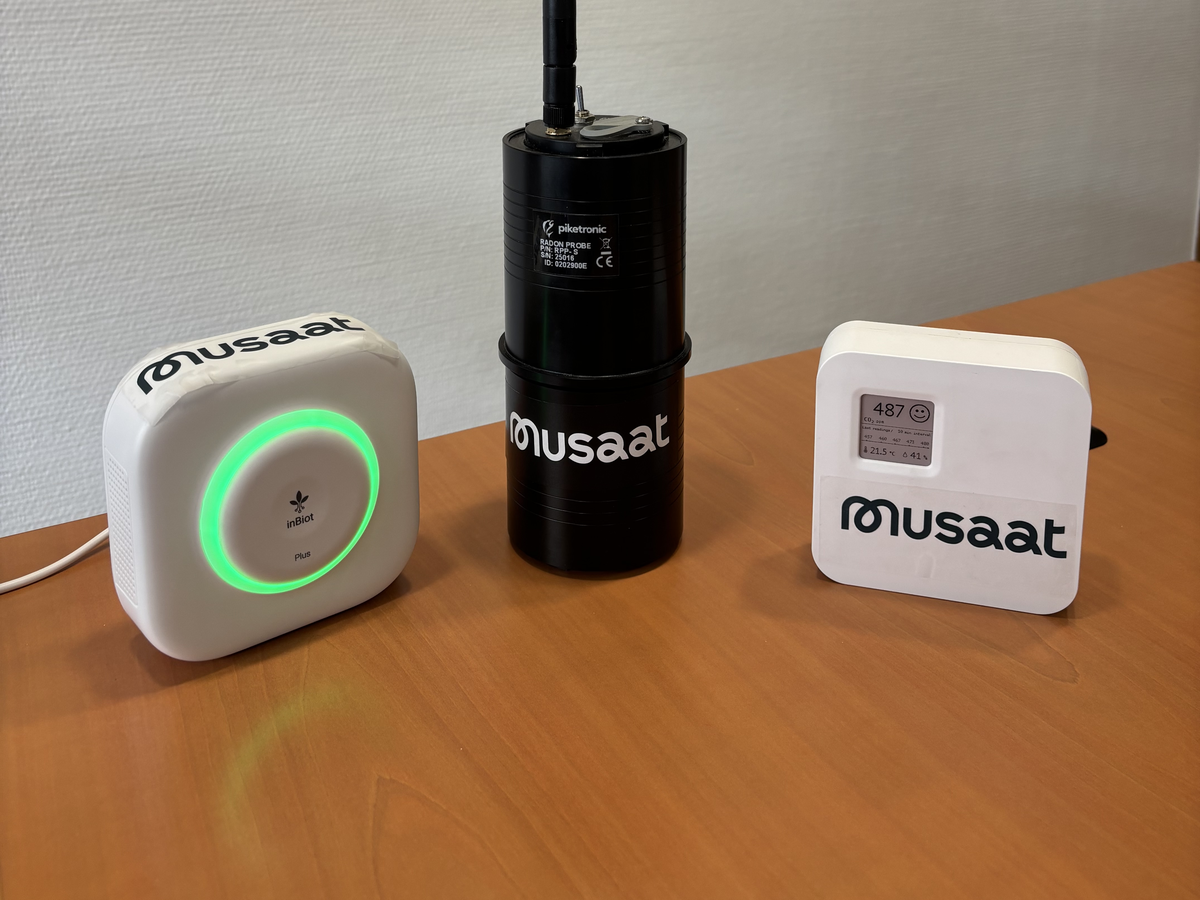
The initiative is partly funded by the Ministry of Housing and Urban Agenda (MIVAU) through its grants for the promotion of and research in architecture. The Madrid School of Building Engineering (ETSEM-UPM) will help analyse and disseminate the results; the Spanish Medical Association (OMC) has expressed its support and willingness to take part, and Musaat will contribute to the purchase of the measuring equipment.
Respira Tranquilo will measure radon, CO₂, formaldehyde, volatile organic compounds and particles, with a focus on ground and first floors
An invisible gas with a 300 Bq/m³ reference level
Radon is a naturally occurring radioactive gas that comes from the ground and builds up in enclosed spaces. Spain’s Ministry of Health classifies it as a category 1 human carcinogen and, in the first monitoring report of the National Radon Plan (in Spanish), links approximately 4% of all lung cancer deaths in Spain to radon exposure.
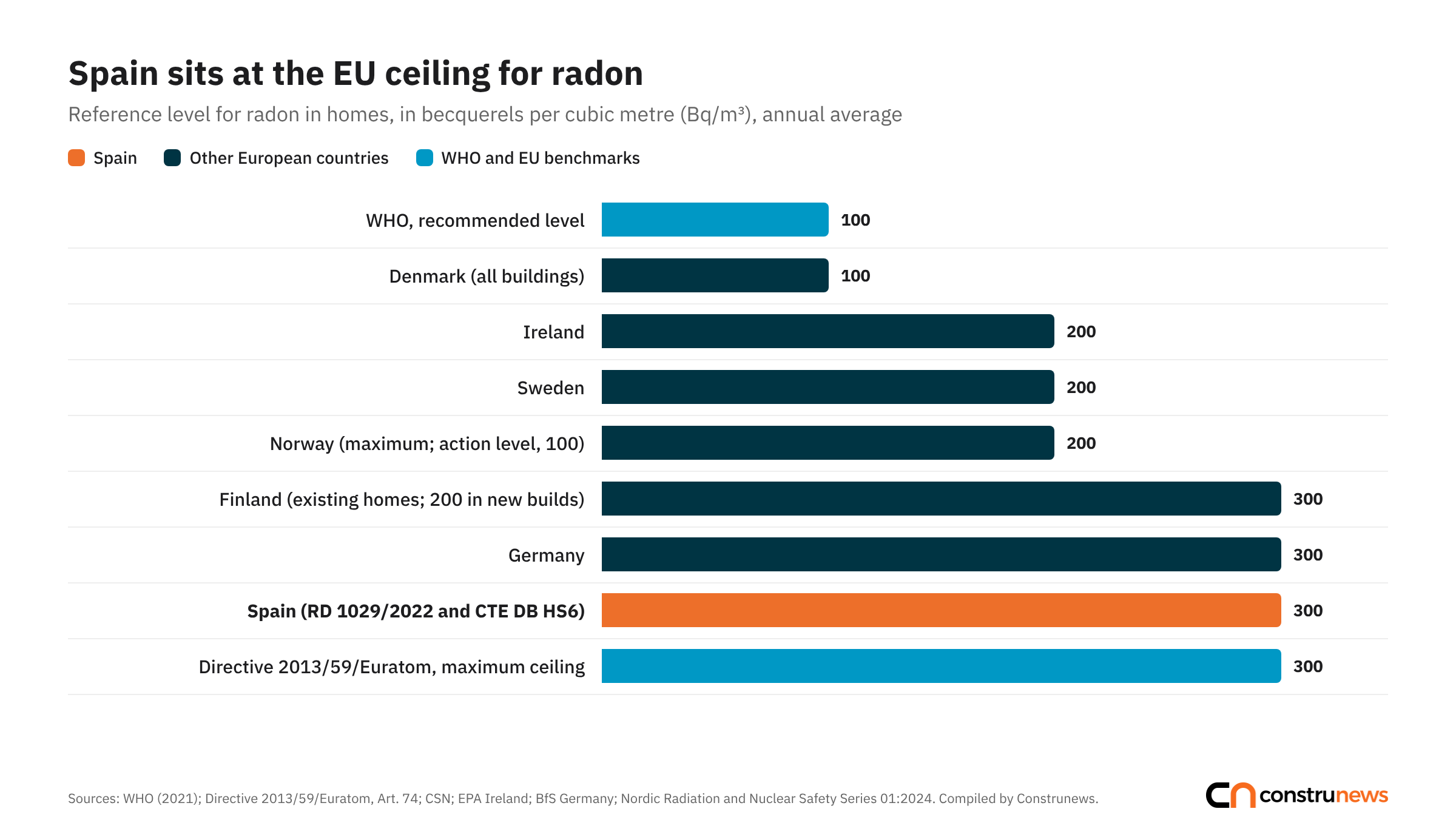
The health framework is set by the Regulation on health protection against the risks of exposure to ionising radiation, approved by Royal Decree 1029/2022 of 20 December, which establishes a reference level of 300 Bq/m³ as the annual average radon concentration. As the Nuclear Safety Council (CSN) points out, this is not a prohibitive limit but “a value that it is recommended not to exceed”.
To know where to look, the CSN publishes the radon potential map of Spain, at a 1:200,000 scale, identifying the areas where a significant proportion of residential buildings may exceed 300 Bq/m³ on the ground or first floor. It was built from the 12,000 measurements available in January 2017 and underpins the Building Code zoning. The CSN warns that, given its scale, it cannot describe a specific street or building and does not replace direct measurement, which it recommends commissioning from an ENAC-accredited laboratory for at least three months, avoiding the summer.
What the Building Code requires: DB HS6
In construction, the key piece is section HS6 “Protection against radon exposure” of the Basic Document on Health and Hygiene of Spain’s Technical Building Code (CTE), introduced by Royal Decree 732/2019. According to the Ministry’s basic concepts document (in Spanish), it applies to new buildings in municipalities classified as zone I and zone II (Appendix B), and to works on existing buildings in those municipalities when they affect elements that influence radon concentration, as well as extensions and changes of use.
The solutions envisaged are a protective barrier, a ventilated air chamber and soil depressurisation, with stricter requirements in zone II, where they must be combined. For existing buildings, sealing of the envelope and improved ventilation are added. The CSN notes that natural ventilation is effective at concentrations of “a few hundred Bq/m³”, while higher levels may require construction measures.
Construnews has already covered the technical construction solutions against radon gas (in Spanish) and the link between buildings, public health and radon in Spain (in Spanish).
DB HS6 requires radon protection in new buildings and in works on existing buildings in zone I and zone II municipalities
The National Radon Plan
On 9 January 2024, the Council of Ministers approved, at the proposal of the Ministry of Health, the National Radon Plan (in Spanish), with a five-year horizon and the aim of “protecting the health of the population as a whole, and workers in particular”. It is built on five strategic axes: basic knowledge and infrastructure; buildings; workplaces; priority action areas; and communication and awareness.
Its first monitoring report, from 2024, records progress in territorial knowledge: 6,209 measurements in Castilla y León, around 6,080 in Galicia with completed data by census section in 165 municipalities, and some 100 new ones in the Canary Islands. It also documents better performance by measuring laboratories: 24 entities took part in intercomparisons in 2024, up from 20 in 2020, and satisfactory results rose from 70% to 87%.
Against this background, the database of real homes that “Respira Tranquilo” aims to build, with radon and ventilation measured together, provides information that the official plans regard as a priority.
Europe: mandatory national plans and a 300 Bq/m³ ceiling
The common framework is Directive 2013/59/Euratom, laying down basic safety standards against ionising radiation. Its Article 74 requires Member States to set national reference levels for indoor radon that “shall not be higher than 300 Bq m–3” as an annual average, and to promote the identification of homes that exceed them. Article 103 requires a national action plan on long-term risks in dwellings, buildings with public access and workplaces, updated regularly, with measures to prevent radon ingress into new buildings and the identification of areas where many buildings are expected to exceed the reference level.
The European Environment Agency estimates that around 19,000 lung cancer deaths in Europe in 2019 may have been due to residential radon and that 1 in 10 lung cancer cases in Europe may be linked to this exposure. The fifth edition of the European Code Against Cancer devotes its recommendation 10 to the gas: check the local radon map, seek professional help to measure and, if necessary, reduce levels.
The Euratom Directive requires every EU Member State to have a radon plan and sets a ceiling of 300 Bq/m³ as an annual average
How other countries tackle it
Within that ceiling, each country has chosen its own bar. Germany sets 300 Bq/m³ in its radiation protection act, according to the Federal Office for Radiation Protection (BfS). Ireland sets 200 Bq/m³ for homes, with an average of 77 Bq/m³ in Irish homes, according to the Irish EPA.
The Nordic countries, according to a 2024 joint report by their authorities, go further. Denmark applies 100 Bq/m³ in all buildings; Sweden, 200 Bq/m³ in existing buildings and a strict limit of 200 in new ones; Finland, 300 in existing homes and 200 in new ones; and Norway has an action level of 100 and a maximum of 200, which are binding limit values in schools, kindergartens and rental housing.
Globally, the WHO recommends a reference level of 100 Bq/m³ and, where this is not feasible, no higher than 300. In its 2021 survey of 56 countries, 44% had a national plan and 39% had included radon in their building codes. Only 12% provided radon training for building professionals and 15% offered financial support to fix existing buildings. The WHO estimates that residential radon caused 84,000 lung cancer deaths worldwide in 2019.