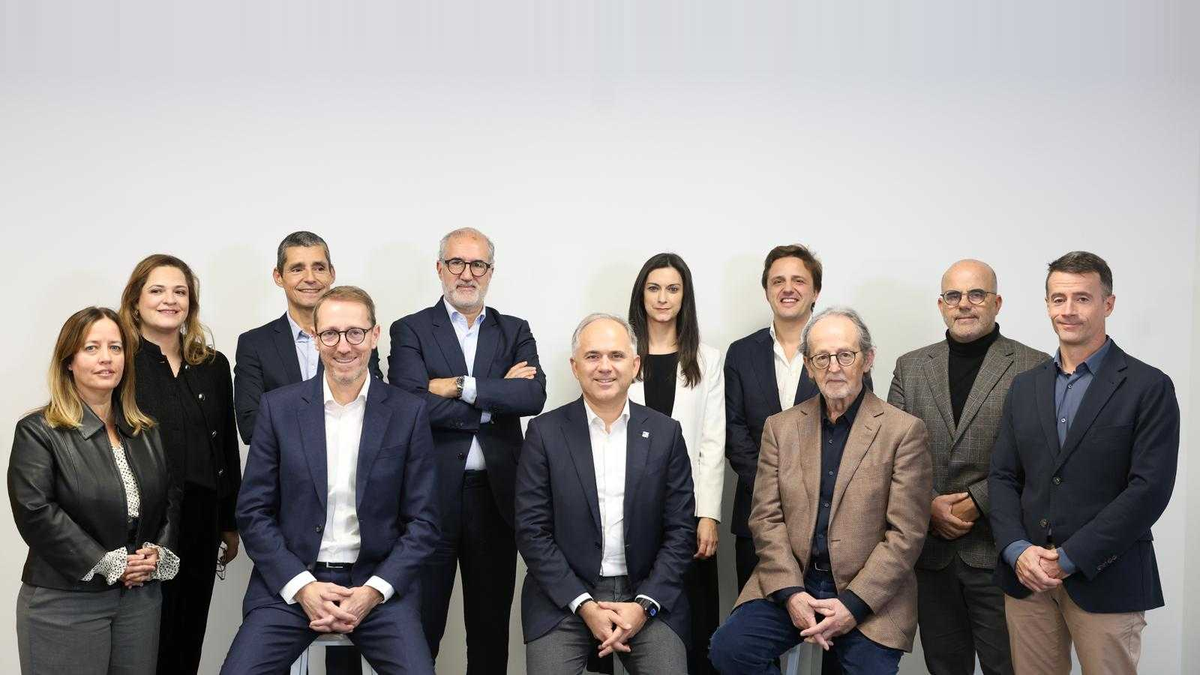

Grupo Casais has completed the acquisition of 80% of the share capital of Grupo ACR, the Portuguese company announced in a press release (in Portuguese) published on 24 November 2026. The seller is the Spanish contractor’s founder and majority shareholder, Navarrese businessman Javier Osés. Michel Elizalde will continue to lead the company as CEO and keeps his stake as a partner.
It is Casais’s second acquisition in Spain in twelve months, which the group itself presents as a clear sign of its commitment to the Spanish market. The stated aim is to put the Braga-based group at the forefront of sustainable industrialised construction in the Iberian Peninsula by 2030 and, in the following decade, among the leading European references in the sector.
ACR keeps its brand, team and autonomy
According to both companies, the arrival of the new shareholder gives the Spanish contractor greater scale and financial capacity to pursue its strategic projects. The Board of Directors changes to reflect the new shareholding structure, but Grupo ACR retains its brand, its management team and its operational autonomy in Spain. Teams, contacts and contractual commitments remain unchanged, a relevant point for developers, engineering firms and architecture practices with ongoing projects with the contractor.
On the deal, Grupo ACR was advised by Sinergia Partners and the law firm Uría Menéndez. Grupo Casais worked with PwC on due diligence and with Laffer Abogados on legal advice.
ACR keeps its brand, management team and operational autonomy in Spain; teams, contacts and contractual commitments do not change
What each side brings
The purchase gives ACR access to the engineering, digital tools and industrialised components of Casais Industries, and to the know-how the group has built up across several markets. Casais, for its part, strengthens its presence in Spain and takes its solutions to more projects in growing segments: housing, student residences, hotels and offices. For clients, the companies say, this means better-prepared projects and greater predictability of costs and timelines, with gains in quality and environmental performance.
The buyer’s size helps gauge the scope of the move. According to Casais’s corporate figures, the group posted revenue of €1,017 million in 2025 (€549 million in Portugal and €468 million abroad), has 7,725 employees (2,838 in Portugal and 4,887 internationally) and operates in 18 markets, including Spain. In October 2026 it opened the Casais Offsite & Technology Hub (in Portuguese) in Braga, which brings together BIM digital coordination, engineering, off-site production and the integration of industrialised components, with companies such as Blufab, BluMEP and TopBIM, a robotic micro-factory and Boston Dynamics’ SPOT robot for 3D site scanning.
What the leaders say
António Carlos Rodrigues, CEO do Grupo Casais, says they chose ACR “for the quality of its team and the complementarity between our companies”. “We have already proven, on site, that the two teams know how to deliver projects together. With ACR’s knowledge of the Spanish market and backed by the engineering and production capacity of Casais Industries, we are laying the foundations to lead the industrialised transformation of the sector in the region,” he adds.
Michel Elizalde, CEO de ACR, says the deal “came about naturally, driven by the affinity between both companies and the convergence of their strategies, aimed at transforming the sector through more sustainable, industrialised and innovative construction”. “ACR keeps its name, its team, its culture and its purpose,” he stresses. Elizalde credits Javier Osés with founding ACR and steering it for more than 50 years along a path of growth and innovation until it became a spearhead of the sector’s transformation.
Osés, for his part, is pleased to leave the company in the hands of a multinational family group that “understands construction as we do”. “Casais’s future plan for ACR, as well as its innovative and sustainable outlook, were fundamental to my decision,” says the founder, who set up the company in 1973.
From Tres Cantos to CREE Iberia: the timber-concrete hybrid system
The relationship between the two contractors began in 2023, when they built the B&B Hotel Madrid Tres Cantos as a consortium, the first building in Spain to use the industrialised timber-concrete hybrid system of CREE Buildings, in which Casais has been a reference shareholder since February 2023. The hotel’s industrialised structure, with 120 rooms and 4,500 m², was assembled in 14 days. ACR later applied the same technology at Calido Valdebebas (Madrid), a 500-apartment project completed in 2025 whose seven-storey, 19,600 m² above-ground structure was finished in 77 days, as Construnews reported (in Spanish).
The step before the purchase was CREE Iberia, a 50/50 company owned by Casais and ACR, set up in June and presented in July 2026, which holds the exclusive licence for the CREE Buildings system in the Iberian Peninsula. The company coordinates the commercial, technical and operational development of the system in Spain and Portugal and targets hotels, student residences, senior living, housing, flex living and other assets where repetition, speed, quality and sustainability are key. In the division of roles, Casais contributes prefabrication, engineering, BIM, MEP integration and complementary industrialised solutions; ACR, its footprint in the Spanish market and its building experience.
CREE Iberia, owned 50/50 by Casais and ACR, holds the exclusive licence for the CREE Buildings hybrid system in Spain and Portugal
CREE Buildings is an industrialised hybrid system that combines timber, concrete and other prefabricated components and integrates design, engineering, manufacturing, logistics and execution from the earliest stages. According to CREE Buildings data released by Casais in 2023, up to 50% of the materials can be reused at the end of the building’s life, waste is cut by 70% and on-site noise pollution by more than 50%.
Results measured on site
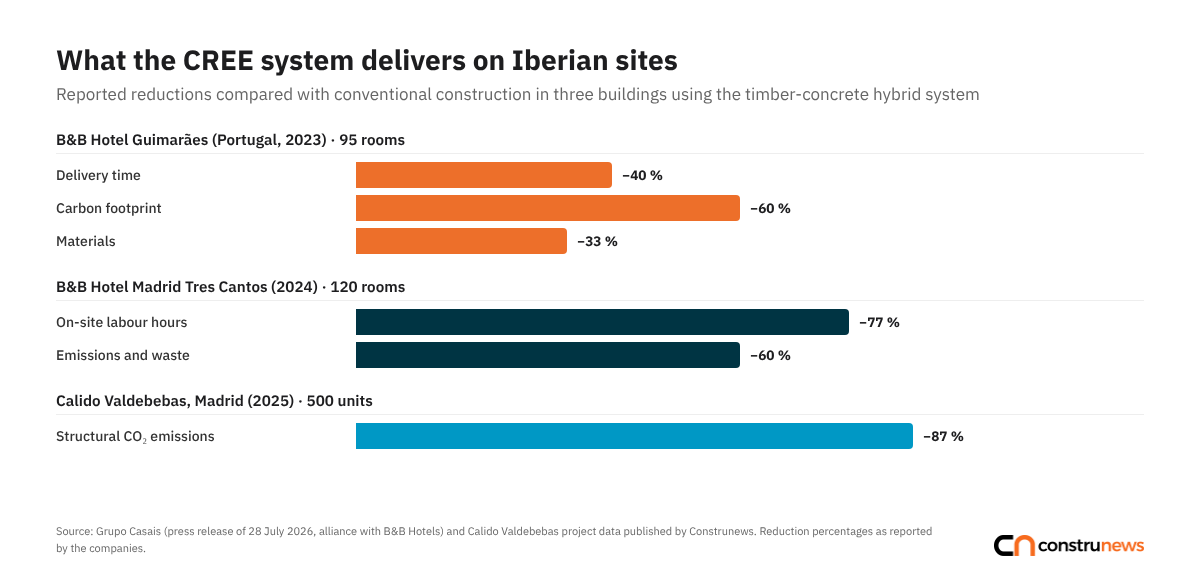
Data from projects built with the system explain the sector’s interest. In the alliance signed in July with B&B Hotels (in Portuguese), CREE Buildings and First Properties to industrialise hotel development in the peninsula, Casais reported that B&B Guimarães (Portugal, 2023), with 95 rooms and 8,300 m², completed structural assembly in eight days, was delivered 40% faster than with conventional construction, cut its carbon footprint by 60% and saved 33% in materials. In Tres Cantos, the works reduced on-site labour hours by 77% and emissions and waste by 60%. In Valdebebas, the system cut CO₂ emissions from structural elements by 87% and the building achieved BREEAM Excellent certification.
Casais aims to lead sustainable industrialised construction in the Iberian Peninsula by 2030 and then rank among Europe’s benchmarks
A Spanish market pushing towards industrialisation
The purchase comes amid public support for industrialised housing construction in Spain. On 10 November, the Ministry of Housing and Urban Agenda published the rules for grants (in Spanish) under the PERTE for the Industrialisation of Housing, with up to €5 million per project for SMEs, and the 2026-2030 State Housing Plan for the first time increases aid when advanced industrialisation techniques are used. New industrial players, such as Cecotec’s gigafactory in Almussafes, aim to produce thousands of homes a year, while the sector debates the policies needed to scale up, as discussed at The Green Beer Sessions.
For architects, engineers and developers, the deal consolidates a value chain that integrates design, manufacturing and assembly with a hybrid structural system already proven in hotel and residential buildings. The Construnews data monograph on industrialisation (in Spanish) sets out the context of a sector seeking to shorten timelines and offset labour shortages with more factory production.

