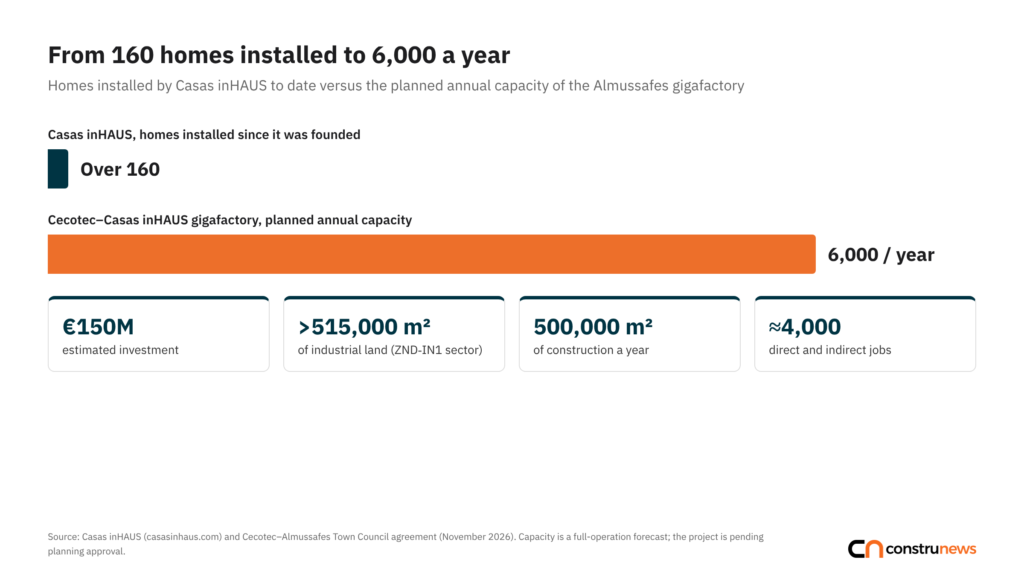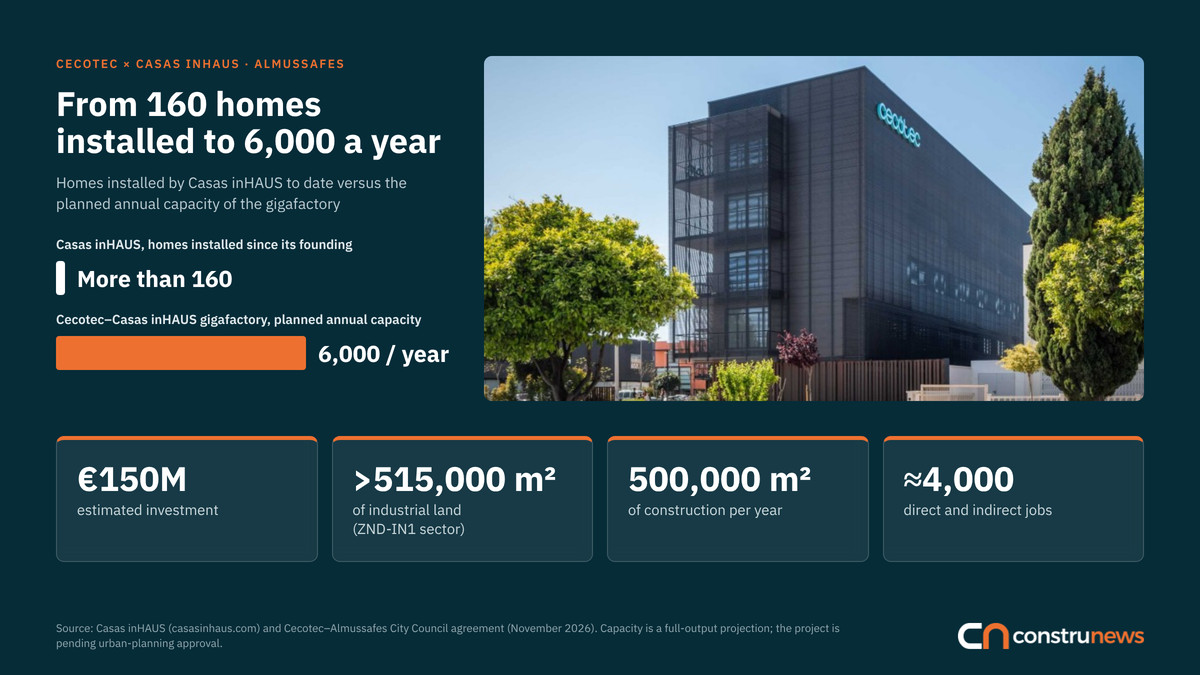

The Cecotec group and Almussafes Town Council (Valencia) signed on 18 November the agreement that takes forward what both parties describe as one of the largest industrialised housing gigafactories in Europe. The plant, to be developed together with Valencia-based Casas inHAUS, would have capacity for up to 6,000 homes a year, around 500,000 m² of construction, and an estimated investment of €150 million. It still depends on the planning and administrative approval process.
From protocol to agreement in three weeks
The signing, held at the Almussafes Cultural Centre and attended by César Orts, CEO y fundador de Cecotec, and Toni González, alcalde de Almussafes, closes a fast sequence. On 27 October both parties signed a protocol of actions setting out a preliminary roadmap to coordinate technical and planning work. On 12 November, an extraordinary plenary session backed the project with the unanimous vote of all municipal groups. Six days later came the agreement which, according to the company, gives “full solidity to the roadmap” of the project.
For Orts, “the formalisation of this agreement and the unanimous support of the Plenary” provide “the ideal institutional stability” to plan the investment. He argues that conventional construction lacks the production capacity to meet current demand and that “large-scale industrialisation is the indispensable path” to tackle the housing access problem. González frames the operation as “a strategy for the future aimed at strengthening the local economy” and at diversifying an industrial base closely tied to the car industry.
Cecotec and Almussafes moved from the protocol of actions of 27 October to the agreement of 18 November, with the unanimous backing of the municipal Plenary
Land: 515,000 m² in a sector awaiting the new general plan
The gigafactory is planned on more than 515,000 m² of industrial land next to the Juan Carlos I industrial estate, in the new ZND-IN1 sector included in the revision of the Almussafes General Urban Development Plan (PGOU). At the end of October, the plan was close to final approval; the Town Council is already negotiating the purchase of the plots with landowners.
The council itself notes that it still has to complete the planning and administrative procedures: land management, infrastructure coordination and permits. For that reason, neither the protocol nor the agreement sets dates for land development, start of works or start of production. The facilities and the start of activity are expected to be rolled out “progressively over the coming years”. When Cecotec announced its move into the business with Casas inHAUS in July, the plant was expected to be operational in 2029. The built floor area of the factory buildings and the contractor or engineering firm that will carry out the works have not yet been made public.
Among the reasons for the location, the parties point to road and rail connectivity, direct access to the Port of Valencia and the Mediterranean Corridor, and the industrial culture and skilled workforce of the town, home to the Ford plant.
Grade 6: 3D modules 95% finished in the factory
The leap in scale is the key figure for the sector. The plant will work to a grade 6 industrialisation standard, the top level of the 0-to-6 scale set out in the document Medir y clasificar la industrialización de los edificios by Spain’s Clúster de la Edificación. As Casas inHAUS explains (in Spanish), that grade corresponds to volumetric 3D systems: complete modules that integrate structure, envelope, building services and interior finishes.
In the gigafactory, around 95% of each building will be manufactured, fitted out and checked in the factory before being transported and assembled on site, through automation, robotisation and digitalisation of processes. The company estimates that the average delivery time will fall to around three months and argues that the model limits the risk of cost overruns caused by inflation during construction.
The starting construction system is that of Casas inHAUS, which manufactures three-dimensional steel and concrete modules. The firm, founded by architects Rubén and Sergio Navarro, moved its headquarters in 2018 to a factory building in Almussafes, next to the Ford plant, and says it has installed more than 160 homes, which leave the factory 95% finished and are placed on site in a single day. The gigafactory would scale up that experience to a capacity of 6,000 homes every year.
Grade 6 industrialisation means volumetric 3D systems: 95% of each home is manufactured, fitted out and checked in the plant before assembly
Cecotec, from home appliances to building
Cecotec channels its move into housing through CecoHomes, its architecture and industrialisation division, launched at the end of 2022. In July 2026 it announced its alliance with Casas inHAUS to build a large plant in the province of Valencia, with an investment then put at around €100 million and the site still under study. With Almussafes chosen, the planned figure rises to €150 million.
The factory will serve developers, public administrations, investors, architecture practices and professionals in both the Spanish and European markets. In the July announcement, the companies referred to single-family homes, residential developments, multi-family buildings and hotels.
4,000 jobs and a commitment to local suppliers
The project expects to create around 4,000 direct and indirect jobs, both in building the facilities and in operating them, in a town with an unemployment rate of around 7%. The Town Council’s Local Development Agency (ADL) will help with job placement, publicising recruitment processes and training technical profiles. Cecotec has committed to publishing its job offers locally and to favouring local suppliers and ancillary industry, as long as profiles and technical needs allow.
The announcement adds to other initiatives aimed at scaling up industrialised housing construction in Spain, such as the industrialised housing PERTE (in Spanish) and the CLIC project (in Spanish), which Construnews analysed in its data monograph on the industrialisation of construction (in Spanish).