
Spain’s cement market has now posted four consecutive months of decline. According to the latest Cement Statistics, released today by Oficemen (Spanish Cement Association), domestic consumption fell 13% in October and year-to-date growth has slowed to 1.1%. The association now expects the year to close practically at the same level as 2025.
217,964 tonnes fewer than in October 2025
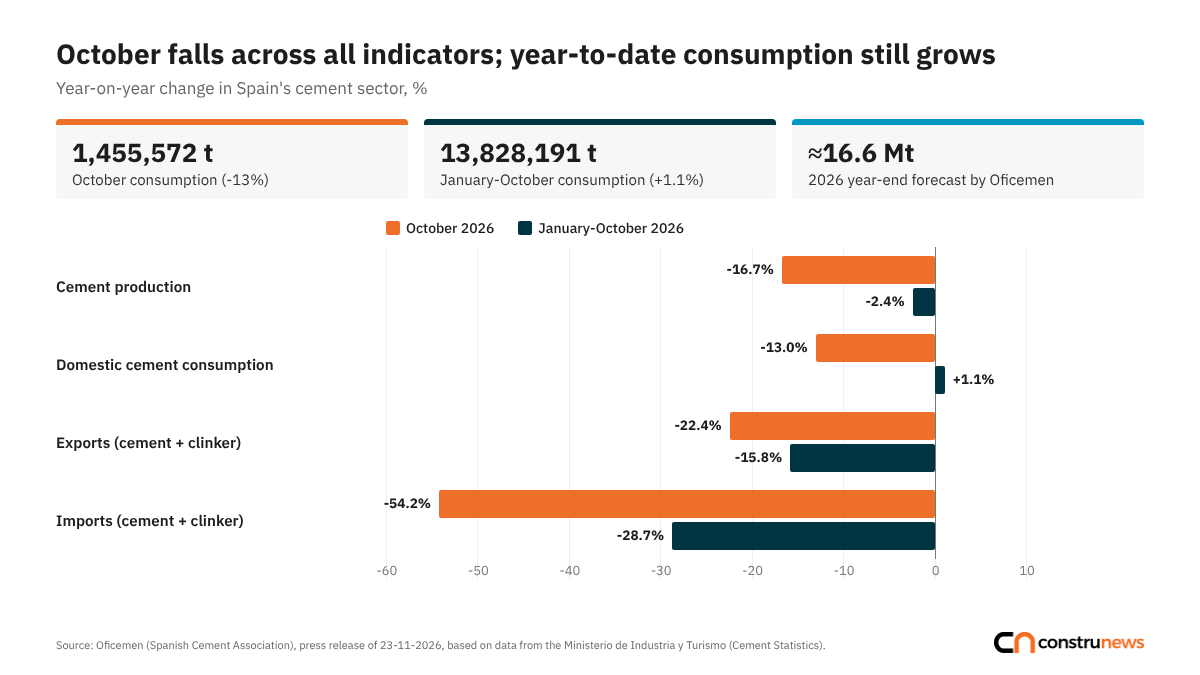
Cement consumption in Spain stood at 1,455,572 tonnes in October, 217,964 tonnes less than in the same month of 2025, when 1,673,536 tonnes were consumed. That October was exceptional: as Construnews reported, consumption posted its strongest growth since 2011 (in Spanish).
With the October figure, consumption over the first ten months of 2026 reached 13,828,191 tonnes, 153,300 tonnes more than in the same period of the previous year. Year-to-date growth has therefore eased to 1.1%, down from 3% at the end of September, when monthly consumption had already fallen by 8.1% (in Spanish).
On a rolling twelve-month basis (November 2025 to October 2026), consumption totals 16,800,762 tonnes, 3.6% more than in the previous period (November 2024 to October 2025), an increase of 591,279 tonnes.
January-October consumption totals 13,828,191 tonnes, 153,300 more than in 2025: year-to-date growth slows to 1.1%
Production and imports also down
Figures from Spain’s Ministerio de Industria y Turismo compiled by Oficemen show that October’s decline extended to the sector’s other indicators. Cement production fell 16.7% in the month to 1,523,210 tonnes, and cement and clinker imports dropped 54.2% to 69,471 tonnes.
From January to October, production totals 15,457,207 tonnes (-2.4%) and imports 1,328,988 tonnes (-28.7%). On a rolling twelve-month basis, production is practically stable at 18,837,876 tonnes (-0.3%), while imports are down 12.6% to 1,820,260 tonnes.
Oficemen lowers its 2026 forecast
The slowdown has forced the association to revise its expectations. In July, Oficemen forecast 2% growth for 2026 (in Spanish), to 17 million tonnes. It now estimates the year will close at around 16.6 million tonnes.
“The slowdown in cement consumption that we anticipated for the second half of the year is proving more intense than expected. Although year-to-date consumption is still up 1.1% on the same period of 2025, the declines recorded over the last four months suggest that we will close the year at around 16.6 million tonnes, practically the same level as last year and below the 2% growth we had forecast for 2026,” explains Elena Guede, directora general of Oficemen.
Oficemen expects 2026 to close at around 16.6 million tonnes, far from the more than 20 million it considers necessary
“We are still far” from 20 million tonnes
Guede links the figures to the country’s housing and infrastructure needs. “This trend is not good news, either for our sector or for society as a whole. To meet our country’s current housing and infrastructure needs, cement consumption should exceed 20 million tonnes a year. However, the latest data show that we are still far from reaching that level,” she adds.
Exports fall 22.4% in October
Export indicators remain negative. In October, cement and clinker exports fell 22.4% to 311,928 tonnes, a loss of almost 90,000 tonnes compared with the same month of 2025.
The figure for the first ten months is down 15.8% at 3,240,548 tonnes, 609,243 tonnes less than in the same period of 2025. The rolling twelve-month comparison (November 2025 to October 2026) is also negative, with an 18.3% fall that leaves total exports at 3,882,857 tonnes.
Oficemen, whose centenary (in Spanish) was covered by Construnews, publishes these figures monthly based on the Cement Statistics.

