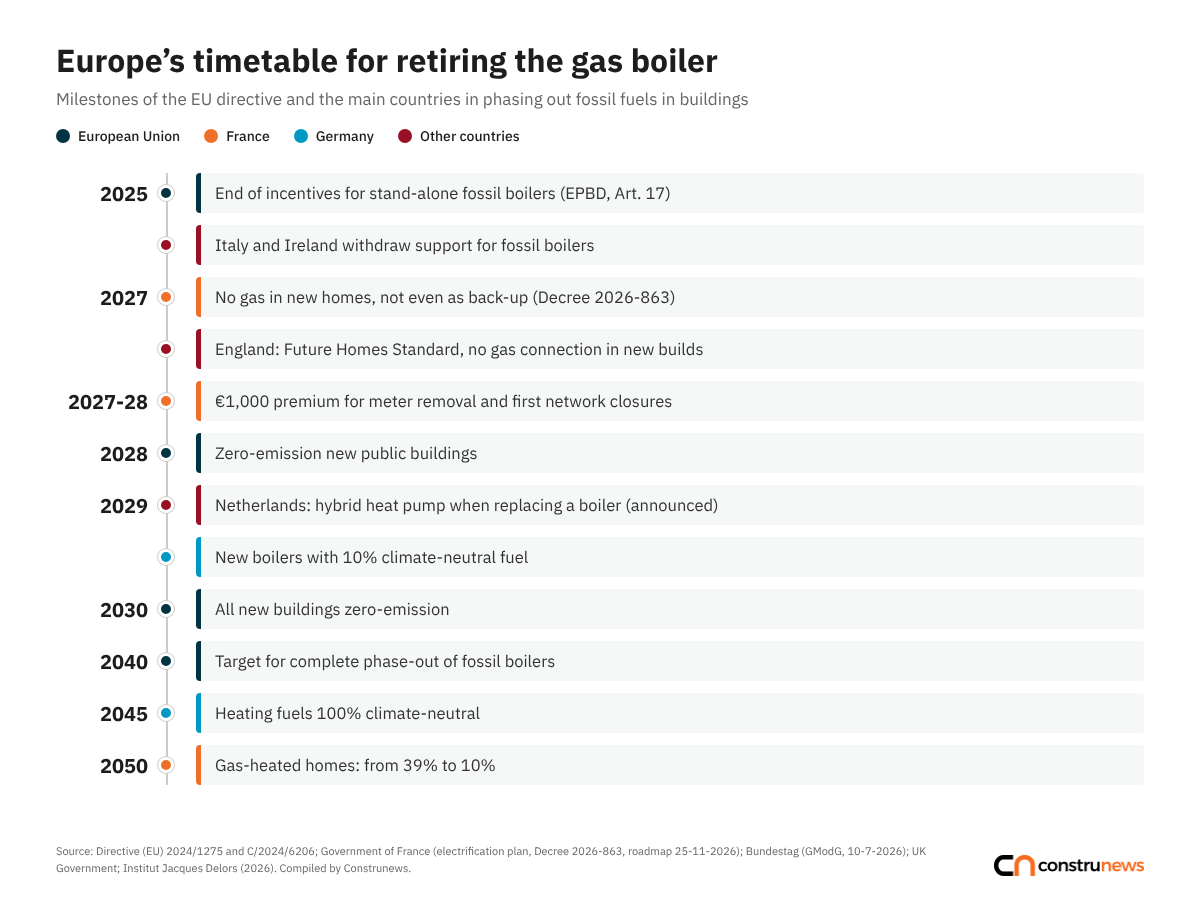

The French government has taken a further step in its strategy to take gas out of the building stock. On 25 November, during the annual gathering of mayors in Paris, it presented a guide to exiting gas and signed the first three territorial electrification roadmaps. The move comes as Directive (EU) 2024/1275 now requires every Member State to plan the end of fossil boilers, and as countries such as Germany, the Netherlands, the United Kingdom, Italy and Spain advance at very different speeds.
What France has decided
The new phase builds on the plan for the electrification of uses, presented in April with 22 measures and a target of installing 1 million heat pumps in 2030, compared with about 180,000 air-to-water heat pumps installed in 2024. On 25 November the first three roadmaps were signed in Nevers, Flandre and Nègrepelisse, out of the 109 electrification territories selected from 197 applications. They cover some 6,700 municipalities and 14 million inhabitants, and 87% are rural municipalities. The remaining roadmaps are due in December.
According to information released after the presentation, from March 2027 municipalities and network operators will identify priority areas, and the first gas pipes could be closed at the end of 2027 or early 2028. A network will only be closed once all its users have stopped using gas, as current legislation does not allow supply to consumers to be cut off. To encourage the switch, the Maison électrique programme, run by ADEME with €100 million from energy savings certificates, provides a premium of up to €1,000 per home for anyone who proves the permanent removal of their meter, compatible with MaPrimeRénov’. The aim is to cut the share of gas-heated homes from 39% today to 10% in 2050.
France wants to cut the share of gas-heated homes from 39% to 10% by 2050 and close the first gas pipes at the end of 2027
The roadmap adds to measures already adopted. Decree No. 2026-863 of 12 September, which transposes Articles 7 and 11 of the EU directive, bans gas boilers in new buildings, including as back-up: from 1 January 2027 for housing, from 2028 for public buildings and from 2030 for all others. In addition, since September 2026 deep renovations of single-family homes funded by MaPrimeRénov’ must replace gas boilers with a decarbonised system, and the éco-PLS loan will stop funding gas installations in social housing from January 2027. France’s social housing stock alone has 3 million gas-heated dwellings.
The EU mandate: 2025, 2030 and 2040
The common framework is set by the Energy Performance of Buildings Directive (EU) 2024/1275 (EPBD), in force since 28 May 2024, whose general transposition deadline expired on 29 May 2026. According to the European Commission, buildings account for around 40% of the energy consumed in the EU and about 50% of its gas consumption.
The directive sets three milestones for fossil heating. Since 1 January 2025, Member States may not grant financial incentives for stand-alone fossil fuel boilers, as detailed in Commission Notice C/2024/6206; hybrid systems with a significant renewable share can still be supported. New buildings must be zero-emission from 2028 if publicly owned and from 2030 in all cases, with no on-site emissions from fossil fuels. And national building renovation plans must include a roadmap towards the complete phase-out of fossil fuel boilers by 2040. Draft plans were due at the end of 2025 and final versions are due by 31 December 2026.
The EU directive has banned subsidies for fossil boilers since 2025 and sets 2040 as the horizon for removing them from the building stock
This framework is complemented by the Electrification Action Plan presented by the Commission on 17 July 2026, which makes the heat pump the flagship technology for replacing fossil boilers and sets an indicative target of 46% electrification of final energy consumption by 2040. The European Heat Pump Association, EHPA, highlights that the plan aims to go from 2.4 million installations in 2025 to 4 million a year by 2030, and for electricity to cost households no more than 2.5 times the price of gas.
Germany and the Netherlands, between the brake and the hybrid
Germany has taken the opposite path to France. On 10 July 2026 the Bundestag passed the Gebäudemodernisierungsgesetz (GModG), which replaces the so-called heating law and scraps the requirement for all new heating systems to run on 65% renewable energy. New gas and oil boilers remain permitted, but must use a rising share of climate-neutral fuels (the so-called Bio-Treppe): 10% from 2029, 15% from 2030, 30% from 2035 and 60% from 2040, reaching 100% in 2045.
In the Netherlands, where new buildings have not been connected to the gas grid since 2018, the government has announced that from 2029 anyone replacing their boiler will have to install a smart hybrid heat pump, with a €2,000 subsidy per household and exemptions for apartments, listed buildings and homes connected to heat networks. It is the second version of a mandate that was planned for 2026 and was cancelled in 2024.
The United Kingdom, Italy and Ireland
In England, the Future Homes and Buildings Standard comes into force on 24 March 2027, with a transition period until March 2028. New homes will not be connected to the gas grid: they will need a heat pump or a low-carbon heat network and must emit at least 75% less over their lifetime.
Italy has, since 1 January 2025, removed Ecobonus tax deductions for boilers running only on gas or other fossil fuels, while keeping support for hybrid systems and heat pumps. Ireland also withdrew public support for fossil boilers in 2025 and has raised heat pump grants to up to €12,500, according to the Institut Jacques Delors. The same report puts the number of heat pumps installed in Europe’s main markets at 29.3 million at the end of 2025, far from the 60 million the Fit for 55 trajectory would require by 2030, and identifies the price of electricity relative to gas as the main barrier: 3.8 times in Belgium and 3.2 in Germany, compared with 1.4 in the Netherlands.
Spain, halfway through transposition
In Spain, transposition of the EPBD is behind schedule. The GBCE compliance analysis (May 2026) put the weighted degree of compliance at 60% one week before the deadline. Spain submitted the draft of its National Building Renovation Plan (PNRE) (in Spanish) on time, in December 2025, one of 7 of the 27 Member States to do so, and must adopt the final version before 31 December. The amendment of the Technical Building Code (CTE) went to public consultation in November 2025 but has not been approved, the RITE heating regulation has no draft, and GBCE warns that public subsidies are still being granted for fossil boilers despite the EU ban.
Spain submitted its renovation plan draft on time, but its compliance with the EU directive stands at 60%
With these timetables, the renovation and building services sector faces a change of product, training and business model over the next five years: fewer replacement boilers and more heat pumps, hybrids and heat network connections, in a market where each country sets its own pace within the shared 2040 horizon.

