

Spain’s Council of Ministers agreed on 20 November to send to the Standing Committee (Diputación Permanente) of the Congress of Deputies a royal decree-law aimed at unlocking the more than €9 billion of Spain’s Social Climate Plan. Around 75% of that amount, some €6.8 billion, is European money from the Social Climate Fund. More than 50 organisations grouped in two alliances, one of them focused on housing renovation, had been calling for this step for months.
A transposition almost three years late
The royal decree-law transposes directly, that is, without changes, Directive (EU) 2023/958 and Directive (EU) 2023/959, adopted in May 2023 to strengthen the EU Emissions Trading System (EU ETS). The first concerns aviation’s contribution; the second, dated 10 May 2023, amends Directive 2003/87/EC establishing the emissions trading system.
The deadline for incorporating these rules into Spanish law expired on 31 December 2023. Following letters of formal notice in January 2024 and reasoned opinions in May 2025, the European Commission announced in June 2026 its decision to refer Spain to the Court of Justice of the European Union for failing to transpose the agreed rules to strengthen the emissions trading system.
Without that transposition, Brussels cannot approve the Social Climate Plan (PSpC), whose draft the Government presented in May, and therefore the European money from the Social Climate Fund due to Spain cannot start to flow. This was explained by Marcos González, of the Commission’s Directorate-General for Climate Action, at a session held in the Congress of Deputies last March. On the Commission page tracking national Social Climate Plans, Spain is not yet listed as having submitted or adopted its plan.
Without transposing the emissions trading directives, Brussels can neither approve the Spanish plan nor release the EU funds allocated to Spain
Why the fund matters for housing and transport
From 2028, the use of fossil fuels for heating and road transport will be subject to CO2 emission payments across Europe. To prevent this extra cost from hitting lower-income households, the EU has created the Social Climate Fund, which will have €65 billion. Spain is entitled to more than €9 billion: 75% EU funds and a 25% national contribution.
The fund’s investments should enable vulnerable citizens to renovate their homes, adopt energy-efficient technologies and access renewable energy and sustainable transport. The aim is to reduce their dependence on fossil fuels in the medium and long term, while direct income support will mitigate possible short-term negative effects. Specifically, the fund can finance:
- The renovation of vulnerable housing and improved thermal comfort against cold spells and heatwaves, treating renovation as a social policy.
- Lower electricity bills and the fight against energy poverty, by replacing fossil-fuel boilers with clean technologies.
- Zero- and low-emission mobility and transport measures, including public transport.
- Access to sustainable transport for those who need it most.
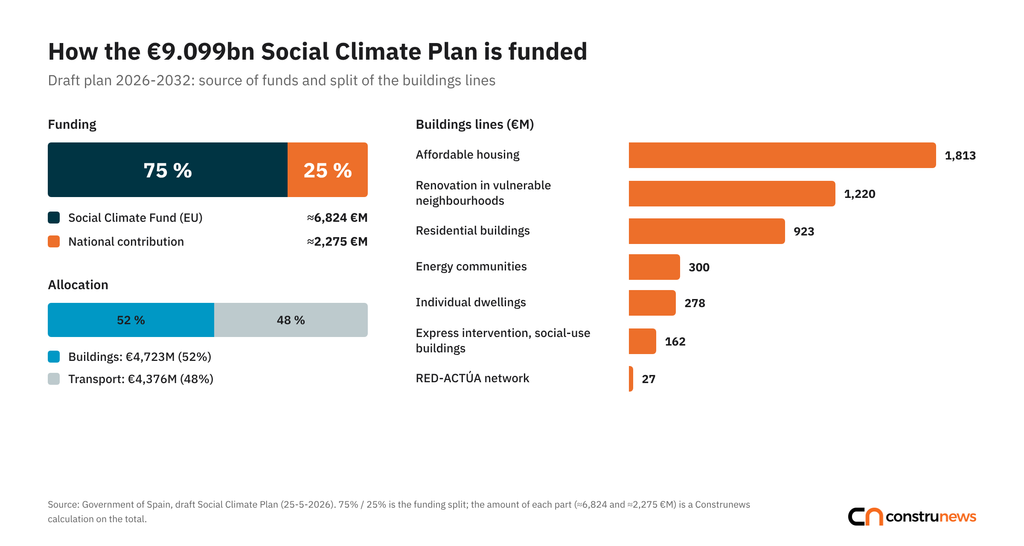
Buildings take 52% of the draft
The draft that the Government put out for public consultation on 25 May, promoted by the ministries for the Ecological Transition, Transport and Housing, puts the plan at €9.099 billion for 2026-2032, financed with 10.52% of the Social Climate Fund’s total resources and a national contribution of 25% of the budget.
Of the total, €4.723 billion (52%) goes to buildings and €4.376 billion (48%) to transport. The buildings block is split into seven lines: affordable housing (€1.813 billion), renovation in vulnerable neighbourhoods (€1.22 billion), residential buildings (€923 million), energy communities (€300 million), individual dwellings (€278 million), express intervention in social-use buildings (€162 million) and the RED-ACTÚA network (€27 million). In transport, the largest item is the decarbonisation of road transport (€2.269 billion), followed by affordable public transport (€964.8 million), which includes a Single Social Pass (Abono Único Social) worth €740.5 million.
Of the €9.099 billion draft, €4.723 billion goes to buildings: affordable housing, renovation in vulnerable neighbourhoods and residential buildings account for €3.956 billion
The alliances call for support in the Standing Committee
The approval responds to the demands of the more than 50 organisations grouped in the Alianza por la Rehabilitación de Viviendas Sin Dejar a Nadie Atrás (Alliance for Housing Renovation Leaving No One Behind) and the Alianza por un Plan Social por el Clima Justo para Usuarios y Microempresas Vulnerables del Transporte (Alliance for a Fair Social Climate Plan for Vulnerable Transport Users and Micro-enterprises).
Carlos Bravo, coordinador de la Alianza por un Plan Social para el Clima justo para usuarios y microempresas vulnerables del transporte, considers that validation in the Standing Committee is “an absolutely necessary step for the European Commission to enable the arrival of the €6.8 billion in EU funds due to Spain to launch the measures of the future Social Climate Plan”. “It is a very significant amount of money that will help the most vulnerable users. We therefore ask the parliamentary groups to facilitate the majority approval of this Royal Decree-Law,” he adds. Bravo also recalls that “in 2023, Spanish MEPs from the PP, PSOE, PNV, EH-Bildu and Junts supported these directives in the corresponding European Parliament vote. We now ask them to be consistent with what they voted there.”
Mario Rodríguez, portavoz de la Alianza por la Rehabilitación de Viviendas Sin Dejar a Nadie Atrás, stresses that approval by the Council of Ministers and subsequent ratification by the Standing Committee are “a very important step not only for access to decent housing, but also to ensure minimum conditions of habitability, comfort and health for the people living in them, especially people in vulnerable situations”.
For Rodríguez, allocating these €9 billion to housing renovation “brings direct benefits for people, as it will enable a significant reduction in electricity and gas bills, while allowing progress in adapting the housing stock to the increasingly drastic impacts of climate change”. He concludes: “It is undoubtedly a fundamental tool, albeit an insufficient one.”
Housing stock renovation and neighbourhood plans are the focus of Construnews’ monograph on renovation and urban regeneration (in Spanish).

