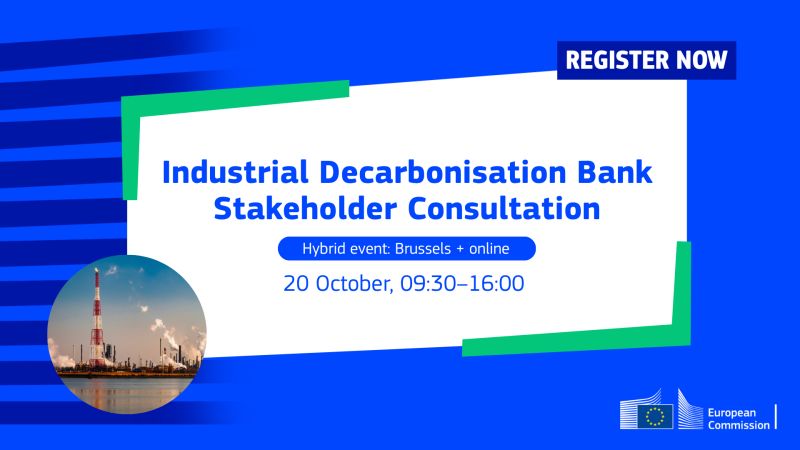


The European Union launched the first consultation with key stakeholders on the implementation of the Investment Booster, the initial phase of the Industrial Decarbonisation Bank. The tool is designed to channel public and private investment towards the sustainable transformation of Europe’s productive fabric and its construction value chain.
The European Union took a decisive step on its roadmap towards climate neutrality with the launch of the first stakeholder consultation on the implementation of the Investment Booster. The mechanism is the initial phase of the Industrial Decarbonisation Bank, a strategic tool designed to channel public and private investment towards the sustainable transformation of the productive fabric and the construction value chain across the continent.
A new financial framework to accelerate industry’s green transformation
Decarbonisation in the European framework requires an unprecedented volume of investment capital and an agile regulatory and financial framework that safeguards the competitiveness of EU companies. Against this backdrop, the European institutions officially convened the first participatory consultation day focused entirely on the operational design of the Investment Booster.
The meeting took place on 20 October 2026, from 09:30 to 16:00, in a hybrid format: in person at the Albert Borschette Conference Centre in Brussels and with an open broadcast via a digital platform.
The Investment Booster will form the first operational phase of the European Union’s Industrial Decarbonisation Bank.
The core purpose of the working day was to lay the operational foundations of the new instrument ahead of its full deployment. The meeting’s programme set out for EU officials and sector representatives to address key questions for the tool’s practical functioning, including the technical scope of eligible projects, application pathways, environmental and economic impact evaluation criteria, and the dynamics of implementation, execution and payment schemes.
Sector integration and eligibility criteria at the heart of the debate
The role of the building industry and materials production is a priority on Europe’s decarbonisation agenda. The shift towards low-emission industrial processes, the promotion of decarbonised materials and the acceleration of efficient energy solutions call for direct financing mechanisms and capital guarantees that mitigate the risk inherent in major technological transformations.
The Brussels event covered everything from the technical selection of projects to the evaluation and disbursement of funds.
For this reason, the European Commission made a direct appeal to developers, manufacturers, financial institutions, technical professionals and representatives of the building sector to share their on-the-ground perspective. The aim was to avoid bureaucratic bottlenecks and ensure that the Investment Booster faithfully reflects the operational realities of companies that must invest in clean technologies and decarbonised infrastructure.
Participation, capacity and access to the consultation platform
Access to the in-person session at the Albert Borschette Conference Centre was subject to limited capacity, with places allocated strictly on a first-come, first-served basis through the official channel set up by the European Union. The online broadcast, for its part, allowed interactive participation by professionals and organisations from all EU Member States.
In-person capacity at the Albert Borschette Centre was limited and allocated strictly in order of registration.
In addition, the Commission made available a dedicated questionnaire and consultation channel on the EUSurvey portal, through which industrial and construction stakeholders could submit their direct comments in advance on how the Industrial Decarbonisation Bank should operate.