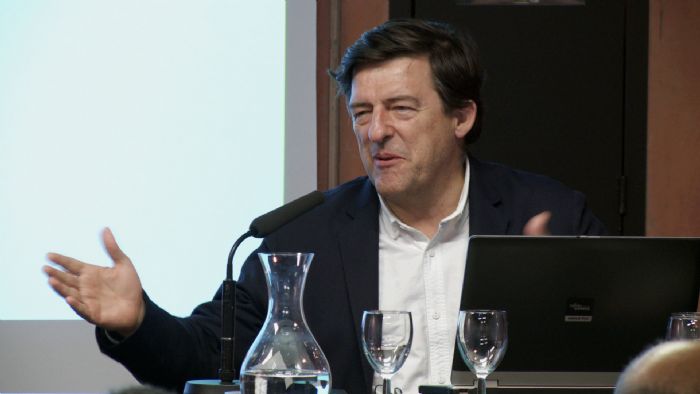


After the bursting of the property bubbles and the concentration of commissions, the prevailing narrative asks architects to give up their “old airs”. Juan M. Otxotorena argues that this reading may fall short: what harms the profession is not creativity but its trivialisation in an “architecture of spectacle” surrendered to pure image, and he calls for a high-level debate that also reaches architectural education.
This text is part of a series of publications curated by Octavi Mestre under the title Other Architectures for Construnews, marking the launch of the publication’s English edition. Its author is Juan Miguel Otxotorena, architect, who for many years was director of the School of Architecture of Navarra.
Creativity versus show: on the present and future of signature architecture
It seems we are going through lean times in the professional and academic field. And that we should see them as one more phase in the course of History and its wave-like or cyclical swings.
In the eyes of many, we might even be living through the hangover that follows a binge. That is what we sometimes tell ourselves, in a kind of raw self-flagellation: this would be the result of having long fed an overly one-sided emphasis on the creativity of the architect’s work. By encouraging narcissistic attitudes for so long, we architects would have managed to distance ourselves from society and lose our ground.1 We would have cultivated that emphasis to unsustainable extremes: “In the future, the accent will have to be placed on construction quality rather than on creativity; the architect need not feel obliged to invent a new form every morning at breakfast…”.2
The model of the architect as diva is cracking, and it is time to step back in an exercise of theoretical recapitulation, attentive to the detection of ‘past excesses’, in line with the drastic call to order imposed by the course of events.
The ‘tradition’ based on that model enjoyed privileged standing throughout the last century. And, in its conventional versions, it leads us to imagine the architect as a social activist and apostle, even as a visionary and ‘demiurge’. It sees the architect as an individual artist, more or less touched by the muses; as a prominent interlocutor in the cultural sphere; and as a kind of custodian of the physical dimension of the social wellbeing of fellow citizens, which he or she studies and implements expressly. That image of the architect revolves around the mystification of authorship. And there is no need to look far for references: it is linked to a very precise professional status, which converges with the one in force until now in the Iberian Peninsula.3
The phenomenon has its precedents. This ‘emphasis on creativity’ has its roots in the mists of time. It has a ‘specific tradition’ in our professional and academic environment; but it goes back a long way: it points to the evident risk of rupture that from the outset burdens the tense and difficult balance between divergent interests that governs the essence of the discipline. And that makes us feel even guiltier. This would be the synthesis: the exaggeration of this ‘emphasis on creativity’ is rooted in the very core of our professional identity, but it responds to a drift that we have allowed, whose deviant nature we failed to detect in time or to correct before it was too late.
The old vision fosters an individualistic and autonomous, inventive and bohemian vocational profile. And it seems already destined for a full stop. It has given rise to often brilliant work; but its days are numbered: it clashes with the signs of the times.
The model of the architect as diva is cracking, and it is time to step back in an exercise of theoretical recapitulation
The rules of the “evolved market”
That profile seems incompatible with the new rules of the game of the ‘evolved market’. Those rules would have exposed it with cold disdain, barely stopping to discuss it, in favour of a much more commercial and anonymous performance.4
We would have to rebuild the fabric of our classic self-awareness in favour of a new way of working. Times are unforgiving and would be charging a very high price for the folly. There lies the alleged balance of the deep crisis of work and identity brought about historically, in our immediate sphere too, by the bursting of the property bubbles.
We have to operate in a highly competitive environment which, among other things, takes for granted the reduction in room for manoeuvre that might follow from economies of scale, together with a reduction in the number of active players on the professional scene, due to the concentration of commissions.
Nevertheless, the counterpoint demands attention; it requires, at the very least, an extra measure of delicacy. The same drift that seems to put on the ropes our ‘classic professional profile’, and that denounces the stardom associated with the ‘exaltation of authorship’ in the architect’s work, at the same time extols a certain ‘architecture of show’ that plays a most prominent role on our social scene,5 in an irksome attitude that hindsight makes even more scandalous.6
The architecture of spectacle
That architecture of spectacle, surrendered to the prerogatives of pure image,7 would sublimate, in extremely uncommitted and frivolous conditions, the very creativity that this drift seemed to be leaving in a dead end. The impression is paradoxical, to say the least, and calls for a more cautious assessment.
The situation raises a series of significant questions: that artistry so inherent to architects’ DNA, which our society now seems to condemn, is it different from the one extolled, by contrast, by the scandalous narcissism of its fatuous star system?8 To what extent does it depart from the artistry of the craft practice of the trade? Can it be recycled for a new way of practising the profession, adapted to circumstances?
The conventional thesis of the prevailing ‘grand narrative’ about ‘what is happening to the profession’ tells architects that they must abandon their old airs: that they must resign themselves to being much more ‘journalists’ than ‘poets’, in the most banal sense of those terms. The problem would lie in our capacity to accept that verdict: we would do better to accept it as soon as possible, without wasting energy or time; but something makes us suspicious of its supposed balance: perhaps it is inaccurate, or falls short.
Perhaps it is not so much a matter of lamenting the loss of the aura as of recognising its nature
Freeing the architect from the “aura”
The aforementioned mythical vision of the figure and work of the architect must not only accept that it is inexorably approaching the end of its days; perhaps it should first be denounced as misleading, as failed and as a source of confusion. It could bring distortions, even when working in favour of so-called ‘signature architecture’. And, in that case, circumstances only add urgency: they merely confirm its relevance.
Perhaps it is not so much a matter of lamenting the loss of the ‘aura’ that our times would have ended up assigning to it as of recognising its nature. We would have to free the architect (the practitioner of design in the field of architecture) from the overload of artifice, theatricality and responsibility that the indiscriminate exaltation of that ‘aura’ imposes on his or her work, and thus rid the architect of the social condemnation it would earn.
We should not mistake the meaning of the operation: its aim is not the denaturing of creative tasks by a certain crude and insensitive, compliant and complacent mentality; it does not entail backing an architecture that renounces being propositional and artistic…
It may be that the solution to our problems has nothing to do with renouncing that creativity whose ‘head’ our times seem to be demanding. The conflict must be identified precisely.
Our alleged historical crisis cannot be reduced to that of the ‘aura’ which its own creator puts at risk while seeking and exploiting it full tilt in that unbridled ‘architecture of show’ celebrated and consumed by the media. We would have to see whether the creativity whose loss our times suffer, and whose crisis they decree, is transfigured to rise from its ashes under the protection of that logic of spectacle we condemn or, on the contrary, is swept away by it. We should ask ourselves whether its enthronement favours or fights that logic: whether it represents and sublimates it or whether, in fact, it acts as a reluctant and eminently critical platform against it.
Perhaps we must conclude that what harms the ordinary propositional ingenuity of the architect’s work is, so to speak, the theatrical (and often subliminal) exacerbation of the modern performance of the ‘artist-genius’. Everything suggests that the bias of many of the catastrophist laments whose echoes almost flood our professional scene favours that ‘mythification of the creative process’ linked to the logic of spectacle. Among other things, it extrapolates a subjectivisation that definitively privatises its management, which is ambivalent to say the least (and, incidentally, hard to free from ‘irksome bourgeois impulses’).9
From the Modern Movement to architectural education
The discourse developed by these laments has a specific origin, linked to the Modern Movement and the historical irruption of its ideals into our professional landscape. The figurative abstraction of Neoplasticism lends itself to the sublimation of discourses focused on the creative condition of design. And these need something like a sensible counterweight.
Perhaps space can be the object of experimental treatment as radical as the most introspective and ‘autistic’ products of the other fine arts; but any possible parallel in this respect has very severe limitations. Architecture depends, in its realisation, on an enormous accumulation of mediations; and it sits in another dimension, quite different from that of painting, sculpture, literature or music.
The fact is that today, when the figure of the architect-author seems especially unattainable and elusive, its primary and festive exaltation within the crude impulses activated by the aforementioned ‘architecture of show’ becomes even more irksome. It may hide a murky reserve of the energies of our frivolous consumer society in favour of the uninhibited celebration of its craziest and most unhinged versions. It is, moreover, very frustrating.
A high-level debate on the matter is urgently needed. It is demanded by the need to adjust the fabric of the self-esteem and professional awareness of contemporary architecture as a whole. And, finally, its importance is obvious for any updated conception of architectural education, as well as for the fate of its traditional ingredients, all the more so as they share those same notes of serene, craft-based artistry of the old paradigm whose death throes we believe we can identify.
It is not easy to fight the aforementioned mythical vision of the figure and work of the architect: not for nothing is it usually the one that approaches the profession with the most ambition and enthusiasm. But it can be dangerous and do it a very poor service. Any exaggeration or hypertrophy can work against it and prove self-destructive.
The observation is not merely corrosive: it does not lead to a kind of radical disenchantment of architecture bound to renounce design quality (to downplay the criterion of excellence in the composition of volumes and the ornament of habitable voids, etc.). But it could help put things in their place.
We must not allow the reproach implicit in that observation to lead us, imperceptibly, to lower our demands regarding the soundness of how the environment is shaped and our capacity to judge it. But nor does it seem serious to add unnecessary tension to the atmosphere, at such a pressing juncture threatened by bewilderment.
Imagination and ingenuity to solve the city
If the creativity that our times are casting aside is that of the frivolous games of an ever-insatiable ego in that famous ‘architecture of show’, so be it. We would have to firmly renounce, where appropriate, the distractions that divert us and threaten to take us away from what is central: the combination of imagination and ingenuity to solve the design problems of our cities, made more necessary than ever by the acceleration of their processes of change.
What is central is the combination of imagination and ingenuity to solve the design problems of our cities
The problem arises insofar as this combination of imagination and ingenuity ends up being set aside in favour of show business; what we should fear is not so much the ‘loss’ of the creativity it claims in order to satisfy its whims as the uncommitted and frivolous trivialisation to which it thus subjects it.
Perhaps we are experiencing the rebound of a pendular distortion originating in the dialectic of opposites that Modernity introduced into the fabric of a discipline which, so to speak, is only coherent if it is technical, craft-based and artistic at once (neither ‘technical versus artistic’ nor ‘craft versus commercial’). It would be a matter of understanding why things are as they are, weighing up our disappointment and refocusing our efforts on the future. That is the way to exorcise the danger of lazy paralysis, somewhere between indecision and scepticism.
Any agonising nonconformism, with its systematic insistence on complaint, faces in itself the challenge of proving live the justification of its own relevance: it must make it evident with a speed and clarity proportionate to its alarmism. It is on the verge of seeming excessive and discrediting itself. It evokes the fussiness of that same ‘permanently dissatisfied’ ego. Put more bluntly: it can go too far; and, as soon as its moment expires, it breeds suspicion, weariness and disdain.
Notes
1 Perhaps whoever puts their finger on the wound and reminds us of this may strike us as an opportunistic and reactionary sniper; but they will no doubt boastfully argue that they do not mind if their position coincides with that of Prince Charles; and, after all, that building a private house is not the same as building a public building. See, for example: WOLFE, T., From Bauhaus to Our House (Spanish ed. ¿Quién teme al Bauhaus feroz?, Anagrama, Madrid 2010); PRINCE OF WALES CHARLES, A Vision of Britain. A Personal View of Architecture, Doubleday, London 1989; JENCKS, Ch., The Prince, the Architects and New Wave Monarchy, Random House Incorporated, London 1988; etc.
2 See, by way of testimony: MASSAD, F., interviewed by Ricardo Batista and Ana Rita Sevilha in Traço, 03, 2013. These are the terms in which he denounces that alleged corporate narcissism: “…the architecture of recent times has shut itself away in a hermetic and inaccessible ivory tower, and the future ‘has to be of this world’: we must overcome the divorce between the real interests of the population and the particular interests of architects. Architecture magazines never talk about the user; and the Renaissance ended long ago, but there are too many architects who think they are Michelangelo…”.
3 MASSAD, F., cit.: “In Spain, the crisis caught architects by surprise…, blind to the evidence that the global scenario was becoming unsustainable… But we must understand that in the world of architecture the crisis of ideas preceded the economic crisis, and it was precisely the economic euphoria that kept it hidden. The crisis of ideas in architecture reveals the ideological decline that allowed the unquestioned rise of star architects, helped by the work of so many complacent and conniving critics and media. Their influence inoculated architecture with narcissism, with a formal obsession that ended up in the supremacy of a spectacular but simplistic objecthood and iconicity; and this led architects of undoubted propositional capacity to join an unreflective race that has ended up leading architecture astray and away from its essence and obligations…”.
4 See BAUDRILLARD, J., The System of Objects (Spanish ed. El sistema de los objetos, Siglo XXI, Mexico 1969); La ilusión y la desilusión estéticas, Monte Ávila, Caracas 1998; La ilusión vital, Siglo XXI, Madrid 2002; La sociedad de consumo. Sus mitos, sus estructuras, Siglo XXI, Madrid 2009; El espejo de la producción, Gedisa, Barcelona 2002; Cultura y simulacro, Kairós, Barcelona 2007; etc.
5 See GOITIA, A., “Soft Show”, Proceedings of the XIII International Congress of Architectural Graphic Expression, ed. Universidad Politécnica de Valencia, 2010, vol. 2, pp. 91-96.
6 See the committed diagnosis by VARGAS LLOSA, M., La civilización del espectáculo (Notes on the Death of Culture), Alfaguara, Madrid 2012.
7 Today’s industrial, mass production of visual imagery tends to distance vision from emotional participation and identification, turning imagery into a fascinating flow without centre or participation. Michel de Certeau warns of the negative expansion of the ocular world: “From television to newspapers, from advertising to all kinds of mercantile epiphanies, our society is characterised by a cancerous growth of sight, …transmuting communication into a visual journey. The cancerous spread of today’s superficial architectural imagery, lacking tectonic logic and any sense of materiality and empathy, would be part of this process…”. See: CERTEAU, M. DE, La cultura en plural, Nueva Visión, Buenos Aires 2004; La invención de lo cotidiano, Universidad Iberoamericana / ITESO / Centro Francés de Estudios Mexicanos y Centroamericanos, Mexico 1999.
8 See, for example: PALLASMAA, J., Understanding Architecture, Phaidon, London 2012; The Eyes of the Skin. Architecture and the Senses, John Wiley, New York 2005; The Thinking Hand, John Wiley, New York 2009; etc. As is well known, Pallasmaa notes how the hegemony of sight has become increasingly nihilistic, to the detriment of a more integrated and complete multisensory perception: many of the architectural projects of recent decades, made famous by the international specialist press, would express as much narcissism as nihilism…
9 See TAFURI, M., La sfera e il labirinto. Avanguardia e architettura da Piranesi agli anni ’70, Einaudi, Turin 1980; Teorie e storia dell’architettura, Laterza, Bari 1968.
Juan Miguel Otxotorena is an architect and for many years was director of the School of Architecture of the University of Navarra.