

Barcelona was the world capital of architecture in 1996 and, thirty years later, it is again: the first city in the world to achieve this twice. Octavi Mestre traces the path from the Olympic legacy to today’s housing shortage and from technical pens to artificial intelligence, and concludes that Catalan architecture is possibly one of the most vibrant in Europe, with its future and continuity guaranteed.
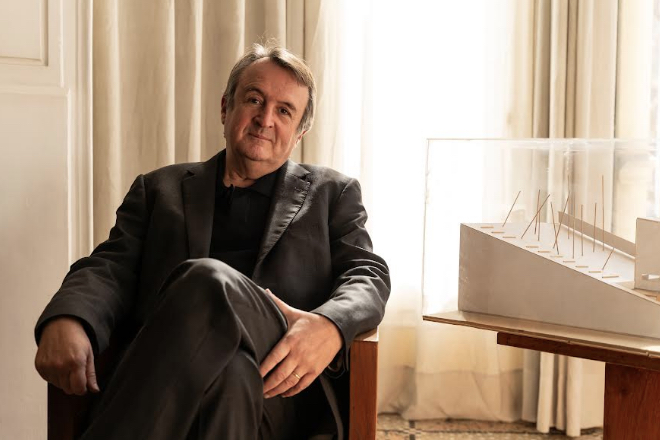
This text is part of a series of publications curated by Octavi Mestre under the title Other Architectures for Construnews, marking the launch of the publication’s English edition. This piece is by the curator himself: Octavi Mestre, architect, head of Mestre Arquitectos and co-director, with Xavier Alba, of the digital architecture magazine t18. The text was originally written for RACO Panorama de Tendències nº 3 and was translated into English and reworked by the author.
That Olympic legacy
Barcelona, as a city, has progressed through events… From the 1888 and 1929 exhibitions, which marked the celebrations of Modernisme and Noucentisme and left us, respectively, the interventions in the Parc de la Ciutadella and the redevelopment of Montjuïc mountain, to the 1992 Olympic Games and their comprehensive intervention across the whole city…
From that period, the late eighties… the idea of moving “from Plan to Project” made it possible to streamline procedures, because urban development plans require initial approval, periods of public consultation and provisional approval before reaching final approval… and that takes time (precisely what we did not have before the Games). In other words, a whole series of projects were validated as if they were a kind of Royal Decree-Law that did not need to go through Congress, thus shortening the timelines.
Then came the policy of creating new squares and parks: Plaça de Sants (also known as Plaça dels Països Catalans), which sparked the debate about hard squares; the parks of Espanya Industrial, Parc del Clot, Parc de la Pegaso, La Sagrera and Parc del Nord; the various squares in the Gràcia district; and the renovation of Plaça Reial, where Oriol Bohigas, the mastermind and driving force behind this new Barcelona, went to live, just as many architects in 1950s Spain ended up living in the housing estates (the Poblados Dirigidos) they themselves had designed, as a sign of commitment.
But the greatest legacy, beyond the facilities and countless trendy bars, was the four Olympic Areas (Olympic Village, Montjuïc, Vall d’Hebron and the University Area), strategically located so far apart that we ended up needing the ring roads to connect them: more than 40 km encircling the city, a prime example of urban integration (in my opinion, one of the best legacies of the 1992 Olympics). Back in the 1980s, the City Council explained it as a comb giving access to every neighbourhood, rather than a knife slicing through the city and dividing it into an inside and an outside. Because that is what it was. These are some of the results of those areas:
…all the residential projects in the Olympic Village (some magnificent, like those by Esteve Bonell and Quico Rius, Elías Torres and Martínez Lapeña, or the Viaplana and Piñón housing complex)…
…the renovation of the Olympic stadium and the entire complex of facilities: the Palau Sant Jordi, the Picornell swimming pools, and Santiago Calatrava’s communications tower, which was awarded to him because the important one, the Tibidabo tower, had been commissioned to Norman Foster…
…the Carles Ferrater housing complex, the Eduard Bru urban development, the Garcés and Sòria pelota pavilion, or the (double) archery facilities by Miralles-Pinós in Vall d’Hebron… and, in the university area, the rest of the facilities, including the Rey Juan Carlos Hotel and the Congress Palace, also designed by Ferrater…
One thing Barcelona did well (among many) was to involve other Catalan towns as sub-venues for different events (hockey in Terrassa, canoeing in Castelldefels, whitewater rafting in the Pyrenees), thus spreading the Olympic momentum throughout the country.
The various frameworks of professional practice: from yesterday to today… an exercise in foresight
Legal framework
In Barcelona, we have a triple legal framework: local, regional and national. And there are guidelines from Europe that also affect us. They are not always more restrictive than the others, so one must apply them all… But, given the current state of the law and its interpretation, this creates a certain legal uncertainty. Besides the fact that legal texts are cumbersome and refer to other articles, for those of us who are not well-versed in them it is difficult to navigate such turbulent waters. And just when you have learned them, they have already changed… There are rules, regulations, provisions and internal criteria that you often do not even know about…
You believe, however, that the only important thing is that the city we leave behind, the buildings we construct, are better than what came before; but that clashes with the practices of certain people who, with a constant “no” on their lips, believe they are doing their job better. A good friend of mine, a municipal architect, once told me that “by saying no, you can never go wrong”. It is true that many cases end up in court these days (another consequence of the saying “when America catches a cold, Europe sneezes”), and that civil servants, the architects employed in the Administration, fear being accused of collusion; but that is not the point. Excessive regulation is bad for everyone. Including them.
But the truth is, it is not normal that we spend far more time processing permits than carrying out the project and the construction work (that is the first complaint from architects at every meeting we attend). And this sometimes reaches inexplicable extremes… to the point where we get tired but, above all, to the point where clients get tired and, in many cases, decide to abandon projects once they have obtained the permit, because the initial conditions have changed over the years… an unforeseen illness, a personal change, prices rising because one country decides to invade another and shipping containers from China have tripled in price… You might ask, “What does that have to do with us?” But of course it does… to the point that projects that were supposed to start never do, and all the work done has been for nothing… It has happened to all of us more than once… Some compare our era to the decline of classical Greece… And there are certainly parallels with the Hellenistic period and its Byzantine debates… Which leads to a paralysis that is difficult to explain.
When I finished my degree, back in ’85, a 10-page report, a preliminary budget broken down by chapter and 10 drawings were enough to get a permit… Today, the latest Technical Suitability Report (IIT, Informe de Idoneidad Técnica) for the renovation of a Modernista building in Barcelona was 1,440 pages long… and Barcelona sets the standard for the rest of the city councils in Catalonia. In other municipalities, after asking us for hundreds of documents, they have ended up telling me to bring them a drawing with red and yellow lines (as those of us in the sector know, new construction in red and demolition in yellow) and, if possible, on paper so they could take measurements, because it is difficult for them to do so with the PDFs sent electronically. Honestly, I do not think we have improved at all. You are always afraid of breaking some rule and, as a good friend of mine, a building surveyor, says, “we are all on probation”. I think about young people who have known nothing else. They struggle too, only they think there are no other ways of doing things. But those of us of a certain age are here to remember… It is the dilemma of whether it is better to be blind from birth or to become blind over the course of your life… I see it clearly.
When I finished my degree in 1985, a 10-page report, a budget and 10 drawings got you a permit. Today, a Technical Suitability Report ran to 1,440 pages
Economic context
“A mi trabajo acudo, con mi dinero pago” (“I go to my work, I pay with my own money”), wrote Antonio Machado…
The Colleges of Architects were the envy of our European colleagues… an organisation that protected you because, before, all permits had to go through the College… But with the abolition of minimum fees (it is now even illegal to suggest reference fees; there are court rulings on the matter)… within the free market, everyone can offer services at whatever price they want (or whatever the market allows). Because there are more and more of us and, when it comes to an open bar, some (clients, I mean) drink more than they should. Fees are fixed by contract, but all the extra work you cannot even imagine before starting is not. And they ask you for much more work for less money. And we architects tend to give in, because, above all else, it is our work… Our work? That is how we were raised. I have always said that, in terms of VAT, architects are not the tax but the added value… because without architects, you are left without architecture…
And so those who legislate do not do their jobs… and when they do, they break the rules they impose, because they recognise that with them you cannot work… The result? The precariousness of the profession… We work more and more, and projects leave less and less economic margin, because if they ask for many more things (useless, most of the time), you inevitably reduce your profit margin… Spending time on paperwork shapes the brain… and, inevitably, one must nourish oneself with other things, so as not to lose an active, curious attitude towards life (curiosity and work are the beginning of everything).
Demographic context: women entering the labour market
I remember when we were students in the 1970s and 1980s, classes were almost exclusively male, while today more than half of the students are women… often the best… a percentage that, in master’s and postgraduate programmes, among international students, can reach around 90%. Is it because men start working earlier? Is it because women are more restless? More curious? … I will not go into an analysis… the fact is, it is true…
Technological framework
Those of us who studied in the 1970s and 1980s drew with technical pens… In the 1990s, the crisis that followed the Olympics gave offices the opportunity to computerise… CAD should have been the panacea, but since then the rules of the game have changed every 20 years… because then came BIM (essential if you want to work for government agencies)… and now, with Artificial Intelligence (AI, or IA, depending on whether you pronounce the acronym in English or Spanish), a true revolution is coming…
Friends dictate prompts and the program does the measurements for them; clients send you 3D models they want improved, which took them two minutes to generate… How are they going to value our work? And I think: what is left for us? But at an age when you have witnessed so many changes while the essence of architecture remains, you already know that all this will only bring more work (because we will be asked to do more) and more difficulty for young architects who, in addition to being expected to be good architects, are also required to master languages and every technology imaginable. It is the what and the how… And it is bad when the how ends up overshadowing the what.
At my grandparents’ house, they had a pantry that opened onto an interior courtyard for storing food, and a coal-fired stove… but in the 1960s, after the post-war boom, it seemed that household appliances were going to solve all our domestic chores and give housewives (today there are also husbands, but back then it was mainly housewives) time to cultivate themselves, read, listen to music and go to the cinema. It will surprise no one that today’s reality is far from what was promised.
Educational framework: the teaching of architecture
We have been educated by comparison (“look at what Le Corbusier did, look at Mies van der Rohe, or that detail by Alvar Aalto…”). We have been educated to be “a big fish in a small pond rather than a small fish in a big pond”… and natural talent, being able to draw well, has been valued… While this has produced a remarkable level of Catalan architecture (in France, where I have worked for years, being a Catalan architect is valued the way being Brazilian is for a footballer: you are automatically considered good, like a soldier’s supposed bravery), it also makes some egos multiply, because work stops being a service to others and becomes a projection of ourselves… So there are some colleagues who, when you hear them speak, sound as if they had invented garlic soup or killed the Dead Sea. You are educated to be a dinosaur hunter when dinosaurs are long extinct… to design… and today 80% of graduates will have to choose other paths. Other career opportunities… which many will see as an undervaluation of their abilities, often leading to a high degree of frustration. But it is true that the general education we receive, among the best in the world, prepares us for many other things, including being managers and conductors of a wide variety of orchestras.
In the USA, where I taught at several universities in the 1990s, I realised the loss of power that was coming our way… because there, 90% of buildings were constructed without an architect… and none of my students ever imagined they would one day work as architects.
Los Monchos (Cruz and Ortiz) once came to explain a social housing competition they had won in the Netherlands, as part of a conference organised at Barcelona’s Mies van der Rohe Pavilion… The floor plans had already been defined by the public developer, the interior design of the apartments was not part of the commission, the building volume was determined by regulations, and other local specialists had been hired for the landscaping. So they said their intervention was limited to the 30 cm of the façades and, when asked, they did not know whether they had built 15,000 m² or just that ribbon, the envelope with which buildings present themselves to the public. How the circumstances of the commission have changed since they built their housing on María Colón Street in Seville! … Perhaps, if that is the future that awaits us all, the best architect would be our friend Xavier Ferrés, a façade consultant. The architect, as the person ultimately responsible for the entire process, is losing ground to Project Management.
The architect, as the person ultimately responsible for the entire process, is losing ground to Project Management
Social context (1): gentrification
Barcelona, like Venice and some other cities around the world, has a problem with tourism… Tourism is a source of wealth, but we can also be victims of our own success. The boom in tourist apartments means that those who own properties to rent prefer to let them by the room or by the season to tourists rather than to local families who can pay much less (especially with current salaries)… And that ends up driving their children, those born in the city, out of town. In fact, on the terraces of cafés and bars in certain neighbourhoods you no longer hear Catalan… you do not hear Spanish at all… And that ends up distorting things. Some say the market regulates itself… that if everyone wants to build hotels and there is oversupply, many will end up closing or being converted, and that is true. But that is the job of the administration… to give it a push to make it happen. And that ties in with today’s big problem: the lack of housing.
Social context (2): the housing problem
Because we were in a hurry, in the 1980s we decided that the land designated 22 (industrial), with the addition of an @ symbol, would be transformed into non-polluting industries and offices, but never housing… and that is the problem with the 22@ designation… Because now that @ symbol is a burden, preventing residential development. And that is the goal of the current Catalan Government: to build 50,000 homes in 4 years, an objective that seems as ambitious as it is unfeasible… because that number can only be achieved by industrialising processes and using prefabrication… and we lack the technology and skilled labour to build them. The senior architects’ group Senyor-a, chaired by Jaume Carner, has held a very interesting series of lectures called A Room with a View, offering possible solutions and inviting all stakeholders in the sector to take part: architects, urban planners, developers, government agencies of all kinds, etc.
The previous “Comuns” government implemented one of its flagship measures: allocating 30% to social housing in every housing project. The result, in eight years, was barely fifty apartments, demonstrating the opposite of the intended effect… because developers stopped building homes as soon as the numbers did not add up. To correct this, in the 22@ district, on top of the 2.2 m² of floor area per m² of land, an additional square metre is permitted for social housing. Just one anecdote: a client of our firm, seeing that the sector is already saturated with co-working spaces, proposed building only housing, and the municipal response was negative, arguing that it would pervert the spirit of the 22@ district (despite the housing shortage!). The regulations have tied our hands.
The 30% social housing quota produced barely fifty apartments in eight years, because developers stopped building when the numbers did not add up
Large tracts of land are located outside urban centres, so the housing problem is intrinsically linked to another key issue: transport and traffic flow… How can you build 500, 1,000 or 2,000 homes, entire neighbourhoods, if they are not connected to urban centres? Who was the genius who thought it was a good idea to put the Camp de Tarragona station where it was built? We are now working on a project of 300 co-living units in two 20-storey towers in the Vallès… because it seems less costly to convert offices into co-living spaces (community facilities) than into residential use. I wonder whether, in an emergency, a doctor who offers to treat a patient having a heart attack is asked to show their degree and certifications before acting. With the land beyond the Olympic Village ruled out, we are left with La Marina del Prat Vermell as a large land reserve where we can act (in fact, action is already being taken)… And, of course, the towns of the former Metropolitan Area.
Social context (3): the concentration of work in a few large firms
There is a Europe of oil (which coincides with the Mediterranean countries) and another of butter… Catalonia produces excellent architecture and good professionals, but they do not know (or we do not know) how to collaborate with each other. This makes it very difficult to compete abroad (I do not like the word, but that is how we all understand each other), where large British and American corporations with more than 1,000 employees end up dominating the market. Similarly, local clients, especially investment groups, have more confidence in large firms… and so some firms have grown exponentially. Even so, small studios with high-quality architectural work are still common. Likewise, Catalonia has a network of small manufacturers that still allows us to innovate. Furniture and lamp manufacturers call it “editing”… you go with your prototype and they can produce it for you… that, and nothing else, is what makes our design so highly regarded in the world (just look at the new DHUB store that we run from the Jordi Capell Cooperative, under the direction of Marc Longaron, to see how rich our commitment to “local design” is).
Environmental framework
There is no Planet B. Sustainability is (and should be) not the driving force behind our actions, but certainly one of them… It is not a trend; it is something much more serious… Deaths from heatwaves can be quantified… scientists talk about the melting of the polar ice caps (what else would the man with the carrot-blond hair want Greenland for?), about how two more degrees and there will be no turning back, about how little progress has been made since Paris and the Rio summit, and how little will be made if major polluting countries, such as China and the United States, do not get their act together. But the greenwashing practised by many companies also occurs among architecture firms that label their traditional architecture as sustainable, with hardly any evident change, when the obvious thing is that a building is more sustainable the more hours it is used and the easier it is to change its use, without excessive additional cost. Today concrete is demonised and wood is praised… a few years ago, consuming wood meant deforesting the world… the same happened with the debate about whether diesel was more polluting than petrol. Today we talk about wood from controlled logging… But I maintain that there are no good or bad materials, only materials used well or poorly, appropriately or not, and that is where architects must play an essential role.
There are no good or bad materials, only materials used well or poorly, and that is where architects must play an essential role
Glocal framework
I once read that economists were people who “spent six months predicting what would happen next year and another six explaining why it didn’t”. And that their job was not to make the economy work (which I suspect they also do) but to invent names (naming) that would encourage the system to function… Of course, I could say similar things about our profession. Or do you really think that preferred mortgages would have been so successful if they had been called “mortgages for the dispossessed” or “junk mortgages”, as they later became known? … Everyone wanted a preferred mortgage, and look where it got us. The 2007 crisis with the collapse of Goldman Sachs was extremely hard on the sector… Because the problem is not when prices rise, but when prices plummet, when deflation hits. Why did banks grant so many loans to people they knew, beforehand, would not be able to repay them? This comes to mind because the local blends with the global, producing the glocal… In the global village McLuhan predicted, everything is connected. Orwell’s Big Brother is more present today than ever.
And speaking of connections… You make an online request and they send you a “satisfaction survey” (supposedly to improve customer service). As if to improve the service, the virtual operator’s recorded voice tells you that “this conversation may be recorded”… and minutes pass before someone helps you, while you accept the privacy policy… Privacy has never been so important, and we have never been more exposed. These mechanisms are used by government agencies. It seems that if you do not communicate what you do, you are dead, you are not doing anything. But if a YouTuber (or influencer) is more successful than a thinker or a philosopher, the world is not going in the right direction (those short, disjointed texts made up of loose phrases meant to be impactful can only produce lazy brains that cannot read a page straight through).
Have you noticed that on social media even the most clueless person is a content creator? … How many new philosophers have emerged, sending us their daily dose of reflection (one can only imagine who writes them). With many businesses, you no longer know what they are selling, but they bombard you with profound reflections they assume will open doors for them… I suppose their business must still be to sell us something. Sometimes I think that if we each devoted all that time to doing our jobs better, things would be very different.
City models
Trends: street calming
The American city forces you to take the car to go anywhere (Los Angeles and Miami are prime examples). In contrast, the Mediterranean city makes mixité, as the French call it, its hallmark… a mix of uses and of people. It is the 15-minute city championed by the Spanish-born mayor of Paris, Ana Hidalgo. Limiting car use seems fundamental, limiting speed… to the point that one sometimes thinks that rather than regulating traffic the aim is to eliminate it, like the man who “ended poverty… by killing the poor”.
I used to think that the traffic removed from Consell de Cent street was multiplied on València street, but it seems studies say no, that traffic has been reduced (many of us have got rid of our cars or, if we have them, never use them). And it is clear that at 30 km/h the city is more humane: the historic city was not designed for cars. Salvador Rueda, as the ideologue, and the magnificent projects by Cierto Estudio are proof of this… The Superblocks and the pedestrianisation of various streets were the flagship project of the previous municipal government. It is certainly curious to learn that the original idea came from Mayor Trias’s office, who, once removed from power due to accusations that proved false, became the idea’s staunchest opponent after the others appropriated the project. That is often how it goes in politics.
Major facilities
If Barcelona has ever been anything, it is a city of culture, of museums… After the MNAC, the MACBA, the DHUB and the historic Miró and Tàpies Foundation museums, it now wants to add the Thyssen Museum, in its chosen location on Passeig de Gràcia – Gran Via. Its design has met with considerable controversy, both for its formal appearance and because a significant portion of the space is intended for commercial activities, despite the former theatre being designated for public use. We will see how this story unfolds. Barcelona does not want to miss any more opportunities like the Hermitage Museum, which was supposed to be built at the mouth of the port. The MNAC also has a significant expansion planned, along with new projects to revitalise the mountain and make it more accessible to the public.
Two of the flagship projects will be located in opposite corners of the city: the three chimneys will house the future Catalunya Media City, a project by Garcés, de Seta and Bonet with Marvel Architects, and the Nou Clínic complex, planned for the other side of the city, straddling Barcelona, L’Hospitalet and Esplugues, will become a true health sciences centre, the result of an international competition. In that part of the city, at the entrance from the Diagonal, high-rise residential buildings by BiR and GCA will become landmarks in the urban landscape, welcoming visitors.
And we must not forget the incredible story of the new Camp Nou and the completion of the Sagrada Família (especially in the centenary year of Antoni Gaudí’s death), two of the city’s major projects, which have generated countless articles, with all kinds of admirers and detractors…
A matter of names
When asked to list trends, where we are headed, one is tempted to present a whole series of names, an alphabetical list without any commentary… But the public likes to be placed… like a taxidermist classifying butterflies (of course, butterflies do not seem to like being classified so much).
The public likes labels… So does the historian, who talks about cycles… And so they cite the Modernista Barcelona of ’88, the Noucentista Barcelona of ’29 (in which Mies van der Rohe’s Pavilion was like an alien fallen from the sky), Olympic Barcelona… That is how we began this article. In fact, some of the architects who led that urban transformation, which put Barcelona back on the map, are still active… Above all, those who have managed to combine their experience with fresh new blood: Carles Ferrater with his children Borja and Lucía and his son-in-law at OAB; Jaume Bach with Eugeni and Anna, his wife; Ramon Sanabria with Lidia Planas; or Jordi Garcés with Daria de Seta and Bonet, to name just a few… And so many others, many of whom are now in the AxA association (Architects for Architecture)… Esteve Bonell (who won the Mies van der Rohe Award for the Joventut de Badalona stadium), Ramon Valls, Fran Fernández and José Mª Gutiérrez, among others. To that generation of “our fathers”, who were our teachers, belong Enric Sòria, Joan Pascual (who works in tandem with Ramon Ausió) and Pepe Llinàs, who still strikes me as an essential architect and who recently won Spain’s National Architecture Prize. A disciple of Coderch (a reference for all of us), his housing on Carrer del Carme, the Institute of Ophthalmology and his Jaume Fuster Library on Lesseps (in the Gràcia district) are just some of his most outstanding works.
Perhaps the large firms have understood, better than others, where our world is headed, flexing their muscles with major commissions and creating significant pieces in the contemporary city (from the numerous office buildings in the 22@ district by BiR or BCA to interventions like La Sagrera by the team of Fermín Vázquez and Anna Bassats of B720). They all go by corporate acronyms, but behind them are faces, architects, friends… BiR (Batlle i Roig), BCA (Blanch & Conca), GCA (founded by Josep Juapere and Antoni Puig), L35 (with Luisa Badia and Tristán López-Chicheri at the helm), B720, MBM (Oriol Capdevila), A&B (Sergi Balaguer), TAC (Eduard Gascón)… as is also the case with engineering firms that employ many architects (notably JG, PGI, BIS or DOPEC, among others). Opposite them are those who treat architecture as an almost artisanal profession, like Flores & Prats and their advocacy of hand drawing. The other day, a colleague from my generation, with a firm of about thirty collaborators, told me he did not know whether to expand or shed some baggage (we are all getting on in years) and keep a smaller structure… because he could not compete with the big firms in certain areas and, besides, the structure was eating up his profit margins.
There are architects who, while based here, work almost more abroad than here, such as Josep Lluís Mateo (at one time) and today Benedetta Tagliabue across the globe (France, Italy and China), Carme Pinós (Mexico, Australia), Josep Miàs (who combines professional practice with teaching and research at the AA in London), Archikubik (in France), Barozzi Veiga (throughout Europe, from Switzerland to Poland), Ricardo Bofill’s Taller de Arquitectura, now led by his children (with projects in the Maghreb and Asia)… or Mesura (who combine local interventions, such as their house in Elche or their houses in the Empordà, with their museums in Saudi Arabia)… And, it must be said, all of them also have noteworthy work here. There are those of us from here who go abroad, just as there are many architects from abroad who work here (from Herzog & de Meuron to Jean Nouvel, from Souto de Moura to Siza, from Chipperfield to Zaha Hadid), people who have even opened offices in Barcelona, like BIG (Bjarke Ingels, who was a student of the late Enric Miralles) or the Belgian Patrick Genard who, coming from Bofill’s studio, ended up setting up his own office in this city, his home.
There are those who make a specific area of expertise their work (hospital design, perhaps the best-known branch, due to its specificity, with Manel Brullet, Albert de Pineda and Alfonso de Luna, Ramon Sanabria, Mario Corea, PMMT, CASA SOLO (Francesc and Roger Pernas and Bernat Gato) or Miquel Espinet, among others) or auditorium design, with Fabré & Dilmé, who worked on the reconstruction of the Liceu opera house alongside Ignasi de Solà-Morales and the acoustician Higini Arau… And then there are more generalist architects, like internists or broad-spectrum medicines.
Then there are those of our generation, a lost generation, whose constant complaint is that our elders did not give us space (of course, space must be earned). There are BAAS at the forefront (all their work is fantastic); R+B (Roldán + Berengué), whose College of Economists building on Plaça Gal·la Placídia seems to me one of the best buildings in modern Barcelona; Pich i Associats; Forgas Arquitectes (winners of a good number of competitions); Jorge Mañas (who combines design with management); Bailo and Rull, Baena and Casamor, now each with their own office; Juli Capella (who shares an office with Miquel García); BCA (authors of the renovations of the old El Corte Inglés on Francesc Macià and of the old Telefónica headquarters on Avinguda de Roma); Enric Massip (with his Telefónica Tower at the end of the Diagonal) and so many others… I do not talk about our own work, because “I haven’t come here to talk about my book”.
In January we held a moving tribute at the COAC (Architects’ Association of Catalonia) to Manel Gausa, who passed away suddenly last summer. Besides being a great architect, he was an inventor of worlds, because he invented words and concepts to define them. A classmate at the ESARQ (School of Architecture) of the UIC (International University of Catalonia), co-founder of the AJAC (Association of Young Architects of Catalonia) and the IAAC (Institute for Advanced Architecture of Catalonia); photos from those times when we were so young, almost immortal, have recently been circulating on social media. One of them includes the members of ACTAR Arquitectura: Manuel Gausa, Oleguer Gelpi, Ignasi Pérez Arnal, Florence Raveau, Aureli Santos, ADP Arquitectes i Ass., Manuel Bailo-Rosa Rull, Urban Area (Núria Llaverías-Mònica Farràn), Félix Arranz, BCQ Arquitectes (David Baena, Toni Casamor, Josep Maria Quera), Cloud 9 (Enric Ruiz-Geli), Xavier Costa, Albert Daniel-Albert Ibáñez, Rafael Díez, Eker & Schaap Landschaapsarchitectuur, Alberto Estévez, Toni Gironès, Vicente Guallart, Enric Massip, Pich-Aguilera Arqs (Felipe Pich-Aguilera and Teresa Batlle), Maurici Pla, R+B (José Miguel Roldán-Mercè Berengué), Vicente Sarrablo, TECNOS (Eva Jiménez-Xavier Llobet), Jaume Valor, Willy Müller + THB Consulting… generations have always been a unifying element. It is interesting to follow each of them and see what has become of them all 30 years later. In 1996, Barcelona was the World Capital of Architecture for the first time, and Manel Gausa, who passed away far too soon, attempted to predict a panorama of architectural families in an article in Quaderns entitled The State of the Question.1 Thirty years later, we can certainly speak of a guaranteed generational shift.
There are those who belong to the Barcelona School and those of the Vallès School, each with their own voice and characteristics (perhaps the latter more experimental, with HArquitectes and DATAAE as major examples). We always talk about Barcelona, but in Olot we have our own Pritzker Prize winners, RCR, as well as Un Parell d’Arquitectes or Xevi Bayona, with his always thought-provoking installations… And the same is true elsewhere… In Girona, for example, we have several generations, from Arcadi Pla and Fuses-Viader to younger architects like Josep Bosch and Beth Capdeferro. Because Architecture is produced in many places.
There are those who share teaching and the drawing board (there are many of us)… and those who have sought their own professional paths in other fields… In photography (Duccio Malagamba or Adrià Goula), in administration (it is essential to have good architects in all decision-making areas; it is a shame there are not more in politics), in management… There are those dedicated to communication (Gaia Pellegrini at L35, Miriam Giordano at Laboh, Miguel Ángel Aguiló at Slowkind)… There are those dedicated to publishing (Félix Arranz and his SCALAE newsletters, which he defines as “cultural activism”, and it is; Ethel Barahona with her motto “books are louder than bombs”; Jordi Badia with his blog HIC; or our magazine, t18,2 which the Brooklyn Rail Track in NYC included years ago among the best digital architecture magazines of the 21st century).
Young, but equally brilliant, are bxd (Francesc Buixeda), as precise as they are elegant; Carles Enrich, with delightful interventions in historical contexts (the Torre de Merola, for example, is fantastic); Meritxell Inaraja; Josep Farrando (also with magnificent work built between Catalonia and Latin America); Twobo; Circular Studio (Fernando Ansorena and Ivan Serano), authors of the brand-new LCI headquarters in the 22@ district; CC245 (Sergi Blanch and Sandra Rodà); Elástiko (with their co-working spaces); Isern i Associats, with magnificent hotels; the members of Cierto Estudio and their urban interventions; MIM-A (Mariona Benedito and Martí Sanz); MAIO (Anna Puigjaner, Maria Charneco, Alfredo Lérida and Guillermo López) and their interventions in Eixample buildings, understood as matrices; Arquitectura G (Jonathan Arnabat, Jordi Ayala-Bril, Aitor Fuentes and Igor Urdampilleta); Arquitecturia (Josep Camps and Olga Felip); Lagula (Toni Alonso, Martín Ezquerro, Ignacio López, Manel Morante and Marc Zaballa); Jaume Prous; and the team of Juan Trias de Bes and Marta Pascual (with magnificent heritage restorations, such as Casa Burés). We selected single-family homes by several of them for issue t18 of the magazine, which we titled Proximity Dwellings.
And then there are interior designers who, in many cases, outshine us in interior design and materials, such as the ever-elegant Francesc Rifé, Isabel López Vilalta, Vilablanch, Denise & von Arendt, Ignasi Bonjoch, Tomás López Amat, Adela Cabré, El Equipo Creativo (with its many and varied restaurants), The Room Studio and so many others… And, to change scale, those who make the landscape their battleground… not only the aforementioned Cierto Estudio, but also Batlle i Roig, pioneers since the 1980s, Imma Jansana, Conchita de la Villa, Michèle & Miquel (how poetic The Dark Line in Sandiaoling, Taiwan, is!), or the TER agency, which, together with landscape architect Ana Coello, designed Plaça de les Glòries, the true nerve centre of the new Barcelona.
The “new realists”
Since people like to talk about generations these days, in the wake of the economic and energy crisis a group emerged to which the DHUB devoted an exhibition entitled The New Realists (among whom there are good ones and better ones). Produced by Disseny Hub Barcelona and curated by Carme Ribas and Joan Roig, the exhibition focused on some thirty Catalan and Balearic architects who, “aware of the social and professional shift brought about by the 2008 crisis, have questioned the parameters within which they had worked until then. A commitment to sustainability, new models of energy and resource management, co-production, and the use of natural and artisanal materials characterise the work of this new generation of architects. Their approach has strengthened as the climate emergency has become more evident; these new realists challenge the parameters that had previously prevailed. Concepts such as sustainability and environmental impact are fundamental to understanding the working methods of this new generation. Their projects incorporate new models of energy and resource management. Regarding materials, natural elements such as stone, wood and ceramics reappear, presented without coatings or superimposed treatments, and almost artisanal materials are revived. It redefines the relationship with the user, who takes on a more central role, almost generating a co-production. All of this defines a proposal that strengthens as the climate emergency becomes more evident” (I quote from the catalogue). Among these new realists are names such as HArquitectes, TEd’A, La Col, Bosch-Capdeferro, Peris+Toral, Albert Faus, Un Parell d’Arquitectes, Josep Bunyesc, Cíclica, Martí Franch, Aulets, Carles Oliver, DATAAE, Carles Enrich, Nua, Arquitectura G, Flexo, Comas-Pont, David Sebastián, Gerard Puig, Àgora, Cierto Estudio, MAIO, Núria Salvadó, Aixopluc, Arnau Estudi d’Arquitectura, Societat Orgànica, Architectural Agonism, Casa OE, 08014 estudi, Dawoffice, Michèle & Miquel and Vora. What they all have in common is that they studied in Barcelona and the Vallès, even though they later developed their work throughout Catalonia and the Balearic Islands.
They all champion arte povera and exposed materials as a metaphor for honesty… However, those of us who have had the opportunity to build extensively throughout our careers do not quite believe that leaving the installations visible is cheaper than plastering and installing a false ceiling. Are they fashionable and therefore destined to go out of fashion? … Is it a style? … Does it reflect the Zeitgeist, the spirit of our time? I do not know… But we must acknowledge their collective response and the fact that they have carved out a niche for themselves, always difficult in this highly competitive world (today, being an architect is much harder than when my generation started out). Except for fully established firms like P+T or HArquitectes (both magnificent), they will have to contend with larger-scale projects (because “size matters”, even though one can be a great architect with smaller works)… It is worth highlighting the importance of the Administration for all of them, especially the initiatives of IBAVI (the Balearic Housing Institute), which has promoted a whole series of exemplary programmes… I maintain that the collective approach, without a convincing formal result, would not succeed, because architecture involves not only the “what” but also the “how” (as we have already said). And fame is like a shadow (I once wrote): sometimes it is ahead of us, sometimes behind us; sometimes it is longer than we are… other times it is shorter. Time will tell.
Peris+Toral (P+T) have won every possible award with their housing in Cornellà (a project where the dwellings are conceived from an undifferentiated matrix, based on the modulation of Japanese tatami mats, allowing each user to create their own home within the home), while HArquitectes and their headquarters for the Prodis Foundation, in the Vapor Cortés building (Terrassa), is a finalist this year for the Mies van der Rohe Award (four Catalan works were among the 40 selected across Europe, along with the Green House, also by P+T, Casa 10K by TAKK and the intervention in the Plaça Major of Olot by Un Parell d’Arquitectes), which speaks to the health of our architecture.
There are many names, yes… And there are all those I have left out and could list (let no one see ill intent in this, but rather space constraints)… or the writer’s bad memory.
Four Catalan works were among the 40 selected across Europe for the Mies van der Rohe Award, which speaks to the health of our architecture
Catalan architecture is possibly one of the most vibrant and attractive examples of architecture being developed in Europe, that is, in the world. Its future and continuity are guaranteed. Barcelona’s architecture moves from Modernista architecture to the modernity of Jean Nouvel and B720.
Notes
1 In 1995, the journal Quaderns of the Col·legi d’Arquitectes de Catalunya (Architects’ Association of Catalonia), under the direction of Manuel Gausa, published a triptych (issues 207-208-209) on 50 years of Catalan architecture (1944-1994). This analysis aims to be an update, 30 years later.
2 Together with Xavier Alba, I direct the digital architecture magazine t18, which the Brooklyn Rail Track of NYC considers one of the best digital architecture magazines of the 21st century. Since then, we have reached 34,000 entries per issue and have subscribers in 110 countries.