

The 31st United Nations Climate Change Conference (COP31) is being held from 9 to 20 November 2026 in Antalya (Türkiye), with the built environment more present than ever on the official agenda: a dedicated thematic day, a pavilion for cities, buildings and cooling, a second ministerial meeting on buildings and climate, and a proposed global compact with 2035 targets. The International Union of Architects (UIA) is taking part with a delegation headed by its President.
Construnews reviews what is at stake in Antalya for architecture, engineering, construction and building operations (AECO) and compares it with what COP30 in Belém delivered a year ago.
The UIA, in five sessions on resilient cities and low-carbon construction
The UIA delegation is headed by Zhang Li (UIA President) and includes Iman Gawad and Ayşen Ciravoğlu (UIA Council Members). According to the organisation, its participation focuses on the role of architecture in climate action, around three themes: resilient cities, low-carbon construction and sustainable housing.
The programme published by the UIA includes five sessions:
- 9 November. Energy Access and a Just Energy Transition in the Built Environment of African Cities, organised by UN-Habitat with İLBANK, the Global Alliance for Buildings and Construction (GlobalABC) and the Cool Coalition, at the Resilient Cities, Buildings and Cooling Pavilion (C505) in the Blue Zone. Iman Gawad takes part.
- 11 November. Climate-Resilient Cities: Energy, Waste and City Design, at the Association for Renewable Energy and Clean Technology Pavilion (C510). Iman Gawad represents the UIA (session page).
- 13 November. Resilience in the Balance: Navigating Tensions and Trade-offs Across the Built Environment, a talk by Saint-Gobain’s Sustainable Construction Observatory in Belek, with Gawad and Ciravoğlu.
- 14 November. Architecture and resilient cities, a panel by the Brazilian Network of Resilient Cities on architecture’s contribution to urban resilience.
- 16 November. Low-Carbon Construction and Sustainable Housing Value Chains, again at Pavilion C505.
The UIA, whose network spans 124 countries and territories, also highlights its two tools for integrating the Sustainable Development Goals into professional practice: the SDG Toolkit and SDG Panorama.
A dedicated pavilion and a day for the built environment
The sector’s meeting point is the Resilient Cities, Buildings and Cooling Pavilion, open from 9 to 18 November in the Blue Zone and co-hosted by the UN Environment Programme (UNEP) Cool Coalition, GlobalABC, UN-Habitat and İLBANK. All sessions are livestreamed on the pavilion’s YouTube channel. According to the German-backed initiative PEEB, which supports it, this is the fifth COP in a row with a pavilion dedicated to buildings.
The programme covers the whole life cycle: electrification and heat pumps, financing retrofits, passive design for cooler cities, circular construction, retrofitting for resilience, artificial intelligence and efficiency, whole-life carbon, decarbonising materials, buildings as a carbon reservoir and national roadmaps for buildings and construction.
The Turkish Presidency’s official calendar sets aside Thursday 12 November for the thematic day Resilient Cities and Built Environment, and the COP31 Action Agenda includes among its six Global Implementation Targets one dedicated to Climate-Resilient Cities and Buildings, alongside another on electrification.
For the first time, a COP Presidency is proposing numerical 2035 targets for building efficiency and electrification
The Antalya Compact: quantified targets for 2035
The main novelty for the sector is the Antalya Compact for Energy Efficient Buildings, prepared by the COP31 Presidency with support from the UNEP-hosted GlobalABC Secretariat. The text, open to endorsement by all Parties and stakeholders, sets two goals for 2035:
- Cut the in-use energy intensity of the building stock by at least 25% relative to 2020.
- Accelerate efficient electrification of buildings to support the Presidency’s goal of electricity reaching 35% of global final energy consumption by 2035 (35 by 35).
The compact is built around six areas: putting efficiency and electrification at the heart of national strategies; buildings with high energy and carbon performance; accelerating renovation of existing buildings; reducing demand and shifting heating, cooling, cooking and appliances to electricity; improving real building performance; and mobilising finance, markets and implementation capacity. The COP31 President and Türkiye’s Minister of Environment, Urbanisation and Climate Change, Murat Kurum (COP31 President), has said buildings “are at the heart of our cities and of the energy transition”.
Countries can endorse it at the Second Ministerial Meeting on Buildings and Climate, convened on 12 November by the Intergovernmental Council for Buildings and Climate (ICBC), co-chaired by France, Brazil and Kenya, with UNEP and the International Energy Agency. The number of endorsements has not yet been published.
The broader framework is the COP31 35-by-35 Global Electrification Pledge, a voluntary commitment launched by Türkiye that mentions buildings in its preamble as one of the end uses to electrify, alongside transport and industry, although its commitments contain no sector-specific measures.
From Belém to Antalya: what has changed in a year
At COP30 in Belém (10-21 November 2025), the ICBC held its first ministerial meeting and launched the Belém Call for Action for Sustainable and Affordable Housing, focused on housing. Its commitments were mainly directional: integrate climate action into affordable housing policies by 2030, work towards a finance alliance to close a US$1.1 trillion annual investment gap and, by 2035, align national housing policies with the Déclaration de Chaillot and avoid building in climate-risk areas without protective measures, in a world where 1.12 billion people live in vulnerable settlements. “We are moving from pledges to implementation,” said Benoît Faraco, France’s ambassador for climate change negotiations and Chair of the ICBC, at the time.
Comparing the two summits shows three changes:
- From housing to energy. Belém focused on affordable housing; Antalya focuses on energy efficiency and electrification of the stock.
- From direction to figures. The Antalya Compact introduces, for the first time, numerical 2035 targets for buildings as a whole.
- A higher profile for architecture. The UIA went to Belém with Rui Leão (Secretary-General) and Cid Blanco Jr. (Co-Director of the UIA UN 17 SDGs Commission), with a message centred on housing and health: “Housing is climate justice, design is a strategic tool for resilience”, according to the UIA’s own review. In Antalya the delegation is headed by the organisation’s President.
What has not changed is the Presidency’s message: in Belém the talk was of moving from pledges to action; Kurum now aims to “make COP31 an implementation-focused summit that delivers results”.
In 2024 buildings emitted 9.9 gigatonnes of CO2 in operation, up 1%, and the sector is 3.5 gigatonnes above its pathway
The data: rising emissions and an index of 2.8 out of 100
Has the sector made progress? The latest data say very little. The Global Status Report for Buildings and Construction 2025-2026 by UNEP and GlobalABC, launched on 19 May 2026 at the World Urban Forum under the title Building fast. Falling short., finds that decarbonisation has slowed since 2020, as Construnews reported when the report was released in “La descarbonización de los edificios se ralentiza mientras el sector ya genera el 37 % de las emisiones globales”.
The key figures:
- The sector generates around 37% of global CO2 emissions, uses 28% of energy and accounts for nearly 50% of global material extraction.
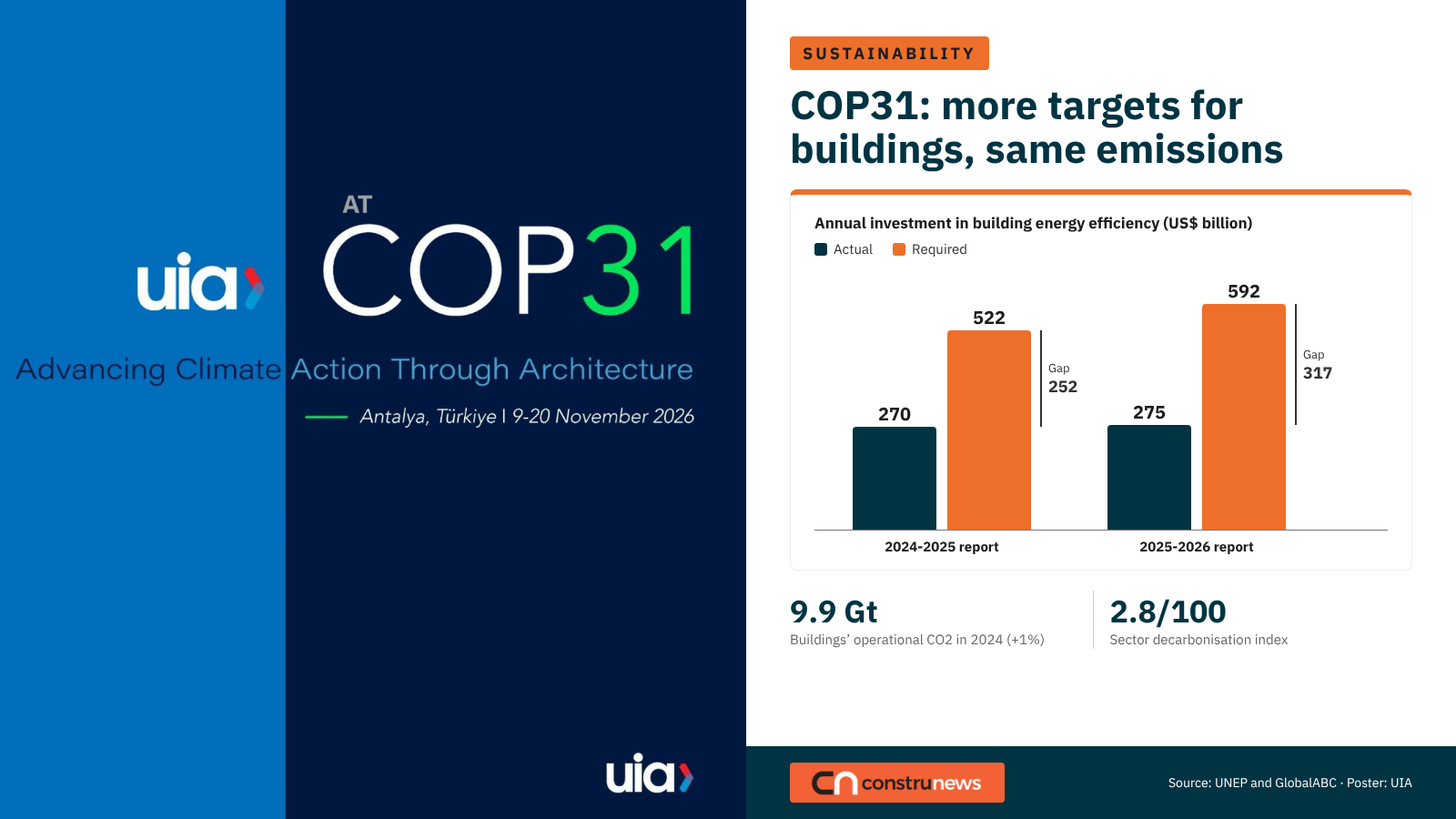
- Buildings’ operational emissions rose 1% in 2024, to 9.9 GtCO2. Between 2015 and 2024 they grew 6.5%, with energy demand up 11% and floor area up 20%.
- The sector is 3.5 GtCO2 off the required trajectory and would need a 56% cut in emissions from 2024 levels to get back on track by 2030.
- Embodied emissions from cement, steel and aluminium are around 2.1 GtCO2, 9% of the global total.
- Floor area grew 1.7% in 2024 to 273 billion square metres; 12.7 million square metres are built every day.
- The report’s decarbonisation index stands at 2.8 points out of 100 in 2024, 49.3 points short of where it should be.
There is partial progress: energy intensity per square metre has fallen 8.5% since 2015, green building certifications have almost tripled and renewables now meet 17.3% of buildings’ energy demand, although they should reach 46% by 2030.
Comparison with the figures circulating in Belém calls for caution. The previous Global Status Report 2024-2025 attributed 32% of energy and 34% of CO2 worldwide to the sector. The percentages have shifted between editions, but the reference value is the same: the 9.9 GtCO2 of operational emissions in 2024 appears both in the review presented at COP30 and in the May 2026 report.
The investment gap widens
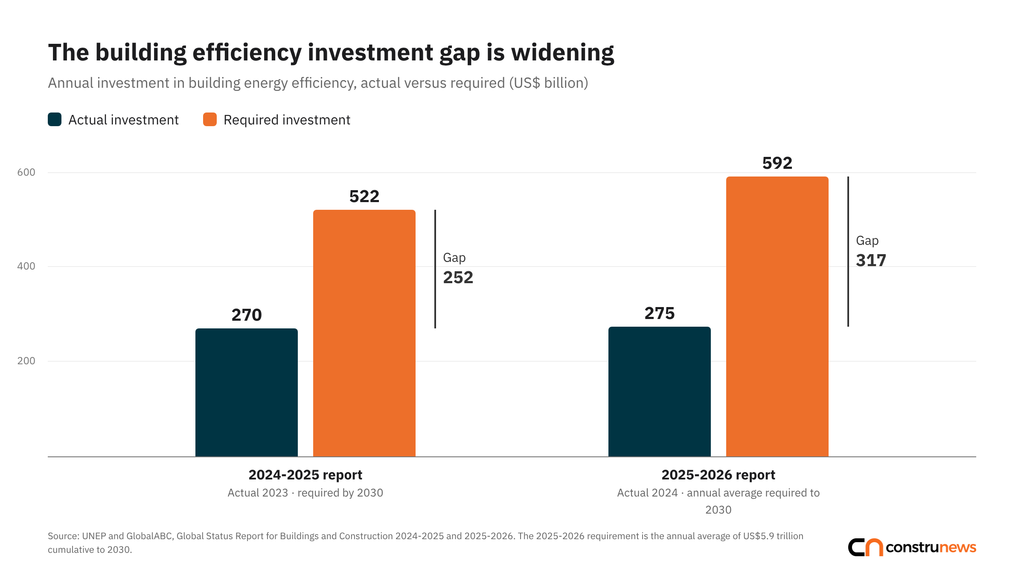
Investment in building energy efficiency reached about US$275 billion in 2024, up 3% on 2023 and 38% on 2015. But the need is growing faster: the 2024-2025 report put investment at US$270 billion and called for doubling it to US$522 billion by 2030; the 2025-2026 report raises the effort to US$5.9 trillion cumulatively by 2030, an average of US$592 billion a year. The distance between what is invested and what is needed has therefore grown from about US$252 billion to about US$317 billion.
“Buildings can either lock in climate risks or deliver safer, healthier, and more affordable living conditions,” said Inger Andersen (Executive Director, UNEP) in the report’s launch press release.
No country has yet published an extensive buildings strategy in the new round of national climate plans
Codes and national plans: the weak link
The lag is most visible in regulation. As of mid-2025, building energy codes covered approximately 60% of new construction worldwide, and none of the mandatory existing codes is aligned with zero-emission principles. The 2024-2025 report called for zero-carbon building codes by 2028 for major emitters and by 2035 for all others; the 2025-2026 report sets as a benchmark that at least all G20 countries and 75 others should have them by 2030.
National climate plans (NDCs) tell the same story: by 2024, 20 countries had submitted an NDC with an extensive strategy for cutting the sector’s emissions, but as of January 2026, no country had yet published extensive strategies for buildings under the new NDC 3.0 round launched in 2025.
What remains to be decided in Antalya
COP31’s outcome for the sector will depend on how many countries endorse the Antalya Compact on 12 November and whether its targets are translated into codes, national plans and investment. Between COP30 and COP31 the sector has gained forums, commitments and quantified goals. What it has not gained, according to United Nations data, is emission reductions: buildings keep emitting more each year and the investment gap is wider than twelve months ago.