


The Consell Assessor d’Infraestructures de Catalunya (CAdIC) has published its document number 17, Land as infrastructure: considerations and proposals to correct and speed up housing construction (El suelo como infraestructura: consideraciones y propuestas para corregir y agilizar la edificación de vivienda), which identifies the lack of suitable, viable, ready-to-build land as one of the main barriers to expanding housing supply. Catalonia faces a structural deficit estimated at around 150,000 homes, and the advisory body sets out 13 measures to mobilise land, streamline urban planning and make it easier to build both market-rate and affordable housing.
For CAdIC, land is “a necessary condition and infrastructure for housing to materialise, and also part of the country’s structure and infrastructure”. On that basis, the document treats land as the first factor of production in the housing value chain and puts forward specific land and planning proposals that, in its view, public administrations can adopt “urgently and immediately”. The text makes clear that it does not set out to reflect on how to build cities or to propose sweeping reforms of planning law, but rather to use the possibilities that existing legislation already offers to allocate land to housing quickly.
Housing output below the Spanish average
The report analyses how residential supply has evolved and highlights the difficulty of meeting current needs. Between 2013 and 2024, Catalonia completed an average of 1.02 market-rate homes per 1,000 inhabitants, compared with 1.32 across Spain. According to the document, that ratio is higher only than those of the Canary Islands, Galicia, Murcia and Ceuta, even though Catalonia is one of the regions whose population has grown most over the past twelve years, behind only the Balearic Islands and the Region of Murcia.
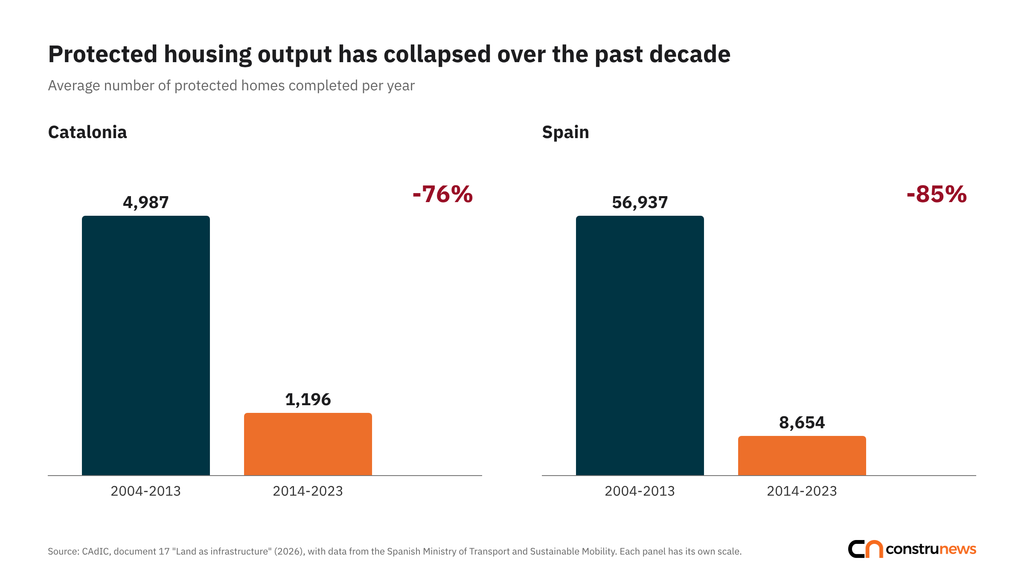
The decline is even sharper in protected (subsidised) housing. Average annual output in Catalonia fell from 4,987 homes in 2004-2013 to 1,196 in 2014-2023. Across Spain, the figure dropped from 56,937 to 8,654 protected homes completed per year over the same periods. CAdIC places the turning point in 2013, when Royal Decree 233/2013 ended state support for financing protected housing through subsidised loans, and stresses that the slump has happened even though planning legislation has steadily increased land reserves for this type of housing over the past decade.
The document also notes that in 2014-2023 65% of protected homes in Catalonia were developed by private promoters, whether for-profit or not-for-profit.
Average annual output of protected housing in Catalonia fell from 4,987 homes in 2004-2013 to 1,196 in 2014-2023
The outlook: more households and more people
Future needs come on top of that deficit. The Pla Territorial Sectorial d’Habitatge, approved on 22 October 2024, estimates that the number of households in Catalonia will grow by more than 180,000 by 2032. It also sets the goal that, within fifteen years, 15% of homes in the municipalities with the highest demand should be devoted to social policies and that 9% of Catalonia’s housing stock should be affordable rental. Idescat projections cited in the report put Catalonia’s population at 8.6 million in 2034, an increase of 541,000 people in ten years, and 8.9 million in 2049. CAdIC points out that the 150,000-home estimate does not include projections of new households.
The document also reviews the Generalitat’s initiatives: the Pla 50.000, announced in October 2024 to build 50,000 public homes by 2030, and the land mobilisation plan for 214,000 new homes, half of them protected, set out in the Government Agreement of 23 December 2025. For the latter, the Govern has inventoried 179 sectors at different stages of development. The Generalitat’s public plot reserve has registered 670 plots for 22,251 homes under public protection for rent or surface-right transfer, of which 14,398 already have developers and a multi-year budget commitment of €2,696 million.
Mobilising land and speeding up planning procedures
CAdIC considers the availability of ready-to-build land an essential condition for increasing housing supply, and proposes acting both on identifying and mobilising land and on the administrative procedures that govern its development. The main measures include:
- Creating a single register of land subject to urban transformation, showing which plots can host new residential developments and how feasible they are. According to the report, this information “increases legal certainty for investors and the predictability of the land’s planning conditions”.
- Simplifying planning procedures, moving from three to two planning approvals and setting a maximum of three months for sectoral reports, with positive administrative silence, except where public property is affected.
- Reviving Municipal Urban Action Programmes (PAUM), a six-year instrument provided for in Catalan planning law, as a framework to plan land and agree actions between town councils and the Generalitat.
- Reviewing land zoned for uses that have never materialised, to assess whether it could be turned over to public housing.
- Encouraging densification and the transfer of buildable floor area in the consolidated city, including identifying where extra storeys can be added, when planning conditions allow.
- Promoting public-private partnership to develop new residential areas.
- Guaranteeing stable budgets, approved every year, to give continuity to housing policies.
The report also calls for setting up and strengthening public land and housing assets, municipal registers of vacant plots, with Generalitat support and a model bylaw, and territorial planning through Urban Master Plans (Planes Directores Urbanísticos) for land with territorial priority.
CAdIC proposes a three-month limit for sectoral reports, with positive silence, and cutting planning approvals from three to two
Implementation, as important as new rules
The document warns that passing new laws is not enough unless their effective application is guaranteed. CAdIC speaks of an “inflation of legislation” passed on a case-by-case basis, without assessing its consequences or socio-economic impact and without the necessary budget. According to the report, regulatory impact assessment, resources, deadlines and coordination between administrations are decisive if housing policies are to deliver results.
Timescales show the scale of the problem: preparing land can take between six and ten years, and drafting a Municipal Urban Development Plan (POUM) takes around eight years on average in Catalonia. The triple-approval system, with initial and provisional approval by town councils and final approval by the Generalitat’s planning bodies, “slows down and complicates” the approval of plans and, above all, of their amendments.
As an example of measures that have not delivered the expected results, the report cites Barcelona’s 30% protected housing reserve, in force since December 2018. It aimed to generate around 334 affordable flats a year, but between 2019 and 2024 only 93 protected homes were recorded, of which just eight were built, according to figures from the Ajuntament de Barcelona itself.
Barcelona’s 30% reserve aimed at 334 affordable flats a year; between 2019 and 2024 it produced 93 protected homes, only eight of them built
No public funding, no housing policy
These difficulties are compounded by the need for sufficient and sustained public funding. Between 2007 and 2022, the combined recognised budget obligations of the Spanish State and the Generalitat for housing stood at around 1% of the total, compared with 4% for health and 3% for education. “Without public funding there is no public housing policy”, CAdIC concludes, calling for housing to be treated as a service of general interest with its own budget, as already happens with those other pillars of the welfare state.
Continuity and coordination between administrations
The advisory body believes that tackling the deficit requires coordinated action sustained over time, in which land mobilisation, faster procedures and resources form part of a strategy shared by all administrations. It urges inter-administrative cooperation at every level and stresses that, without “real and close” public-private partnership, it is not possible to provide market-rate and affordable housing.
CAdIC is a collegiate body made up of 21 independent experts that contributes to analysis and debate on Catalonia’s infrastructure and makes proposals to improve its planning, development and management. Construnews previously covered its roadmap on infrastructure and the circular economy.