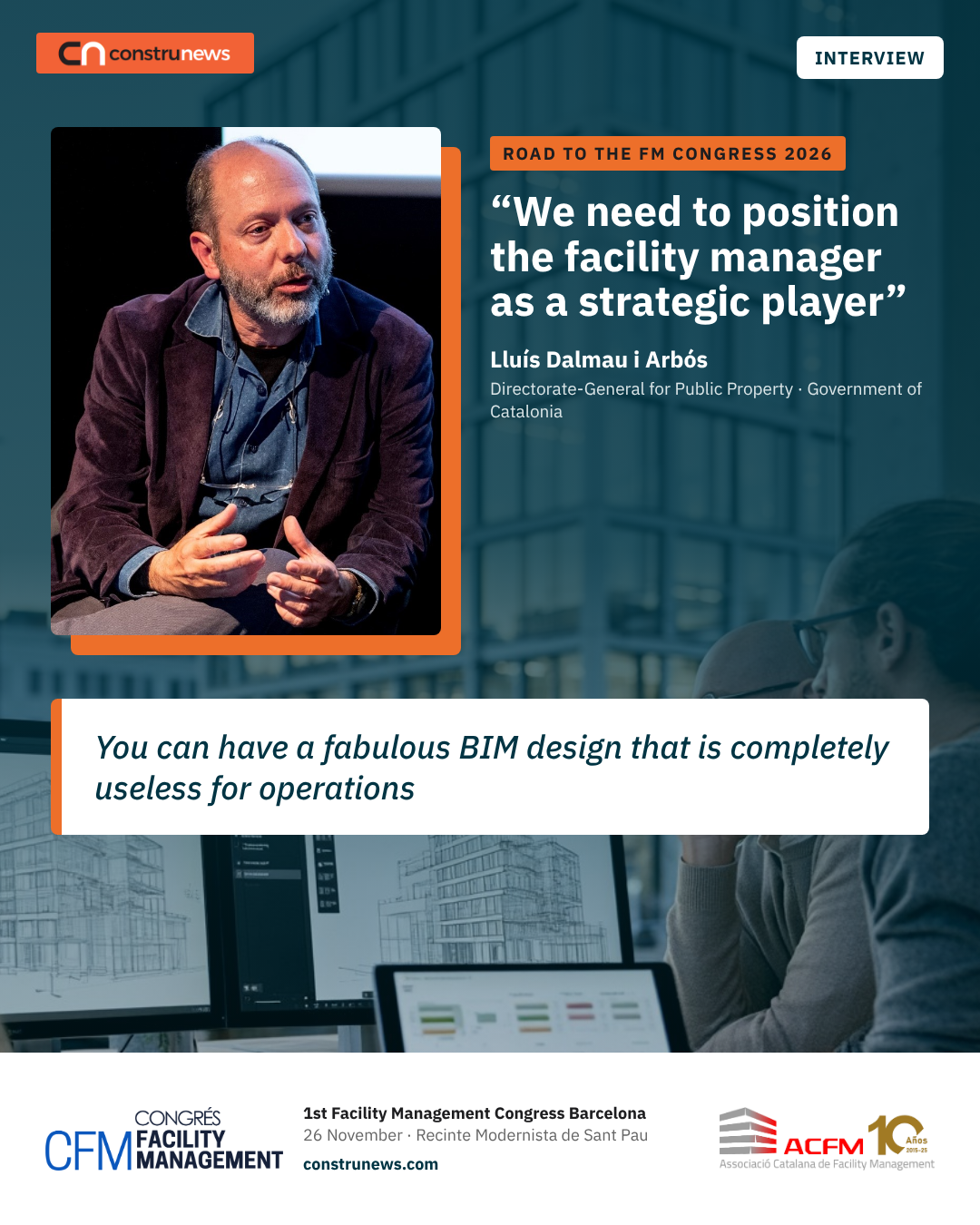

 discusses facility management in the public estate, BIM, data governance and the FM Congress Barcelona 2026.)
On 26 November, Barcelona’s Recinte Modernista de Sant Pau will host the 1st Facility Management Congress Barcelona 2026 (CFMBCN26), organised by the Catalan Facility Management Association (ACFM) as part of the World Capital of Architecture programme. Under the motto “Transforming spaces, connecting people”, the main day will feature seven panel debates on strategy and governance, digitalisation and smart facilities, sustainability and energy, regulation and costs, maintenance, risk and user experience. In the run-up, Construnews is publishing a series of six interviews with professionals from the sector.
The series opens with Lluís Dalmau i Arbós, Cap de l’Àrea d’implementació de gestió d’immobles i serveis de suport. Direcció General del Patrimoni. Departament d’Economia i Finances. Generalitat de Catalunya and a member of the congress’s scientific committee.
Measuring success: strategy and a sense of community
Barcelona will hold its first facility management congress on 26 November at the Recinte Modernista de Sant Pau. What has to happen that day for us to be able to say, a year from now, that the congress changed something in the sector?
For me, there are two aspects. First, facility management is very often confused with maintenance, with the more operational side. I think one of the successes of this first congress would be to position the facility manager as an important figure in the strategy of any organisation: their involvement in the strategy and governance of their organisation, and their decision-making power within it, in order to align built environments and support services with that organisation’s objectives. If this gained relevance and people incorporated it into each of their organisations, that would be key. In other words, positioning the facility manager as a strategic player in organisations. For me, that would be the greatest success.
The second element is much simpler and, at congresses like ours, I almost take it for granted: the feeling of belonging to a community. Facility management exists; I am a facility manager and I am part of a community. A very broad, very powerful community which is also very interesting, very holistic and very complete. I think this second part will almost take care of itself. The first, being strategic, is the one I am most involved in. And, precisely, the congress’s first panel will be on FM Strategy and Governance.
One of the successes of this first congress would be to position the facility manager as an important figure in the strategy of any organisation
FM across the Government of Catalonia’s entire estate
Your area was created in 2020 to roll out FM across the Government of Catalonia’s entire estate. Five years on, how many properties are now working with this model, and what has been the hardest part?
How many properties? I would say all of them, relatively speaking. This is a process that takes years, and facility management is very broad. In fact, the master’s thesis I wrote at ESADE was entitled The Implementation of Facility Management in the Generalitat, so I am putting it into practice. I am also in the privileged position to do so, at the Directorate-General for Public Property of the Ministry of Economy. From there we have a strategic view of the Generalitat’s entire estate and so we are working on many fronts: providing digital solutions to support facility management, and regulations published in the Official Journal of the Generalitat de Catalunya (DOGC) that explain what facility management is and how property is to be managed. This is in black and white, published in the DOGC, and it places obligations on all public-sector ministries and bodies regarding how they must carry out facility management. There are seventeen ministries, but more than two hundred bodies.
So, all of them: tens of thousands of buildings and millions of square metres, covering almost every type of building that exists. I say buildings, but I prefer to talk about built environments, which are sometimes built, such as airports, ports or roads, and sometimes barely built at all, such as national parks, which also have to be managed through facility management. So, as well as office buildings, hospitals and schools, we have all of these types. All of them.
I am very satisfied with the progress we have made, and I have always had great support from all the Directors-General for Public Property. There has been a great deal of understanding; they have seen the strategic side of this challenge and have supported me fully. I am very satisfied with the journey we have made, which we are still making and will continue.
The Districte Administratiu, the seed for administrative buildings
The Generalitat’s Districte Administratiu (Administrative District) was conceived as a comprehensive FM project from the outset. What lessons from it are being transferred to other buildings?
I believe it was the first facility management project to incorporate the entire facility management life cycle. That is key; it is part of the strategy. The Districte Administratiu is part of a strategic plan, so we started well, because that is the most strategic, initial stage. We compared what we had with what we needed and saw that there was a need for an administrative district, in other words, an office building. At the time, the figure was 2,500 workstations, but 3,200 people are working there, precisely because space management, within facility management, is one of the elements that has been handled well.
The Districte Administratiu is a seed for the rest of the administrative buildings. Since then, instructions, orders and rules have been published on what the Generalitat’s administrative buildings must be like. And work is under way on districts two, three and four, which build on the Districte Administratiu and improve on it, because the facility management life cycle is a continuous improvement cycle. Obviously, every time we do something, however well we do it, it can be improved, and that is what we are doing.
Hybrid working, office occupancy and rents freed up
With hybrid working, the Generalitat set new occupancy criteria for its offices in 2021. Is there now surplus space, and what is being done with it?
This is part of asset management, which is one of the elements of facility management. There would be a lot of surplus space if we had issued regulations on how spaces are occupied and done nothing else. But we have done much more. We have freed up millions of euros a year in rent on thousands of square metres that we have vacated because they were not needed. The Districte Administratiu and other buildings in progress, as well as buildings we already owned that had room for improvement, have taken in staff from the buildings we have left. In this way we have freed up many square metres and many euros a month that we were paying in rent in central Barcelona. So, there is no surplus space.
We have freed up millions of euros a year in rent on thousands of square metres that we have vacated because they were not needed
BIM that serves operations, and a building handover that works
You argue that you need to spend a lot of time on site and that BIM is only useful if it is updated during construction. What is missing today when a building is handed over to the team that will manage it?
You have raised two key issues here: BIM on the one hand, and the building handover on the other. As for BIM, design models, historically and still today, are somewhat different from the BIM models of the construction phase. There are differences. And when the building is handed over, the operations-phase BIM model is different from the design and construction models. That is why the Generalitat and the public administrations of Catalonia have approved GuBIMclass, which sets out what BIM models must be like and how everything must be coded and organised, so that the design, construction and operations BIM models are coded from the outset.
We can all talk a great deal about BIM, but when you actually get down to it, it is much more complex. You can have a fabulous BIM design that is completely useless for operations. At the design stage you have to take part in deciding how the building will be operated, so that you can code and define it according to what you will need in the operations phase. And this links us back to the facility management life cycle. It is always the same: if we intervene in the life cycle, that is, in how BIM models are coded at the design and construction stages, then when we receive the BIM model it can be useful for operations.
You also mentioned the handover phase. Apart from BIM, in the traditional life cycle, which was not followed through, we had designs and construction works in which an architect produced the design and managed the works, and when it was handed over the architect disappeared and another team came in that had nothing to do with it and had not been involved in the first phase. Where did these two phases meet? Precisely at the building handover. And what happened at that handover? The architect was keen to leave and the newcomers did not know what was about to land on them. Traditionally, that handover was done badly. The architect said the operators were useless because they did not use the building properly, and the operators said the design was poorly done because it had not taken their needs into account.
With facility management and the life-cycle approach, whoever receives the building has been involved since the initial definition phase and will then operate it. So this handover can be, should be and is increasingly becoming better, and buildings are better operated, because at the handover all the installations, which are increasingly digital, are better validated; it is a very complex point.
Hence the need to spend a lot of time on site?
Well, in the construction phase, yes: you need to be there during construction when it is the construction phase. You need to be there in every phase; it is the full life cycle. In the construction phase too, of course. In any case, the construction phase is operational, not strategic, because if the project is well defined in the strategic plan and the functional brief, design and construction are operational rather than strategic: they carry out what was planned at the outset. In other words, a construction site with no surprises could be visited once a month, almost with your hands in your pockets, because the important things are already defined.
Governing data
At this point, what data does an administration need to manage its estate properly, and which data do you find are still missing?
Facility management, like any other kind of management, economic or human resources, needs data, and today data is held digitally. Rather than which data, because we have to define which data we want, and that is part of the initial strategic stage (what data we will need in order to manage well), the most important thing is governing the data. It is a subject that rarely comes up and is rarely discussed.
For example, the address field: will we call it address, location or something else? Governing data means that each data item has one name, and only one; that it has a definition; and that it is subject to quality control. Take the municipality field: if it is published on an official website, we should not invent the capitalisation or the spelling; it already exists. Governing data means going to the Barcelona street directory database or the National Statistics Institute, because they publish this data; you have to go to that source, not invent it. And it has to exist only once.
Digital management increasingly requires specialised digital tools. BIM is one, asset management is another, environmental management another, energy management another. Each has its own specialised digital solution, but they must be integrated with one another. And for them to be integrated, data has to originate in one of these applications only once and travel between them, because they are integrated. That is how we govern data and, from there, we will have data that is comparable and assessable. Because if one calls it address, another location, another GPS and another something else, we are off to a bad start, as it will not be comparable. So we could talk about many kinds of data, but it depends on what we want to do. Each application will have its own important data, but above all we must work on governing that data and on integrating the systems so that data originates in one application and travels through the others.
You can have a fabulous BIM design that is completely useless for operations
So digitalisation is key. This reminds me of a conversation twenty or twenty-five years ago about home automation, in which an engineer told me the problem was that the different brands had not created protocols to understand each other. Do you think the current moment allows us to understand each other thanks to digitalisation?
Precisely thanks to governing data. Because if home automation is to regulate temperature, we must call temperature temperature, not degrees centigrade, nor in English or Italian, but in one single way. And that data item has to be defined: whether we want it in degrees Celsius or Fahrenheit, and in the units we set ourselves, for example two digits, a decimal point and two more digits. But it has to be defined. And all the systems we install in our buildings must be required to send us the sensor’s temperature data with a specific code and in a specific way, so that it can be read by the artificial intelligence system that regulates the HVAC equipment.
We come back to the same point: governing data. Without governing data, we will have many systems that do not talk to each other. We will spend a fortune solving one particular case with a tailor-made solution, when what we want is a standard. Because if we have one building, fine, but if we have thousands, they all have to have the same data.
What the masters of architecture are missing
You trained with Martorell, Bohigas and Mackay. What do you retain of the designer in your facility management work?
I am not going to criticise them, because they are masters of architecture. But there is something that ties in closely with what I have said so far. MBM, produced designs and managed construction works and then disappeared. I have seen many of their works that have aged badly, precisely because there was no facility manager involved from the start, managing them from the start and loving them from the start. Everyone makes their own decisions: “I don’t know how this works, I don’t know what it’s for, I’ll change it”. And that ages badly.
I would say that, not just them but all the great figures of architecture, what they lack is this life-cycle vision. If MBM had brought the building manager and the client into their projects in a more integrated way from minute zero, their marvellous works, because they are marvellous, would surely be better preserved today. And they would also be more efficient, not only in energy terms but also in the use they offer the users of those spaces.
Public and private FM: the same model
You also teach and direct a master’s programme that combines facility management and public management. How does public FM differ from private FM, apart from public procurement law?
I am glad you asked me that. I work in public administration and, in a large administration, we have tens of thousands of buildings and millions of square metres; at the other end of facility management there might be, for example, a florist with a single fifty-square-metre shop in Barcelona. The facility management model is the same for everyone. The concept is the same for public and private; for small, medium, large and huge.
And what is it? Understanding that any organisation, the Generalitat or the florist, has three resources. One is financial resources: the florist has income and outgoings, and so does the Generalitat. Another is human resources: the Generalitat has a hundred thousand employees, the florist perhaps one or two. And the third is built spaces and their support services, that is, the shop the florist works in.
Once it is understood that these three resources are needed, a very large company, public or private, will have its own teams in charge of them: human resources, financial resources and facility management. And the florist needs to be very clear that, if they do not know about these things, they will have to hire an adviser for the financial side, for paying taxes and so on; they will have to hire a company to handle the payroll of their employee, who they may have to replace; and, on the facility management side, since they will not know how to contract maintenance or cleaning, or draw up lease agreements, they will have to hire an FM company to help them contract electricity, data, cleaning and maintenance. Fundamentally, it is the same.
Is facility management arriving late?
Finally, your mention of florists reminded me of the gardener’s metaphor: you have always arrived too early or too late, because the flowers have not yet opened or the beds have not grown enough. In light of everything you have said, do you think facility management is in a good moment, or are we arriving late, or early?
You always arrive late everywhere. Always. If that were not the case, we would live in a perfect world, and I don’t think we do. But even though we arrive late in every sphere of life, including the governance of planet Earth, and even though we move more slowly than we would like, we are always moving forward, in every sphere. And in facility management I believe we have made a great deal of progress in a few years, an enormous amount.
The Catalan Facility Management Association is, I believe, now fifteen years old. It is at a splendid moment in terms of capacity and established internationally. The congress we are about to hold is proof of that. So we are late, because we are always late; we are slow, because we would like to go faster; but we are doing very well and moving very fast.
Dalmau describes the roll-out of facility management across the Generalitat’s entire estate (17 ministries, more than 200 bodies and tens of thousands of buildings) through regulations in the DOGC. The Districte Administratiu, planned for 2,500 workstations, houses 3,200 people, while data governance and GuBIMclass underpin operations.