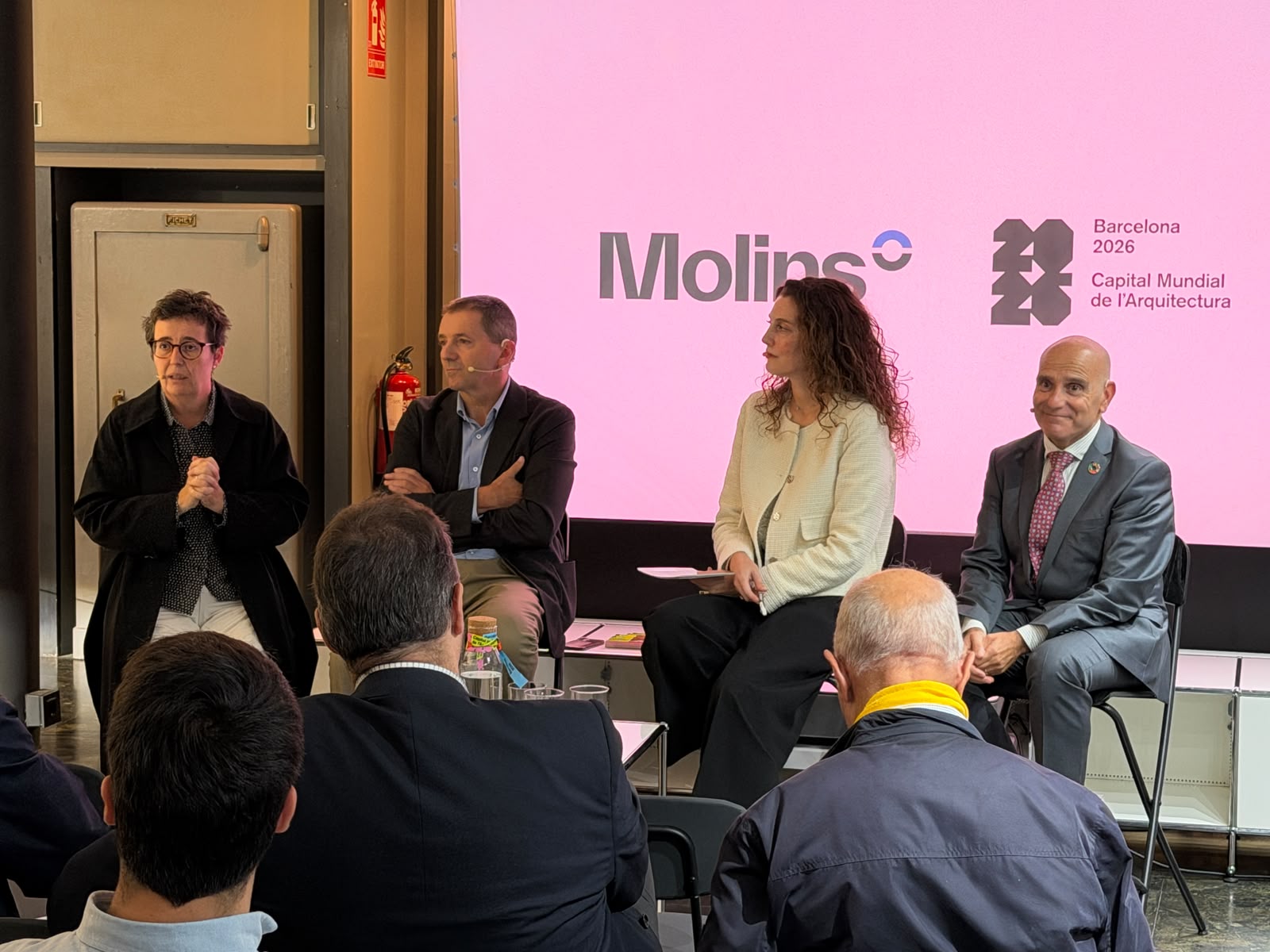


On 10 November, Molins closed its Molins Talks: present and future of architecture series, which it organises as a collaborator of Barcelona World Capital of Architecture 2026, with a panel on urban renovation. At the House of Architecture, the former headquarters of the Gustavo Gili publishing house, Maria Buhigas, arquitecta en cap de l’Ajuntament de Barcelona; Josep Antoni Martínez Zaplana, president del Gremi de Constructors, and Enric Heredia, president d’ACE – Associació de Consultors d’Estructures, spent more than an hour discussing why so little renovation takes place and what it would take to change that. The debate was moderated by Célia Pérez, Executive VP Construction Solutions at Molins.
Barcelona has nowhere left to grow. Martínez Zaplana summed it up during the debate: the city has “a Llobregat, a Besòs, a Tibidabo and a Mediterranean Sea” that will not let it expand. The existing building stock therefore holds much of the potential to improve efficiency, accessibility and quality of life, but intervening in what already exists means balancing housing, heritage, sustainability and economic viability.
Célia Pérez opened the session by recalling that Molins takes part in the capital programme as a sponsor, and warned that the company’s products would not be discussed. Before the first question, she polled the room: around half of the audience had taken part or were taking part in a renovation project, a dozen were involved in one at that moment and only two attendees said they had ever received a renovation grant.
A cultural barrier before an economic one
Why is there not more renovation? Martínez Zaplana, who has focused mainly on renovating multi-family buildings with owners’ associations (although he has also worked on the Fundació Miró and the Las Arenas bullring), placed the first obstacle within the association itself: reaching agreement and, after that, the money. Before anything else, he explained, he needs to establish two things: whether the residents want to go ahead and what monthly contribution they can pay. But the underlying problem is different: “We do not have a clear concept of building conservation and maintenance.” Simply by being owners, he recalled, people have an obligation to conserve and maintain their buildings.
Maria Buhigas, who arrived after the session had started, coming from a meeting at City Hall, agreed that, as well as regulations, administrative procedures and grants, there is a cultural barrier. She illustrated it with the car: Catalonia is full of petrol stations with space to wash it, an asset that loses value from day one, while the home, “the most important purchase any of us will make in our lives”, is not looked after accordingly. She gave the example of party walls, through which much of the heating escapes in winter: the City Council cannot reach residents’ associations and, for these grants, money is left over every year. “It is not that it is an obligation, it is that, economically, not doing it means not knowing how to do the maths. It is a loss of value,” she said.
The cultural barrier is the biggest of all, and it cuts across society: it does not depend on socio-economic profile
Enric Heredia added the time factor: the numbers work in the long term, but society lives in the short term. From a technical point of view, he warned that renovation is highly complex and has a lower success rate than new build, because it often starts from an insufficient diagnosis that leads to solutions unsuited to the building, and because execution is also difficult. The life expectancy of repairs, he said, “is frankly poor”.
Grants: reaching citizens and not making them pay upfront
Buhigas acknowledged that the administration must ask itself what it is doing wrong in failing to reach citizens. She cited the dispersion of municipal portals, despite the aspiration of a one-stop shop, and the way grants work, most of which operate “the other way round”: owners make the whole initial investment and the grant arrives after the paperwork has been submitted and an inspection carried out. “You put up the money first, and we’ll pay you back,” she described.
Martínez Zaplana, who has been processing grants since 1994 and has taken part in between thirty and thirty-five renovations of owners’ associations with Next Generation funds from the Metropolitan Consortium, Barcelona City Council and the Catalan Housing Agency, described the figure he first meets in every association: the denialist, who relies on myths such as the idea that a building that has lasted forty years can last forty more, or that grants are never paid. He also pointed to a paradox: “We penalise those who do things right“, because those who have not maintained their building expect a grant to fix it. Even so, he argued for helping vulnerable households, which cannot renovate without support, and called for continuity: grants should follow a technical cycle rather than an electoral one, because if a call for applications dies with the legislature, “the myth comes in and becomes reality”.
Buhigas explained that in vulnerable neighbourhoods the City Council acts subsidiarily and that money need not be a barrier: in addition to the subsidised part, the share the owner cannot pay is registered as a charge on the property until it is sold or changes hands. She also recalled that in these areas, with buildings that were deficient from the outset, the country created a public housing stock “as large as or larger than Vienna’s”, but based on ownership.
Diagnosis: measure before deciding
Diagnosis was the common thread of the debate. Martínez Zaplana recalled his involvement in the renovation of Turó de la Peira, where work began with a large-scale diagnosis of a series of building types: “We renovated almost fifty or sixty buildings” and, from the seventh or eighth onwards, with a proper diagnosis and by replicating what had been learned, costs deviated by around 5%, “and not much more”. Buhigas argued that renovation requires far more in-depth preliminary studies than new build, and new ways of working: “Cheap always turns out expensive.” The panel cited the case of a project by Belgian architects in which an external consultancy concluded that 70% of the savings came simply from accepting the structure as it was.
If we do not make a good diagnosis, we do not know the state of the building or what we need to repair or renovate
Heredia warned that the building stock is “a ticking time bomb”, with “precarious or non-existent” maintenance, and that associations usually undertake works only because of a serious defect or an essential installation such as a lift; once work starts, problems emerge in the structure, foundations, envelope and roofs. Célia Pérez asked why, given the importance of diagnosis, there are hardly any grants for it. Buhigas replied that she was taking note.
From the building logbook to the “building passport”
Martínez Zaplana asked the audience how many knew their building’s logbook (llibre de l’edifici) and regretted that a document drawn up by technical professionals ends up abandoned; he asked that the logbooks produced under renovation programmes be recovered so that owners can be required to carry out repairs. Heredia proposed speaking instead of a building passport, like a vaccination card, digitised and controlled by the administration. Buhigas rejected a “paternalistic” approach and defended shared responsibility: “Rights come with duties.” She did call for technical information to be translated into language citizens can understand, and admitted that her aim with the capital’s party-wall competition is a documentary that reaches prime-time television and makes “the phones ring off the hook”.
One attendee offered a figure on participation: according to his studies, average attendance at owners’ meetings is below 25%. Another, who led the early stages of the Ciutat Vella operation, recalled that renovation took off thanks to proactive campaigns, such as offers of an additional 20% grant for those who signed up in the first three months in a specific area, and the Barcelona, posa’t guapa campaign. Martínez Zaplana added the contagion effect: when an area sees renovation happening, residents start asking why not them.
Financing: “There is financing”
When an attendee complained that banks did not offer credit lines to owners’ associations, Martínez Zaplana replied that, following Royal Decree-Law 19/2021, the Government of Catalonia signed an agreement with banks and that 99% of the associations he has handled have been financed by four institutions, over fifteen years, with no guarantee and no entry in the land registry, the only condition being that there are no internal arrears. “An owners’ association is never in default,” he said. What is missing, he admitted, is communicating it.
Heredia qualified this by noting that such financing has been possible because Next Generation funds made “very powerful” contributions, but only for energy improvements: structural defects can account for barely 30 or 40% of the work, even though they matter more. In some special renovation areas, up to 80% has been funded, with the bank providing 20%. Buhigas cited the case of Santa Coloma de Gramenet, where residents began paying 25 euros a month from the day they agreed to the works, and explained that she has commissioned an audit of the state of conservation of municipal heritage buildings, using a red, amber and green traffic-light system, to calculate how much it costs to bring red and amber up to green and keep it there: “If I am asking society to do it, I have to start by setting an example.”
What about industrialisation?
Asked by Construnews whether industrialisation is part of the solution in renovation, Heredia described it as a matter of the present and the future that is advancing slowly. Célia Pérez noted that Molins already carries out industrialised construction in Polinyà. Martínez Zaplana pointed out that, with residents living inside, industrialisation can only act on the building’s skin, roofs and façades, and that it needs replicability, which only appears in housing estates: in an Eixample block, he wagered, no two buildings are the same. In major renovations, however, there is room for industrialised components such as bathrooms.
Buhigas distinguished several fields: new build, with open questions about the urban outcome of excessive modules; the renovation of housing blocks from that period, where industrialisation cuts on-site time, noise and disruption; mechanisation in heritage settings; and, on the other side, valuing traditional crafts. She warned that there will be more problems with contemporary architecture than with older buildings, because of the limited lifespan of silicones and plastics, and that timber requires maintenance. Renovation, she recalled, is a European challenge that is not limited to energy. Célia Pérez argued that today’s industrialised buildings “are and will be much more reliable, sustainable and durable”.
In renovation with residents living inside, industrialisation can only act on the building’s skin: roofs and façades
Three magic wands
To close, the moderator asked each speaker for a first measure. Heredia chose knowing what we really have: diagnosing the building stock, with a campaign of grants for diagnosis that includes testing because, as Martínez Zaplana added, many associations only want visual inspections and will not pay for samples to be taken from the joists. Martínez Zaplana called for a tax incentive for renovation through personal income tax (IRPF) deductions, since the demand for a super-reduced VAT rate on renovation has not succeeded in Europe, and recalled that some grant recipients lost benefits such as the social energy discount because the grant was counted as income, a problem that, according to the panel, has now been resolved. Célia Pérez summed up the proposals as a communication campaign, an in-depth study of the building stock and a tax incentive, to achieve a Barcelona that is “liveable, accessible, sustainable and durable”.