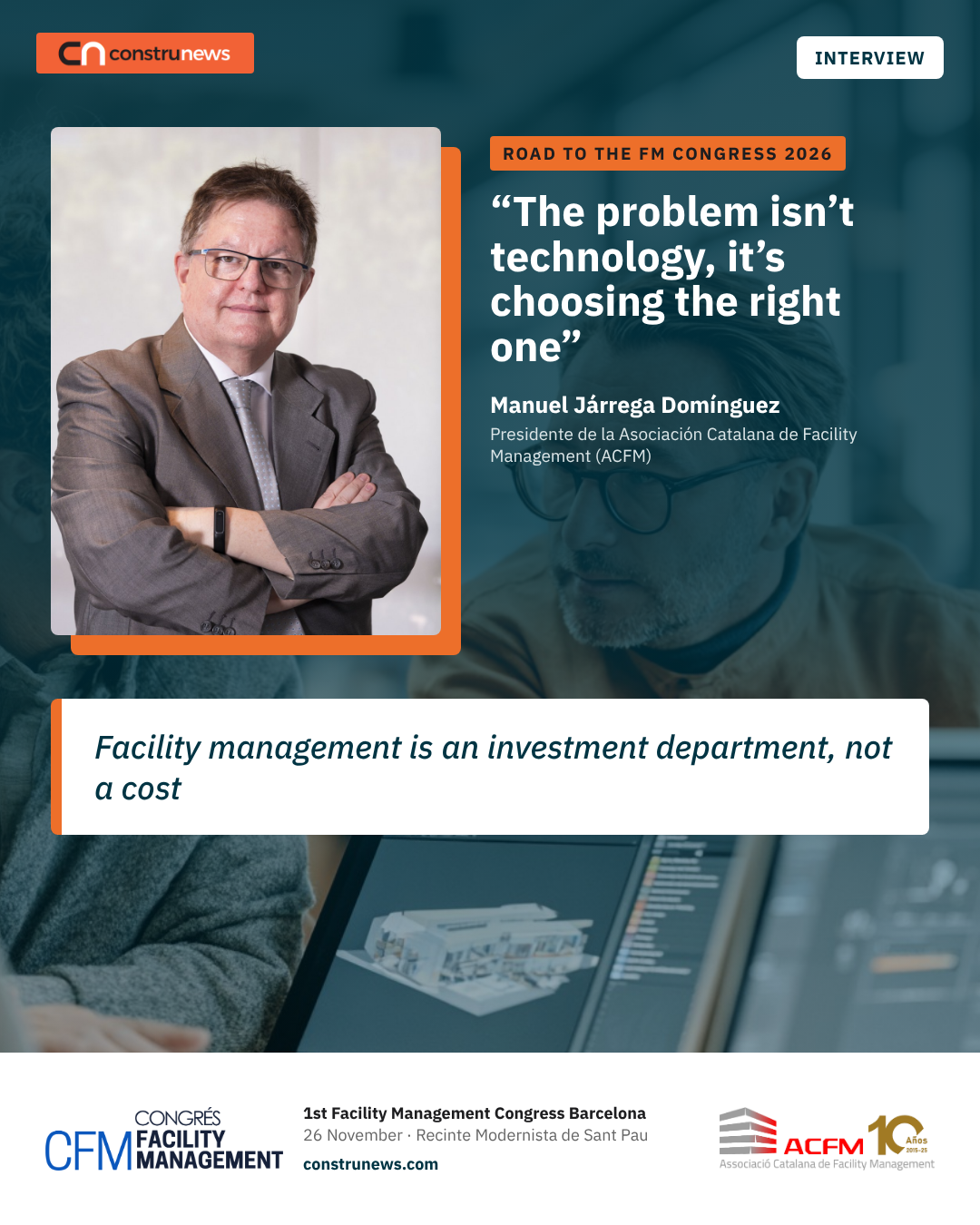

 on the FM Congress Barcelona 2026, AI-driven predictive maintenance, talent and the building life cycle.)
On 26 November, Barcelona’s Recinte Modernista de Sant Pau will host the 1st Facility Management Congress Barcelona 2026 (CFMBCN26), organised by the Catalan Facility Management Association (ACFM) as part of the World Capital of Architecture programme. Under the motto “Transforming spaces, connecting people”, the main day will feature seven panel debates on strategy and governance, digitalisation and smart facilities, sustainability and energy, regulation and costs, maintenance, risk and user experience. In the run-up, Construnews is publishing a series of six interviews with professionals from the sector.
The series continues with Manuel Járrega Domínguez, Ingeniero Industrial, Presidente de la Asociación Catalana de Facility Management (ACFM) and Codirector del Postgrado de Facility Management de la Escola Sert.
On 26 November, Barcelona holds its first facility management congress at the Recinte Modernista de Sant Pau. What needs to happen that day so that, a year from now, we can say the congress changed something in the sector?
The first thing that has to have happened is that the sector can make use of everything explained at this congress to improve facility management best practice. That we have managed to give facility management the relevance it truly deserves in society, which is going to be very hard for us.
This is simply one more step in the process we are carrying out to place facility management in the social value it has. And also that all of us, let me say, have good memories of this congress so that we can repeat it in 2028.
From the Nit del FM to the congress
ACFM has held eight editions of the Nit del FM. Why take the step to a congress now, and what figures will you use to measure whether it has worked? Attendees, companies, agreements…
I’m glad you asked me that. This is actually the eighth Nit del FM, and with it what we are doing is opening the congress: this Nit is closely tied to the congress. Why is it so special this time? We are holding the congress, but we are also in Barcelona’s year as World Capital of Architecture. In fact, Barcelona being World Capital of Architecture in 2026 is what led us, a few years ago, to start working on creating this congress. That is why, in the end, we went for it, we fought for it and we have made it happen.
As for results, what we expect is a congress with 190 people. It is also a congress with participation from across Spain as well as international reach and recognition. The idea is for the congress to be successful enough for 2028 to be even more international. Those would be, let’s say, the stages we are aiming for in order to succeed.
One very important thing is our sponsors, and I’d like to take this opportunity to thank them for all their support, both for the association and for the congress. They are the ones making this possible, through all their commitment to facility management. As are many other organisations: I want to highlight the public bodies, the Generalitat, Barcelona City Council, the AMB, Infraestructures.cat, the professional associations and so many others, and our sister associations, IFMA, AEM and so on, who are helping make this a success.
Implementing technology doesn’t just mean subcontracting a company, it means having a team that can make use of that data
What the factory can teach the building
You come from industrial maintenance 4.0. Which technologies that are already common in a factory have still not reached buildings? And why?
That’s a very good question, because we could even say that we overrate the technologies in factories. If we went to a factory, we would find that there are still many technologies, such as predictive maintenance, that are far from fully implemented.
That said, in which technologies can we make rapid progress in buildings? Predictive maintenance, adding a layer of artificial intelligence. There are already technologies at work that read maintenance information from buildings and, using artificial intelligence, let us see trends and anticipate problems. And the same with energy: artificial intelligence applied to the control of building energy systems.
All these technologies are available to be implemented. As I always say, the problem isn’t technology, the problem is choosing the right technology for your problem, with the right support, both internal, within companies, and external. Because implementing technology doesn’t just mean subcontracting a company, it means having a team that can make use of that data. Otherwise, it’s useless.
Facility management and maintenance
You are involved in both ACFM and the Spanish Maintenance Association. Are FM and maintenance two disciplines, or one with two names?
FM covers a much wider landscape than maintenance. In FM we deal with cleaning, gardening, catering and many other disciplines besides maintenance, so we could say its range is far broader.
Maintenance is an extremely important part of facility work, but facilities teams also handle energy, cleaning and the workplace, and make sure people are happy with their experience inside buildings, hotels and shopping centres. Facility management covers a much wider area than maintenance.
Historically, facility management has been discussed mostly in relation to buildings. But it is also true that, from an industrial point of view, a lot of facility management works in industry. The proof is that we have industrial members in our association.
How not to become a prisoner of one supplier
I know the question I’m about to ask is a bit awkward, and I’d ask you not to give me a footballer’s “one game at a time” answer. You have worked with a major technology manufacturer. How does a facility manager avoid being tied to a single supplier or a closed platform?
That’s a very good question. The first thing is that you have to choose a supplier with a philosophy of open data and open systems, one that allows interoperability between systems, because otherwise you can end up a prisoner.
That’s one issue. Another very important one is having a strong in-house team to run the system, interpret the data and hold an informed conversation with the supplier. I have seen many cases of suppliers installed in different buildings without a valid counterpart to work with on improvements. In the end, it isn’t even the supplier’s fault: it’s that on the other side there is nobody who speaks their language.
Catalonia and Spain compared with the benchmark countries
Speaking of languages, compared with the benchmark countries in facility management, where are Catalonia and Spain ahead, and where are they behind?
Another very good question. Fortunately, we are part of Global FM, the worldwide facility management association. So we have the chance to compare ourselves with other countries, in South America, Arabia, the United States, England, and especially with two sister associations, those of Mexico and Panama, with which we have an agreement and work jointly.
That said, in Catalonia we have a very positive feature that I don’t see elsewhere: the approach of the public administration. In Catalonia we have a public administration that is very close to the facility manager. That is why the Generalitat, Infraestructures.cat and the City Council are honorary members of the association. There are departments working on facility management and extending it across the whole administration, to each of these public administrations. I haven’t seen this in other regional governments, and I think it is an excellent practice. I look at other countries and I find the same, exactly the same.
Another area where we are well ahead is in our professionals and companies. We have great professionals, great companies, technology, trained people and educational institutions offering facility management postgraduate programmes. And here I’m talking about Spain as a whole: we are in a very strong, optimal position to provide services.
Where do we need to improve? I’m afraid not just Spain, but the whole world: in management seeing facility management as an investment department, not a cost. That would avoid a lot of arguments and would give buildings an optimal life cycle, a hugely important concept at the congress. Because sometimes, to save money, you cut maintenance and then you have problems. We could talk about many cases recently, and a great many historically.
So one of our roles as an association is to get this message across to company owners, executives and decision-makers: FM has to be part of strategy, because it is what can deliver the optimal life cycle of the buildings, the equipment and so on within that company. It has to be empowered, know the company’s strategy and be able to contribute to it. For me, the facility manager should be at executive level in order to add value effectively.
Facility management is an investment department, not a cost
The talent shortage
You mentioned training. As a lecturer and co-director of Spain’s benchmark facility management postgraduate programme, the question is unavoidable: is there a shortage of facility managers? Which profile do you find hardest to recruit?
Finding talent is the usual complaint of every facility management company. It is very difficult, among other reasons because there is no formal, accredited degree in facility management.
These are people who come from different disciplines: there are engineers, biologists, architects and so on who move towards facility management. But a facility manager is not just a technician. They need enough personal skills to lead a team, to explain themselves and to collaborate with the teams around them, such as human resources or finance. And something very important: explaining to management how well we are doing things, which we don’t know how to do and have to learn. In fact, that is why we have a module on it. It is a very demanding profile, and that is why there is a shortage of talent.
It should also be said that this is the big battle in maintenance, facilities and other disciplines: young talent doesn’t know this profession, doesn’t know it exists and therefore doesn’t join it. And we are finding it extremely hard.
Playing in another league
But you go a step further, because you advise and mentor companies. What would you tell a services company that wants to stop competing on price alone?
Basically, that it has to enrich its offer by adding services, digital and consultancy-type services, in order to stand out. The important thing is to differentiate yourself, because otherwise you end up competing on price.
Only by adding that kind of service can you get to play in another league. That’s what it is about: playing in another league.
The life cycle, from design to operation
With everything we’ve said, I think I have a good picture of where facility management stands, but I’m sure you are already looking at where it needs to go in the medium term. What can you tell us?
As I mentioned, for me it has to evolve towards the life-cycle concept. It means that, from the moment a project is created, whether a building, a hotel, a factory or a smart city, someone has to think about it: there has to be a facility manager within the team so that it is designed to be maintainable, and optimally maintainable. And so that the project budget includes not only the construction budget, or CapEx, but also the operating budget, or OpEx.
Bear in mind that 85% of the cost of a building is operation. What happens? We carry out projects and then there isn’t enough money, or no money at all, to operate them. That’s when we have the problem and serious mistakes can occur. That is why it is very important for facilities to be involved in the whole life cycle of a project.
The other important point, which I’ve already mentioned, is that facility management should be seen as a strategic element within companies. And I say companies or organisations; I prefer to say organisations, because we’re talking about universities, governments and so on. They all have buildings, they all have equipment and they all need to optimise this life cycle.
85% of the cost of a building is operation
A congress with continuity
Do you think this congress is the right tool to bring order to exactly what you have just described?
We are trying to make that the leitmotiv of the congress. We are working on all the content of the seven round tables so that the future strategy I’ve just described can be understood.
We have to keep improving, which is why we don’t want to stop at this congress. We want to hold this congress, a pre-congress next year and, in 2028, we hope to hold another congress, even bigger and more international.
Járrega expects 190 attendees at ACFM’s first congress, a pre-congress in 2027 and a second, more international edition in 2028. He backs AI-driven predictive maintenance, open systems over single suppliers and an executive-level facility manager, given that 85% of a building’s cost lies in its operation.