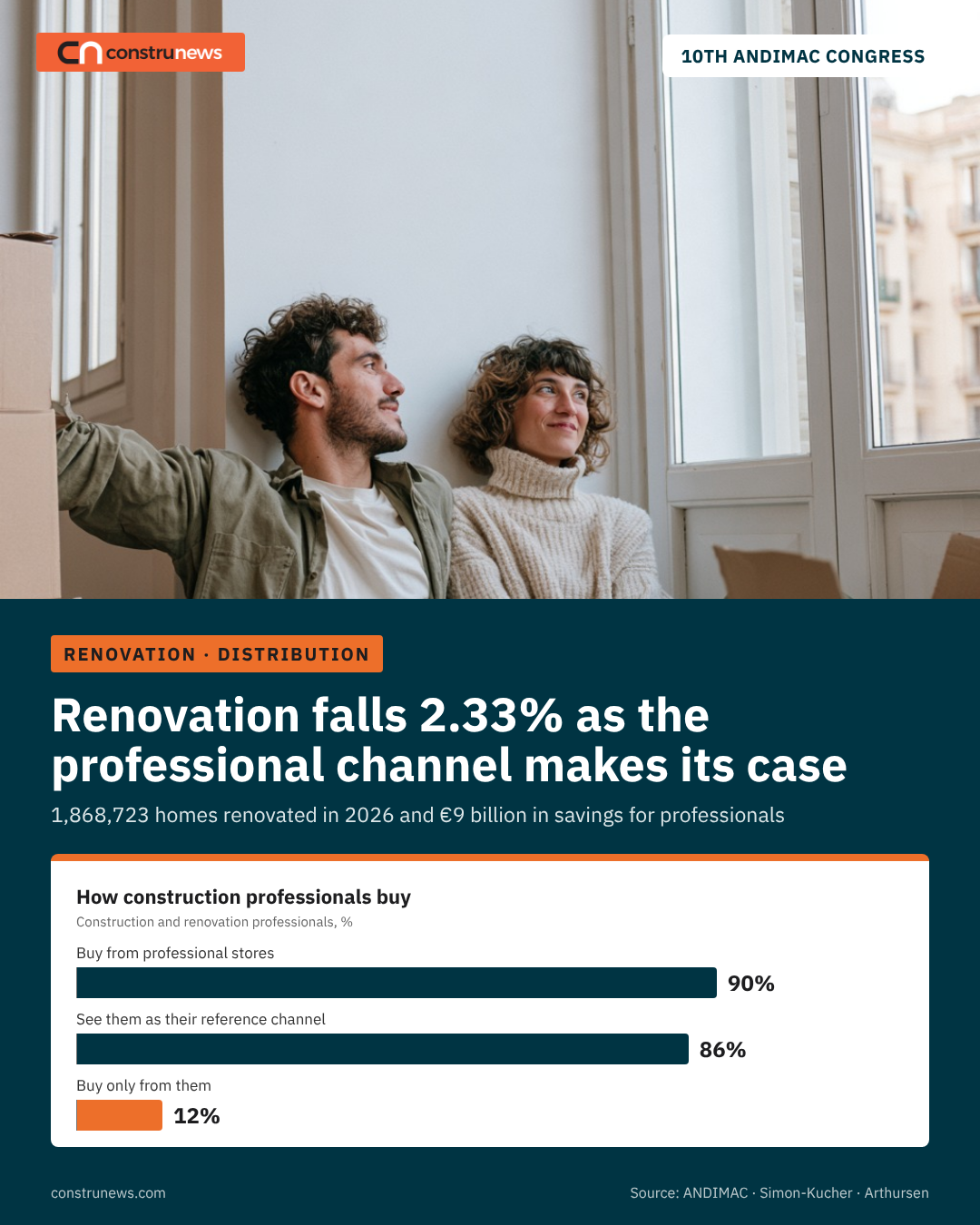


Spain will renovate 1,868,723 homes this year, 2.33% fewer than in 2025, against a backdrop of falling second-hand home sales, inflation and labour shortages. The figures were presented at ANDIMAC’s 10th Congress, which also quantified the savings, productivity and financing that professional distribution brings to the sector.
Spain will renovate 1,868,723 homes this year, 2.33% fewer than in 2025, according to the annual forecasts prepared by consultancy Arthursen for ANDIMAC, the association of professional distributors of construction materials, plumbing and HVAC. The employers’ association attributes the decline mainly to three factors: the drop in second-hand home sales, the impact of inflation on households and the labour shortage affecting the renovation and refurbishment sector.
The figure breaks with last year’s trend, when the association forecast 1.6% growth in renovations for 2025.
Meanwhile, average spending per household remains stable at around €1,300, despite rising material costs. According to ANDIMAC, inflationary pressure is holding back household spending and limiting renovation activity.
An ageing housing stock
On top of this comes the ageing of the housing stock. In 2026, some 338,500 homes will turn 18 years old, underlining the need to promote renovation and refurbishment work to improve the condition of homes and buildings. In absolute terms, some 25 million homes are already more than 18 years old.
In 2026, some 338,500 homes will turn 18, and the stock already past that age stands at 25 million homes.
All these figures were presented at the 10th ANDIMAC Congress, held on 28 and 29 October in Guadalajara under the slogan “The value of the professional”, which coincided with the 20th anniversary of an association established as the voice of the professional distribution of construction materials, plumbing and HVAC.
Nine out of ten professionals buy from specialist stores
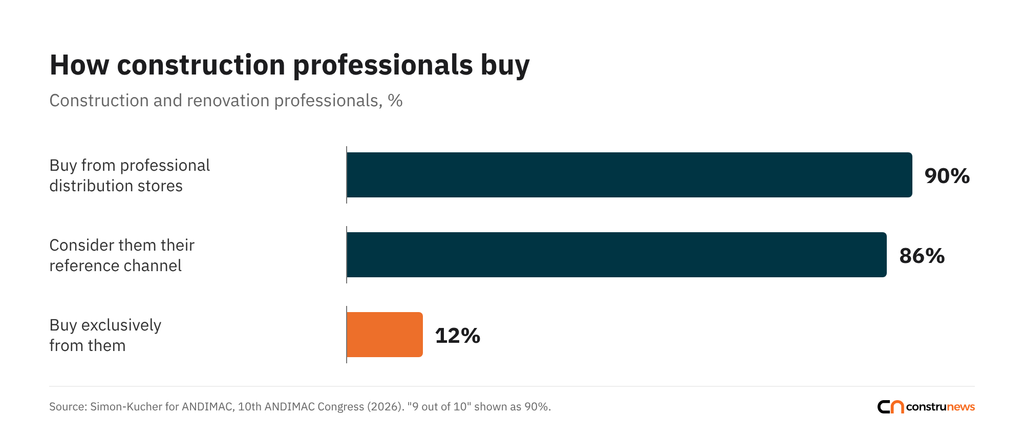
The congress also revealed that 9 out of 10 construction and renovation professionals buy from professional stores distributing materials, plumbing and HVAC products. This is the finding of a report by consultancy Simon-Kucher, which reflects the value professionals find in a distribution model that goes far beyond selling products.
In fact, 86% consider it their reference channel, although only 12% buy exclusively through it.
Solving problems and making daily site work easier
ANDIMAC maintains that the main strength of specialist stores lies in their ability to solve problems and make day-to-day site work easier. Professionals highlight trust in their sales staff, direct delivery to site, availability of materials and technical advice. Compared with large retail outlets, the professional channel is better able to reduce technical errors that directly affect deadlines, costs and productivity.
All this translates into time savings, fewer incidents and better-quality work, representing a productivity gain of between 9% and 12% compared with distribution models that do not provide services like those of professional distribution. The association stresses the importance of this figure at a time when the sector’s main problem is the shortage of labour: boosting professionals’ productivity improves the ratio of units produced.
Specialist stores generate average savings of 10% to 12% per purchase, an estimated value of around €9 billion.
In economic terms, specialist materials stores generate average savings of between 10% and 12% per purchase, representing an estimated value of around €9 billion.
More than €5.7 billion in extra financing for the market
In addition, the professional industrial and construction distribution sector as a whole (steel, timber, electrical…) provides the market with extra financing of just over €5.7 billion, by selling its products with an average payment term of around 70 days. Expressed in terms of the value of materials in a new home, this figure is equivalent to financing the materials for an outstanding balance of some 67,000 homes.
By selling on an average 70-day term, professional distribution finances the market with over €5.7 billion, the equivalent of 67,000 homes.
Large retailers versus the specialist channel
ANDIMAC acknowledges that large retailers retain advantages in price perception, promotions and accessibility, especially for small purchases and standard products that require little advice. However, it stresses that when a purchase demands technical knowledge, coordination, delivery to site or the ability to respond to the unexpected, professionals opt for specialist stores.
The employers’ organisation also warns of the risk posed by distribution models able to shape the basic building basket by setting a range of high-turnover products without depth in specific solutions. In its view, this can lead to optimal products and solutions being replaced by others that merely “tick the box” but deliver poorer performance some time after installation.
The challenge: making the professional channel’s value visible
For Sebastián Molinero, secretary general of ANDIMAC, “the challenge for the professional channel now is to make that value more visible and get the market to recognise it. Specialist stores must better explain how much time and money they save their customers, highlight their services, adapt their offering to each professional’s needs and make the buying process as easy as possible. The key is not to be the cheapest, but to show why their service is worth more.”
ANDIMAC represents the professional distribution of construction materials, plumbing and HVAC and defends the interests of more than a thousand companies, acting as the sector’s spokesperson before the Spanish Administration on Trade and Housing matters. It also holds this representation in bodies such as the Executive Committee of the Spanish Confederation of Commerce (CEC). Internationally, it defends the sector’s interests in the EU through the European Federation of National Associations of Building Materials Distributors (UFEMAT), which it currently chairs.