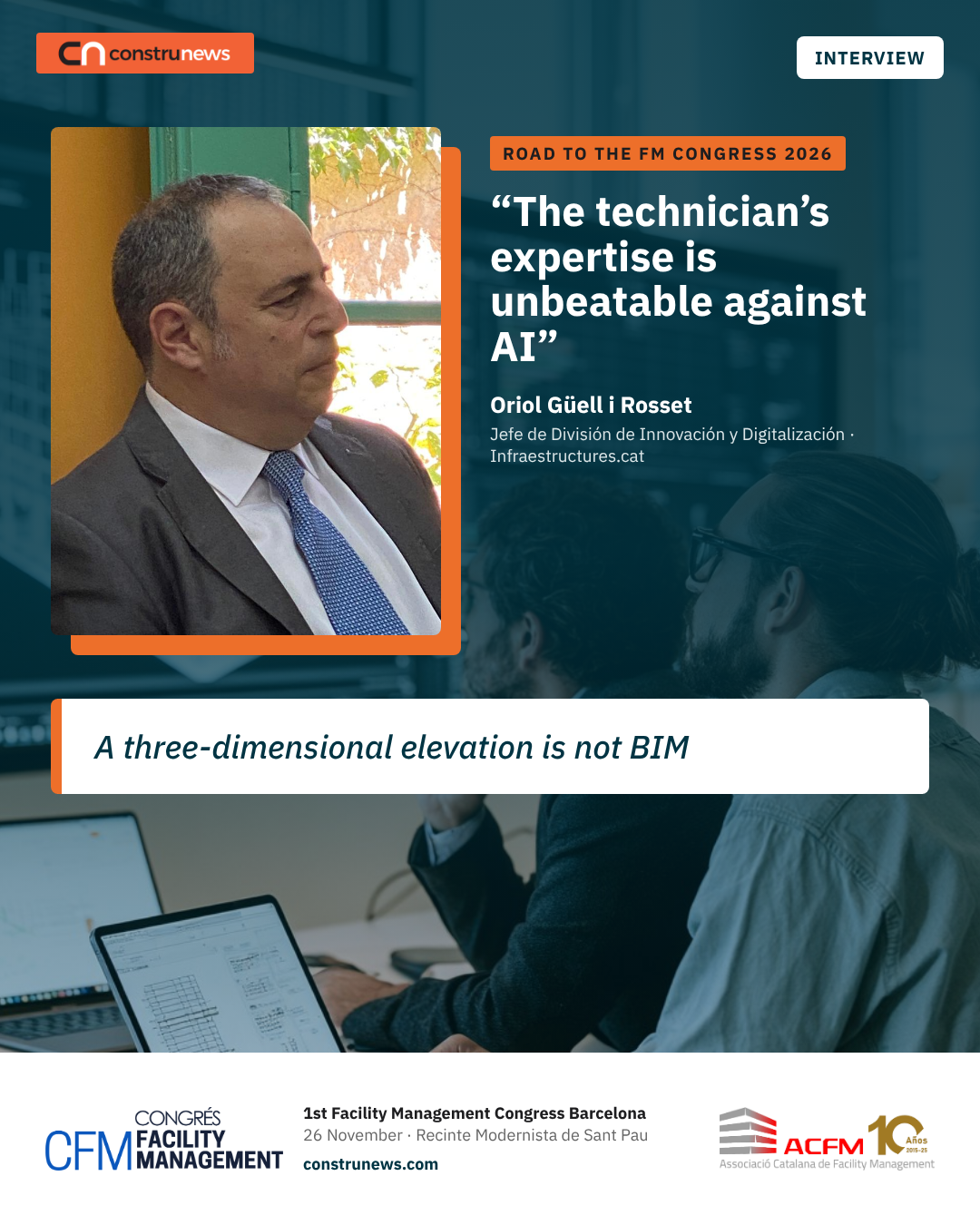

 on managing data for a thousand public buildings, AI and the FM Congress Barcelona 2026.)
On 26 November, Barcelona’s Recinte Modernista de Sant Pau will host the 1st Facility Management Congress Barcelona 2026 (CFMBCN26), organised by the Catalan Facility Management Association (ACFM) as part of the World Capital of Architecture programme. Under the motto “Transforming spaces, connecting people”, the main day will feature seven panel debates on strategy and governance, digitalisation and smart facilities, sustainability and energy, regulation and costs, maintenance, risk and user experience. In the run-up, Construnews is publishing a series of six interviews with professionals from the sector.
The series continues with Oriol Güell i Rosset, Jefe de División de Innovación y Digitalización de Infraestructures.cat y miembro del Comité Científico del Congreso de Facility Management Barcelona 2026.
Three wishes for the congress
On 26 November Barcelona holds its first Facility Management Congress at the Recinte Modernista de Sant Pau. What has to happen that day for us to be able to say, a year from now, that the congress changed something in the sector?
For me there are three things which, moreover, have come up again and again with colleagues on the Technical Committee and in the facility management association itself. The first is that, in general, facility managers should not appear after construction, after the building services have been designed, but should already be there at the design stage, during preparation and sizing, that is, in the functional brief itself; that we are able to have our say, because there are insights we bring that are crucial for the subsequent use of the building.
The second is that I would like this congress to generate action, so that we do not stop at a diagnosis, a description of what is happening to all of us. This may well be the congress’s main virtue: having a dedicated networking space, a meeting point that we hope will consolidate over time, from which concrete collaborations can emerge, projects can get under way, we can question ourselves, ask one another questions and present what we are doing in order to share experiences. And from there, new contacts, new contracts, new collaborations, and something tangible as a result.
And finally, just as I was saying it would be very good for the facility manager to appear in the earlier phase, I would also like us, when conceiving the property, the real estate asset, with everything it means as a place to live, work or produce, not to think of it only at the design and construction stage, but to engage fully with the life cycle of the building. Linked to this, the great challenges we face as humanity have to do with emissions, energy consumption, sustainability and circularity, and facility management has a great deal to say in all of them.
So what I would like is for these three points, generating action, intervening in the phase before construction and, above all, above all, in the phase afterwards, to become a reality.
A career that sums up facility management
You have been a maintenance technician, energy manager, chief executive and now head of innovation. How does facility management look from each of these seats?
In fact, the facility manager is precisely the profile that encompasses them all. It is the story of my professional life: this is my life. It begins with maintenance, and facility management fits squarely there: control of operations, guaranteeing service continuity, sizing, in every sense, how the building services and operations work. All of that falls within facility management, and I would say that a maintenance professional eager to improve evolves quickly towards the other areas, which have also been stages of my career.
I started as a maintenance manager with a very strong calling to move into energy. And once again, in the operation of buildings, facility management has a fundamental criterion that has to do with the wellbeing of occupants, the proper functioning of the services and the profit and loss account, the operating account of the building, and that is where the energy chapter comes in: both the energy consumed and, now, the energy produced in the buildings themselves and the energy a building shares with its neighbouring buildings. This highly sophisticated aspect, which even goes beyond the figure of the energy manager, is also part of facility management.
The innovation and digitalisation side, where I am now, is also a natural evolution, a consequence of what I was doing before. It is essential: maintenance makes no sense, energy management makes no sense, without digital support, a candelabrum holding up all the operations linked to these services.
And finally, the chief executive, managerial side. Facility management is a crucial aspect of any business, so crucial that it rises to board level. Of course you have to focus on the core activity of your business, but that core activity will not be real, will not be effective, unless you have the whole facility management side covered, with everything that entails: maintenance, energy management or digital services, which facility management is filling in, all of them.
A thousand buildings in one data space
As a media outlet, Construnews talks especially about data linked to the AECO sector. We are very interested in learning what the Infraestructures.cat orchestrator is, what data it gathers and how many buildings or facilities you manage.
I am glad you ask, because, in the sense of professional evolution I was describing, this orchestrator, which is the commercial name of our data space, would be the culmination of the digitalisation process we have been carrying out. At first, from the maintenance point of view, to make operations easier, remote control and operating the BMS remotely are an advantage when managing these buildings. Monitoring environmental variables and variables linked to energy consumption is a necessity for energy management.
What I am telling you is that you start installing hardware, controllers, sensors. You realise that this material base matters, and that it then expands with the notion of IoT, with all the sensing, which takes many forms of deployment and many protocols. But what is essential is the data. And using that data, organising it, curating it and exploiting it to generate new services, is what is fundamental. The orchestrator is this data space of ours, which has been maturing until it has reached a certain point.
Today we are serving around a thousand buildings. In some of them we carry out energy management and, in a similar share, remote management of the building services. Out of the total of this thousand, we are talking about some 400 in which we have both energy management and remote control. We started with… there weren’t even three hundred. We are at a thousand. The outlook is that in the medium term we will be handling a range of 3,000 to 5,000 public facilities, which soon, I hope, will include not only buildings belonging strictly to the Generalitat and its public sector but also buildings assigned to other administrative bodies, such as town councils, county councils and others.
From my perspective, from the stage of maturity we have reached at Infraestructures, what we see above all is data: the need to capture it, to organise it in this space of ours that is the orchestrator and, from there, to start generating new services. We have already reached the stage in which these data spaces are used to build viewers and dashboards. We already report to the board of directors and to the Government of Catalonia, for example, on how the Pla Genercat is progressing, on whether or not we are meeting the savings targets that the Government itself sets for the buildings it entrusts to us.
We are now at a stage where we have run pilots in several areas and are planning how to scale up prediction solutions, for example in energy consumption or generation, or in condition-based maintenance, to know how close a failure is, that is, predictive maintenance. Beyond that, we are also asking what the projected useful life of a given asset is, in order to foresee how it should be replaced, as sustainably as possible, as financially affordable as possible and in a way that fits the service we owe our clients and the users of public facilities.
I have talked little about data and a lot about service, because in the end that is exactly what it is about.
A 10% saving is achieved immediately simply by installing sensors and remote control, and we exceed it comfortably
The missing data
You have another chance to talk about data, because you launched a challenge at Smart City on missing data. Why is incomplete data today the main obstacle to energy management, more than technology?
In general, any data space will be defined above all by the quality of its data. We cannot make predictions, we cannot remunerate savings targets, we cannot inform our clients of consumption or production forecasts if the data from which we have to infer those results do not exist. So the data quality chapter is crucial for us, as is being able to reconstruct data on solid scientific foundations, drawing on everything machine learning offers today or the application of artificial intelligence in its various forms, to make these data consistent. This is fundamental for us.
And, as you mention, in the Smart City – Open Innovation Challenge we have launched, one strand is filling the data gaps that inevitably occur in the operation of any real system, due to improper handling of the installations, communication problems or routine updates that create a temporary gap. To recover these data, in addition to the physical intervention that lets you retrieve them from local memories at the perimeter, at the edge of the installations, what we aim to do is develop solutions in this specific area that allow us to fill those gaps with calculated values. Firmly calculated.
The next step we present as a follow-on is that, since we are able to infer the values in these gaps, we look at the values of future gaps so that we can make predictions. We would like to predict in the very short term, for the following week’s operation, but also over a longer horizon, so that the Government departments, which are our clients and work on an annual, strictly annual, budgetary logic, can make their forecasts on the basis of consistent estimates that we provide. That is a significant technical challenge. That is why we are putting it forward.
Remote management: from a flood of calls to savings
Infraestructures.cat has a building services telematics unit. What savings or service improvement have you been able to measure since buildings have been managed remotely?
The objective measure, and this may sound unserious, can be seen for example in schools. A special season is Christmas: usually there is very sharp cold in some parts of the country and a break in activity that involves switching off the installations, sometimes in a rather disorderly way. After Epiphany, when the children, teachers and staff return, you get a flood of calls under the heading “The heating isn’t working”.
What we have perceived, very clearly and forcefully, is that being able to operate and interact with the installations remotely allows you to distinguish what is really a problem, a fault that requires immediate intervention, from what is simply an omission, an improper shutdown at the time. Operating remotely, the system starts up again without any problem, the school opens on the first day after the holidays in perfect comfort and you are concentrating efforts where they are really needed. Unlike before, when you had a roving team going round all the schools that reported problems, without being able to tell remotely what was going on. It may seem trivial, but it is not at all. There is no index, no KPI that measures it, but it is something all of us, colleagues, have perceived.
Beyond that, there is also the immediacy of day-to-day work. This is the prevailing mindset right now, we are all on the same wavelength: we need this remote access to the facility because it gives us a presence, an ability to interact that would otherwise overwhelm our capacity. It is no longer a question of saving a few kilowatts, although that too, but of being able to step in quickly to meet our users’ needs through these remotely managed installations.
That said, from the energy management team’s side, controlling phantom consumption, the consumption that appears at times when it should not be there, and wrongly set setpoints, all of that pays off. Without a consolidated measurement and verification system I cannot give you a figure you can stand on, but the standard, the common view in the sector, is that a 10% saving is achieved immediately simply by installing sensors and remote control, and we exceed it comfortably.
Artificial intelligence: where the line lies
You mentioned triviality. A few years ago we still heard that the internet was the future, and it has become something trivial. Now AI is in our very bones, and this is not at all a trivial question: in which maintenance or energy decisions is artificial intelligence already helping in the public sector, and where would you draw the line?
It is a very good question, because, I will tell you, without realising it we are already using artificial intelligence solutions in all their forms, from conventional machine learning to generative AI and deep learning, and they appear as a component of solutions within our reach or that we have deployed. So right now the point is not to discuss whether it is needed or not: it is being used. We are using it for anomaly prediction, for example, for consumption estimates or for detecting abnormal drifts that allow us to intervene on the installations. Whether we are aware of it or not, artificial intelligence is already there, supporting very well-defined, very specific questions.
Where it should not go or, to put it another way, what artificial intelligence should not replace. People can say whatever they like, they can speculate on Twitter, in the media, on social networks, that artificial intelligence has come to push us aside. My experience, and derived from it, my conviction, is that natural intelligence, expertise, intuition consolidated through study, years of interest and hard graft, if you will allow me to put it that way, is unbeatable against artificial intelligence.
The judgement that lets you tell an anomaly, an outlier, a meaningless value you should ignore, from what is really a symptom that something is happening, is still today, and I have the feeling it will be for a long time, the preserve of the technicians, men and women, who lead the service. And that is something you cannot do without. I do not mean only that we have to serve as model trainers, but that the ultimate decision-making capacity must always rest with the person, with the technician, with their background and their expertise, which provides a differential that no artificial intelligence tool has replaced to date.
Moreover, the public sector, which administers public money and is therefore accountable to citizens for it, needs things to be explainable, traceable and auditable. This sets a limit and must shape solutions in such a way that certain probabilistic applications have to be taken with some reservations. That is where the line would be.
The ultimate decision-making capacity must always rest with the person, with the technician
Innovating within procurement law
In relation to what you have just said, public procurement usually lags behind innovation. How can a public company test new solutions, from start-ups for example, without breaking procurement law?
Procurement law makes it perfectly possible, and once again I appeal to experience, to procure innovation, to procure research and development, and moreover to do so tailored to the needs of the various bodies, entities and departments of this government and of any government. Speaking from recent memory: we have just come out of a public procurement of innovation process that is now being awarded. In previous years we have taken part in public procurements of innovation that follow what the Public Sector Contracts Act requires, because those tools exist. There is no further problem with that.
Likewise, it is possible to run pilots with adapted, but not anomalous, arrangements; by no means illegal or in a legal grey area. They simply require in-depth knowledge of public procurement and, above all, the ability to define what the needs are so that they can then be incorporated into the texts that must legally underpin a tender: the technical specifications and the administrative clauses. That said, you can develop whatever you want and, as I say, we have not had any kind of problem at any time.
BIM and digital twins: what for and at what cost
Digital twins, BIM in operation, sensors. What is realistic today for such a large public portfolio, and what is still a sales pitch?
What is fundamental, as I mentioned before, is the data space, being able to capture. That is the sensing chapter, the communications chapter, the services linked to this capture and communication, with special emphasis on everything to do with physical security and cybersecurity. From there, the data spaces and data environments described within BIM itself are extraordinarily useful, as ordered and curated data repositories.
That said, and specialists know far more about BIM than I do, you often find that the notion of BIM is reduced to a 3D render. A three-dimensional elevation is not BIM. What matters is being able to link the topology to the place, to a specific location where there is a certain type of installation, and the data linked to that item, whether static, catalogue or commercial data, or operational data provided by the BMS or other elements that let you control the various installations. To sum up: BIM as a way of organising data and, moreover, giving it physical meaning, because it is closely linked to the make-up of the physical asset. Hence the digital twin question. In that sense it makes sense. It does not if it is considered merely a render which, well, you have it to do what?
Because the question you have to answer when you adopt BIM methodology or consider a machine learning algorithm is: that’s all very well, but what do I want it for? And at what cost? Because all of this has specific costs. In certain highly complex buildings, the demand comes from the very technicians responsible for managing them: we would need to model these installations or this place, or develop a machine learning solution based on data science to tackle this issue, which is a pain point for us. That is where the answer comes from. What is not needed, and now I am thinking of the most remote school in the country, is a fantastic three-dimensional rendering that nobody will look at, that will not provide any information you could not gather with much more modest and much more useful means.
Looking to the medium term
A double question to finish: how do you see the evolution of facility management and your own professional development in the medium term?
As for facility management, I think I already pointed it out at the beginning. There are challenges on a global scale: the future of the planet is tied to tackling some basic issues that are closely linked to the way we manage the places where we live. Those places are facilities: our offices, our homes, the infrastructure that serves us. From there, facility management speaks to the resilience we must give these installations, to their energy and communication needs, and it does so by adopting new perspectives, which is where the sector is unquestionably heading, because that is where we, as professionals, as citizens, as human beings, must make a difference: nature-based solutions, resilience solutions, solutions that tackle emissions and the recirculation of what we build, and that ensure a set of assets, a support for our homes and offices, that meets sustainability criteria in all its dimensions.
And this last question surprises me. I have not thought about what the next years of my career should be. Right now I am very happy doing what I do and this evolution is truly very satisfying. I don’t know, perhaps I am also becoming aware that I am getting on a bit, and what I would like is to be able to focus also on training people who will take on these challenges much better than I could. With the same enthusiasm, though, and more if possible, with which I would like to keep tackling them in the coming years.
A three-dimensional elevation is not BIM
Güell explains that Infraestructures.cat’s data space serves a thousand public buildings, 400 of them with energy management and remote control, and expects to reach 3,000 to 5,000. It exceeds the 10% immediate saving, and he sets a limit on AI: the final decision rests with the technician.