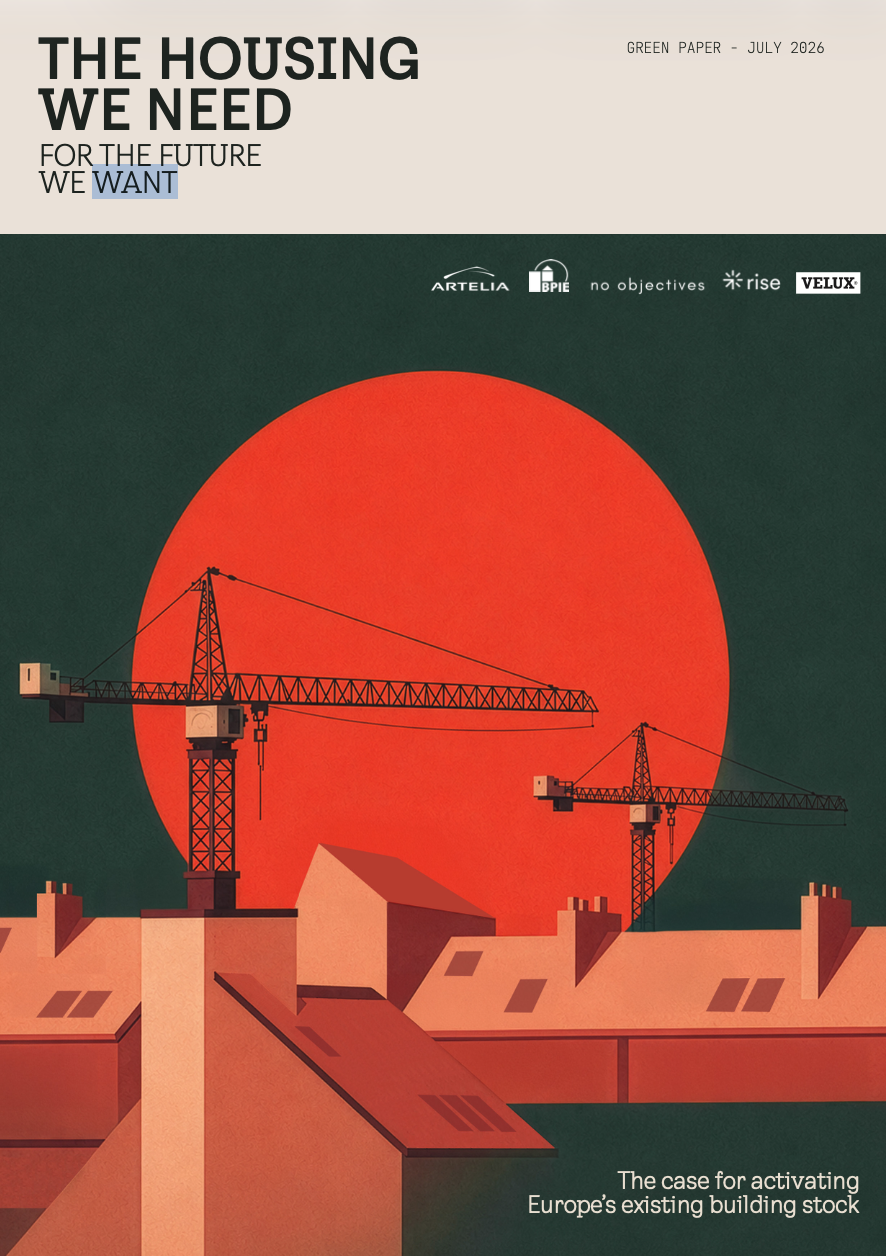


Building in the European Union sits at the centre of four interconnected crises: the lack of access to affordable housing, household health precariousness, energy insecurity and the climate emergency. A report prepared by the VELUX Group together with BPIE, no objectives, RISE Lab and Artelia concludes that the answer to housing stress does not lie in the intensive production of new construction, but in the strategic optimisation of the built heritage.
Europe faces an estimated demand of more than 2 million additional homes per year. At the same time, the building sector consumes 40% of final energy and generates 36% of greenhouse gas emissions, while 75% of the stock remains at energy-inefficient levels.
Against this backdrop, the report The Housing We Need For The Future We Want demonstrates, through exhaustive technical modelling, that 85% of the buildings Europe will inhabit in 2050 are already built. The conclusion is clear: the solution to housing stress does not lie in multiplying traditional new construction, but in making better use of what already exists.
A prioritisation framework to decarbonise the sector
To quantify this potential, the research analysed a universe of 21 billion square metres through more than 10,000 building archetypes, comparing the 50-year impact of nine residential capacity generation formulas. The result is the so-called Impact Framework, a prioritisation hierarchy designed to transform decision-making in public policy and industry:
- Priority renovation and optimisation: adapt, redistribute, recover empty homes, convert tertiary and industrial buildings to residential use and carry out deep energy retrofits before undertaking larger-scale interventions.
- Expansion and upward extension: fit out attics, add upper floors and build lateral extensions when renovation within the existing volume is not enough to absorb demand.
- New build as a last resort: restrict new construction to compact approaches under sufficiency principles, developed exclusively on urban voids or previously transformed land (brownfields).
Producing one square metre through compact new build requires 1,477 kg of materials and generates 1,606 kgCO₂eq over 50 years; a conversion requires 349 kg and avoids 2,695 kgCO₂eq.
The environmental gap between building new and transforming
The modelling data reveal a decisive sustainability gap between the different intervention models. Building one square metre of housing through compact new construction demands 1,477 kg of materials and generates a climate footprint of 1,606 kgCO₂eq over a 50-year life cycle.
Conversely, transforming an existing property to residential use requires 349 kg of materials per square metre and manages to avoid 2,695 kgCO₂eq, as the operational savings delivered by energy efficiency comfortably exceed the embodied emissions of the renovation works. This represents a net difference of 4.3 tonnes of CO₂eq per square metre in favour of intervening on what is already built.
The total intervention potential in the building stock would accommodate between 120 and 250 million people in the most stressed market areas.
Between 50 and 107 million homes
Applying this framework to the entire eligible European building stock, the research concludes that better-use measures, which include activating empty apartments, converting uses and deep renovations, would provide between 31 and 75 million homes.
Adding vertical and lateral extensions, and reserving compact new build only for the remainder of demand, the total achievable capacity stands at between 50 and 107 million homes. This volume is equivalent to a floor area of between 4 and 9 billion square metres and would guarantee residential access for a population of between 120 and 250 million people.
Macroeconomic impact, material savings and emission reductions
From a global climate impact perspective, prioritising the renovation and optimisation of the real estate heritage over new build would avoid the emission of between 3.9 and 19.1 gigatons of CO₂ equivalent over the next 50 years. 75% of this reduction comes directly from actions on existing structures. The sector’s energy demand would also fall by between 25% and 75%, paying back the carbon invested in renovation works within just 3 to 7 years.
At industry level, full adoption of the Impact Framework would cut the European construction industry’s carbon footprint by up to 32%. In macroeconomic terms, the avoided tonnes of CO₂ represent between 2% and 11% of all accumulated emissions from every sector of the European Union economy. The upper bracket of this estimate equals the total annual emissions of countries such as France or Spain, or the combined impact of the entire vehicle fleet on European roads.
Applying measures to make better use of the building stock would avoid between 5.8 and 13 gigatons of raw material consumption over the next 50 years.
On natural resources, the model calculates that containing material use would avoid the extraction and processing of between 5.8 and 13 Gt of raw materials, directly reducing pressure on ecosystems and slowing the biodiversity loss associated with mining and the manufacture of building components.
What it means for the Spanish housing market
Although the study stresses that these figures represent a technical potential to be weighed according to the location, ownership, costs and viability of each asset, its conclusions speak directly to the Spanish real estate debate.
Against a sector discourse focused mainly on the zoning of new developable land and the number of new building permits, the data from the VELUX and BPIE report show the need for precise diagnoses of the national building stock. Locating unoccupied properties, identifying building voids and lifting the regulatory and financing barriers that prevent their renovation is the most efficient way to respond to social demand without compromising climate goals.