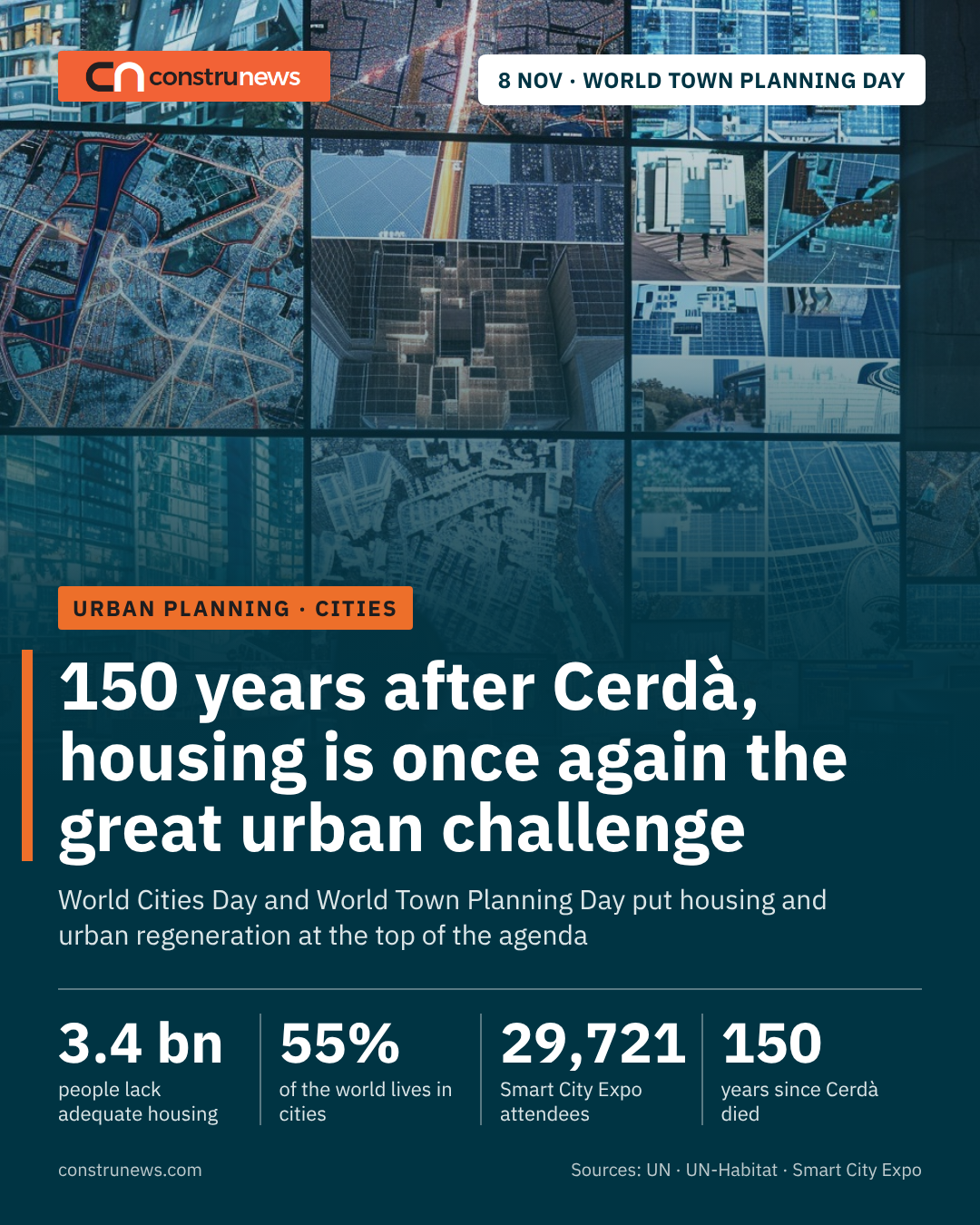


Today, 8 November, is World Town Planning Day, started in Buenos Aires in 1949 by professor Carlos María della Paolera. It comes one week after World Cities Day (31 October), which the United Nations dedicated this year to “Regenerating the City: Adequate Housing for All”, and in the middle of the Cerdà Year, which marks 150 years since the death of the author of Barcelona’s Eixample. Barcelona, World Capital of Architecture 2026, has just hosted the Smart City Expo World Congress and has several exhibitions on the city open.
Some figures explain on their own why urban planning matters. According to the United Nations, up to 3.4 billion people lack access to adequate housing and, according to UN-Habitat, more than 1.1 billion live in informal settlements and slums. The UN also notes that around 55% of the world’s population already lives in towns and cities, a share projected to reach almost 70% by 2050. Until 2009, more people still lived in rural than in urban areas.
Against this background, the two observances of recent weeks, World Cities Day and World Town Planning Day, are more than calendar dates: they gather congresses, exhibitions and debates in Spain, Europe and the rest of the world on how to plan, finance and transform the cities where most of humanity will live.
31 October: Fuzhou and urban regeneration as a route to housing
World Cities Day was established by the UN General Assembly through resolution 68/239 and was first celebrated in 2014. Every 31 October it closes Urban October, the month UN-Habitat devotes to urban challenges and the New Urban Agenda. This year Urban October opened on 5 October with World Habitat Day in Muscat (Oman), with adequate housing as the common thread.
The 2026 global observance was held on 31 October in Fuzhou (China), within a programme running until 2 November at the Fuzhou Strait International Conference and Exhibition Center, organised by China’s Ministry of Housing and Urban-Rural Development, the Fujian Provincial People’s Government and UN-Habitat. The theme, “Regenerating the City: Adequate Housing for All”, puts forward area-based regeneration, combined with housing and informal-settlement strategies, as a tool to create inclusive, climate-resilient neighbourhoods, led by communities and protected against displacement.
The 31 October ceremony included the presentation of the fourth-cycle Global Award for Sustainable Development in Cities (Shanghai Award). The programme announced by UN-Habitat also included forums on 1 November on planning, governance and delivery frameworks for adequate housing, the implementation of the New Urban Agenda and financing for inclusive urban regeneration, and an interactive exhibition with some 200 organisations and 50,000 expected visitors. Announced participants included UN-Habitat Executive Director Anacláudia Rossbach and ESCAP Executive Secretary Armida Salsiah Alisjahbana.
UN Secretary-General António Guterres sums it up in the observance’s institutional message: “Housing is more than just shelter. It is foundational to tackling inequality and speeding sustainable development.”
Up to 3.4 billion people lack adequate housing and more than 1.1 billion live in informal settlements, according to UN-Habitat.
8 November: 77 years of World Town Planning Day
World Town Planning Day was born in Buenos Aires in 1949 at the initiative of Argentine professor Carlos María della Paolera, a graduate of the Institut d’Urbanisme in Paris, according to the American Planning Association (APA). It is now celebrated in 30 countries on four continents, and 2026 marks its 77th anniversary.
The APA, together with the Canadian Institute of Planners, held a free online conference on 6 November under the theme “Navigating Change to Shape Better Futures”, with UN-Habitat’s Shubhagato Dasgupta as keynote speaker. The Global Planners Network, which brings together national and international planning associations, has issued a statement for the day titled “Great Communities are Built on Planning”. In the United Kingdom, the Royal Town Planning Institute (RTPI) is also among the bodies marking the date.
In Spain, the Catalogue of Publications of the General State Administration has devoted a selection of 24 publications on urban topics to the day.
The Cerdà Year: 150 years of the father of modern urban planning
The overlap with the Official Ildefons Cerdà Year gives the date special significance in Catalonia. Ildefons Cerdà i Sunyer (Centelles, 1815 – 1876), author of the 1859 Reform and Extension Plan for Barcelona (the Eixample) and of the General Theory of Urbanisation, died on 21 August 1876. He is regarded as the founder of contemporary urban planning.
The programme, presented on 16 March and officially opened on 16 April in the Saló de Cent of Barcelona City Council, is jointly promoted by the Col·legi d’Enginyers de Camins, Canals i Ports, the Architects’ Association of Catalonia (COAC), the Diputació de Barcelona, the Generalitat de Catalunya and the city councils of Centelles and Barcelona. At the presentation, Barcelona’s first deputy mayor, Laia Bonet, recalled that Cerdà’s thinking placed “housing and mobility as the two great facts of urbanisation”, two issues that remain central in 2026.
As part of the programme, the COAC hosted the exhibition “Modèliques. Cerdà als Top 10” from 23 July to 15 October, which Construnews reviewed at the time. The programme presented in March placed a Cerdà Seminar at the CCCB in November, under the theme “Ruralising the urban and urbanising the rural”, while the Diputació’s exhibition “Cerdà. Beyond the Eixample” will reach the Can Serra building (Rambla de Catalunya, 126) in December after Centelles. Mayor Jaume Collboni also announced a monument to Cerdà in Plaça de la Universitat, scheduled for the first quarter of 2027, a site he described as “one of the gateways between the old Barcelona and the new one he planned”. Cerdà and the future of the city were also the focus of a debate organised by Construnews at Cosentino City Barcelona.
Cerdà placed “housing and mobility as the two great facts of urbanisation”, Laia Bonet recalled at the launch of the Cerdà Year.
Smart City Expo: 29,721 attendees and housing as a new focus
From 3 to 5 November, the Gran Via venue of Fira de Barcelona hosted the 15th Smart City Expo World Congress, under the theme “Urban Solutions, Real Impact”. According to the official closing figures, the congress brought together 29,721 attendees from 140 countries, 1,276 exhibitors, 668 international experts and representatives of more than 1,000 cities. Affordable housing, climate change abatement and mobility were the main topics, with speakers such as former Paris mayor Anne Hidalgo, Atlanta mayor Andre Dickens and Anacláudia Rossbach.
At the World Smart City Awards, which received a record 533 proposals from 68 countries and introduced a housing category, Tokyo was named Smart City of 2026 for its “C³ Powering Tokyo” project. Madrid won the Governance & Economy award with “Madrid Intelligence in Action”, and Bogotá the Housing award with “Mi Casa en Bogotá”. The Leadership Award went to Bruce Katz.
Alongside it, HOWS Barcelona – Housing World Summit took place, the new international housing congress promoted by Barcelona City Council and organised by Fira de Barcelona, with more than 100 experts and five pillars: urban planning and land policy, housing regulation, social and affordable housing, building innovation and renovation, retrofit and reuse. The programme included a mayors’ roundtable led by Jaume Collboni, with the mayors of Milan, Budapest, Athens and Atlanta, and the participation of Eamon Ryan, chair of the European Commission’s Housing Advisory Board. The next Smart City Expo will be held on 2–4 November 2027.
Barcelona, capital of architecture: exhibitions on the city
The programme of Barcelona 2026, World Capital of Architecture, which closes on 13 December, currently includes several exhibitions focused on the city:
- “Wellbeing in the City”, curated by Izaskun Chinchilla, at the La Maternitat site until 13 December. It brings together almost fifty projects from Europe, Asia and Latin America around eight actions (being born, raising, sleeping, eating, healing, playing, socialising and walking) and asks whether investing in urban wellbeing is an expense or a strategic bet.
- EUROPAN 18 Spain prizewinners, with the work of 35 teams on nine sites under the theme “Re-sourcing. The Reborn City”, at Llotja, Escola d’Art i Disseny (Sant Andreu) until 29 November. Its opening launched the Inter-sessions Forum E18/E19 (5–7 November), where the EUROPAN 19 theme, “The Reborn City 2. Living Together”, was presented.
- “Building a Horizon”, on almost 30 years of cooperation between Barcelona and Gaza, including the Barcelona Peace Park in Tal Al-Hawa, at the Oliva Artés space of the Barcelona History Museum until 13 December.
- “Picasso: The Architect“, the Cateb’s “The Body We Inhabit“ and “Aldo Rossi and Grupo 2C” complete November’s exhibitions, together with the travelling show “From Party Walls to Façades. A Legacy for the City”, now in the Gràcia district.
The “From Party Walls to Façades” programme has already moved from paper to site: work has begun to transform ten party walls, one per district, selected from 439 proposals from 51 countries in a competition for young architects held with the UIA and UNESCO. The interventions cover around 4,000 m² and add vegetation, thermal insulation, new windows and refuges for urban biodiversity. Works will be completed during 2027.
From Party Walls to Façades will transform ten walls, around 4,000 m², chosen from 439 proposals from 51 countries.
Other events: green infrastructure, decarbonisation and Madrid
Barcelona also hosted the World Green Infrastructure Congress (WGIC26), organised by the University of Lleida, with attendees from 48 countries, which closed on 28 October at the CCIB calling for green infrastructure to be planned “as seriously as roads”. On 5 November, the fifth edition of “Decarbonising Architecture”, organised by the COAC and the CSCAE, discussed the future of housing in Europe with Matthew Baldwin, head of the European Commission’s Housing Task Force.
In Madrid, the COAM (Madrid Architects’ Association) has a call open until 10 November to select 16 projects for the exhibition of the second Madrid International Urban Forum, to be held on 14 and 15 December. The exhibition will add 20 international initiatives and ten panels from IBA Stuttgart. The first edition of the forum closed with a call for a quality, strategic and human city.
Why urban planning and cities matter
The thread linking all these events is the one Cerdà raised more than a century and a half ago: a city is either planned or suffered. Housing, mobility, water, health and climate are largely decided on the planning map. The UN agenda in Fuzhou, Smart City Expo’s choice of housing as a new track and Barcelona’s exhibitions on wellbeing, party walls and regeneration share one diagnosis: regenerating the existing city and guaranteeing access to housing have become the priorities of 21st-century urban planning.