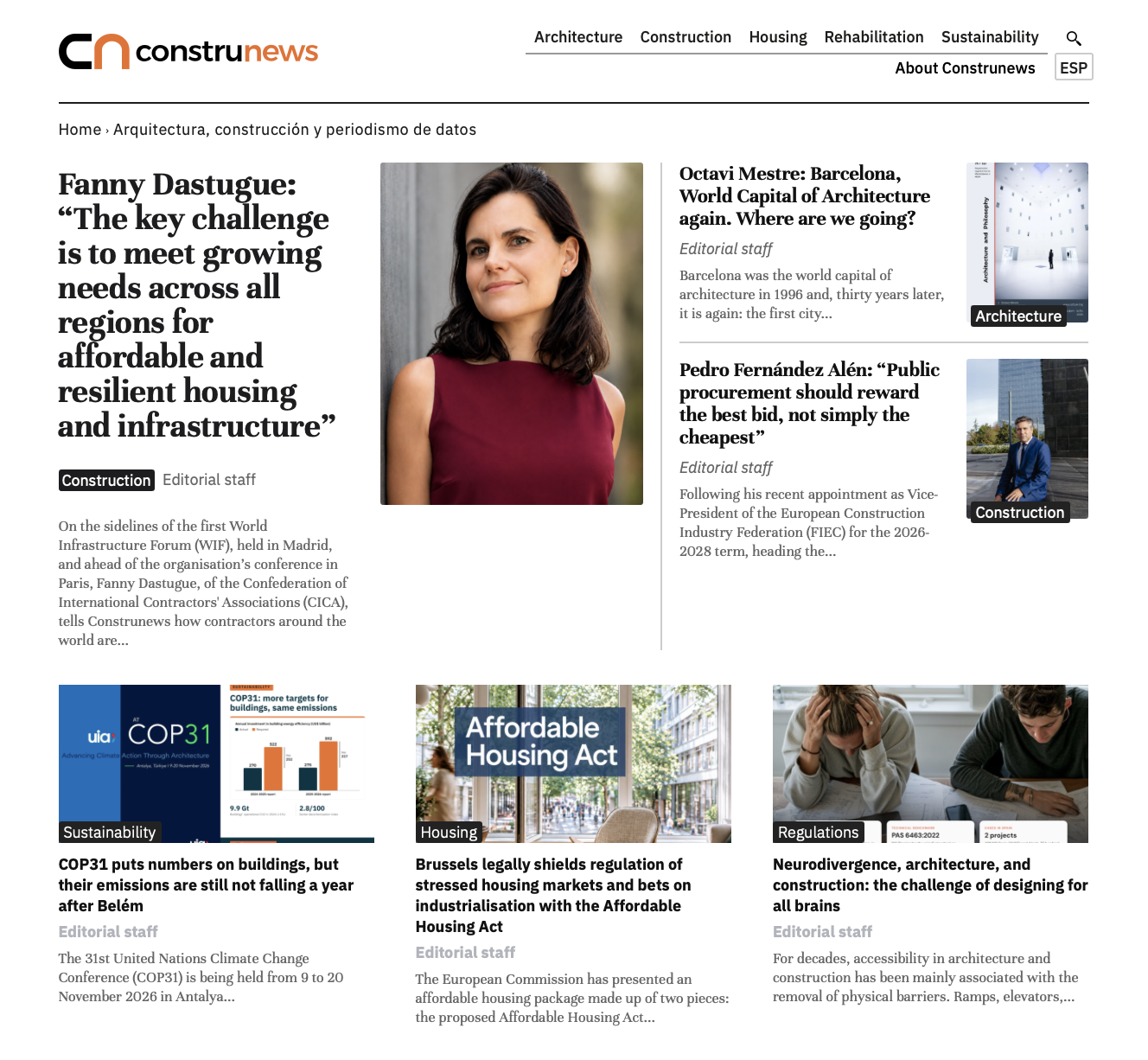


The new edition keeps the publication’s thematic structure, with Architecture, Construction, Housing, Rehabilitation and Sustainability sections, and readers can switch between versions from the masthead. Its aim is to bring to an international audience the content Construnews publishes in Spanish on housing, infrastructure, sustainability, architecture and engineering, and on all the players in the residential and construction sector.
Why an English edition
The decision stems from something that comes up again and again in the interviews, reports and data the publication works with every day: the shortage of affordable housing, the decarbonisation of the building stock, the lack of skilled labour, cost volatility and the modernisation of public procurement are not purely Spanish debates. They are discussed in Brussels, at international contractors’ conferences and in professional associations around the world, with diagnoses and figures that can be compared.
Construnews believes it can bring a different and closer perspective to that debate: the one that general-interest media ought to explain and often do not, across a field as broad as its own, from housing to infrastructure, through sustainability, architecture, engineering and the entire value chain of building and civil works. The English edition shares the editorial line of the Spanish one, based on data journalism, in-depth special reports and interviews with the sector’s key figures.
The AECO sector’s big problems are shared: housing, decarbonisation, skills and public procurement are debated worldwide with comparable figures
Three perspectives to open the front page
The front page of the new edition opens with three articles that reflect different and complementary views of the sector. This is no coincidence: each starts from a different scale (global, European and local), a different player (international contractors, the European industry federation and architecture) and a different genre (two interviews and an opinion essay).
The global view: the world’s contractors
The lead article is the interview with Fanny Dastugue, of the Confederation of International Contractors’ Associations (CICA), conducted on the sidelines of the first World Infrastructure Forum (WIF) in Madrid and ahead of the organisation’s conference in Paris, Building What Matters. Fanny Dastugue: “The key challenge is to meet growing needs across all regions for affordable and resilient housing and infrastructure”.
Hers is the viewpoint of contractors worldwide. Dastugue identifies the key challenge as meeting the growing need, in every region, for affordable and resilient housing and infrastructure, while maintaining and modernising existing assets. She adds a new factor: the management of water and energy in the face of demand from data centres and artificial intelligence infrastructure. She sets out CICA’s three lines of work (balanced contracts, better procurement practices and decarbonisation), the contractors’ missions planned to the Asian Development Bank (first quarter of 2027) and to the World Bank and the Inter-American Development Bank (second quarter of 2027), and the ConTech and PropTech Atlas. She also stresses how important it is for the sector to have specialised media and reliable data, and for English editions to connect professionals from different regions.
The local view: Barcelona, thirty years on
Alongside it, the front page features the text by Octavi Mestre, architect and curator of the Other Architectures series that accompanies the launch of the English edition. Octavi Mestre: Barcelona, World Capital of Architecture again. Where are we going?.
This is the view closest to the ground and to everyday professional practice. Mestre starts from a fact: Barcelona was world capital of architecture in 1996 and is again thirty years later, the first city in the world to achieve this twice. From there he reviews the Olympic legacy and the frameworks that shape architects’ work today. On bureaucracy, he recalls that in 1985 a 10-page report, a budget and 10 drawings were enough to obtain a permit, whereas a recent technical suitability report for renovating a Modernista building ran to 1,440 pages. On housing, he notes that the 30% social housing quota in every development produced barely fifty flats in eight years, and considers the target of 50,000 homes in four years, which he links to industrialisation, as ambitious as it is hard to achieve. On sustainability, he argues that there are no good or bad materials, only materials used well or poorly. He concludes that Catalan architecture is possibly one of the most vibrant in Europe.
One problem, housing, runs through all three articles: as a global need, as a European policy and as regulation that ties architects’ hands in Barcelona
The European view: the rules of the game
The third article is the interview with Pedro Fernández Alén, new Vice-President of the European Construction Industry Federation (FIEC) for the 2026-2028 term, heading Economic and Legal Affairs. Pedro Fernández Alén: “Public procurement should reward the best bid, not simply the cheapest”.
His focus is the EU regulation that sets the rules of the market. Fernández Alén outlines three priorities: the new EU Public Procurement Regulation, European housing policy and environmental and energy efficiency regulation. He calls for limits on in-house awards, progress on European preference (Made in Europe), mandatory price revision mechanisms and a move away from awarding contracts on price alone. He highlights that the text under negotiation provides for quality to account for at least 30% of the assessment of bids, rising to 50% in labour-intensive contracts. He also warns about competition from third-country operators working to different environmental and labour standards, recalls that taxes can account for around 30% of the cost of a home, and proposes talking about construction “with names and faces” to attract talent.
Why they complement each other
Read together, the three articles portray the sector from above, from the middle and from the ground. Dastugue describes the challenges at global scale and the role of multilateral banks; Fernández Alén explains how they translate into rules in the European Union; Mestre shows their effects on a specific city and on the daily work of an architecture practice.
The points of contact are clear. Housing runs through all three: as a global need at CICA, as EU policy and tax burden at FIEC, and as a problem of land, regulation and mobility in Barcelona. Procurement and risk-sharing link Dastugue and Fernández Alén, who both call for balanced contractual conditions and price indexation and revision mechanisms to cope with volatility. The shortage of skilled labour appears in both interviews, and Mestre ties it to the difficulty of industrialising housing. Sustainability is present in all three, from decarbonisation and resource management to criticism of greenwashing. And excessive or complex regulation connects the call for a clearer European framework with the experience of obtaining permits in Barcelona.
From above, from the middle and from the ground: CICA explains global challenges, FIEC the European rules and Octavi Mestre their effects on one city
The Other Architectures series
Mestre’s text is part of Other Architectures, the series of publications he is curating for Construnews to mark the launch of the English edition. The series brings together texts by architects, editors and academics from different backgrounds. Construnews had previously interviewed Mestre in Octavi Mestre: «Las ciudades también se construyen con las palabras» (in Spanish).
Alongside these three articles, the top of the English front page includes other current content from the publication, such as the analysis of COP31 and buildings, the European Commission’s Affordable Housing Act and the challenge of designing for neurodivergence in architecture and construction.