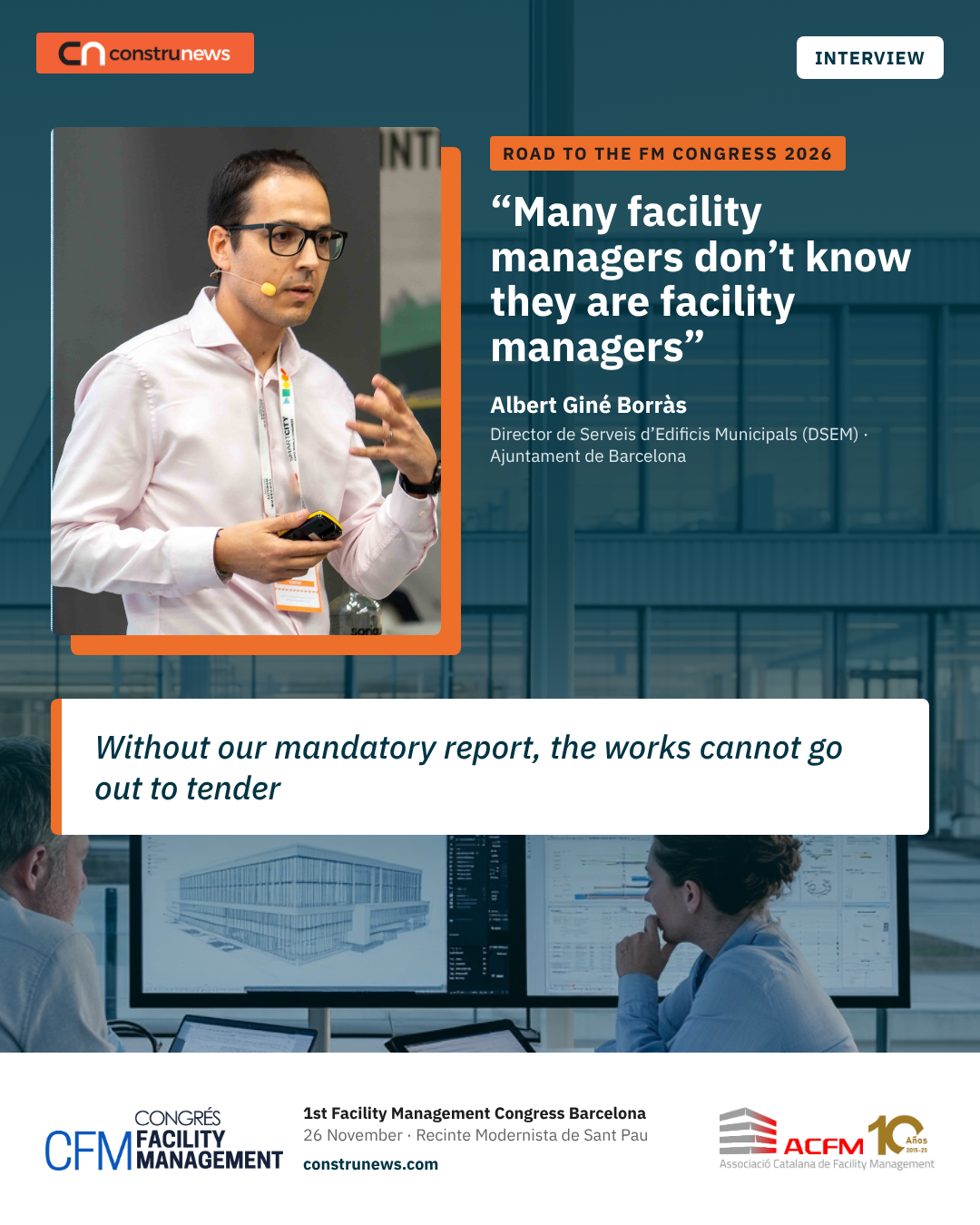

 explains how a 40-strong team manages contracts for around 1,500 municipal buildings.)
On 26 November, Barcelona’s Recinte Modernista de Sant Pau will host the 1st Facility Management Congress Barcelona 2026 (CFMBCN26), organised by the Catalan Facility Management Association (ACFM) as part of the World Capital of Architecture programme. Under the motto “Transforming spaces, connecting people”, the main day will feature seven panel debates on strategy and governance, digitalisation and smart facilities, sustainability and energy, regulation and costs, maintenance, risk and user experience. In the run-up, Construnews is publishing a series of six interviews with professionals from the sector. The series continues with Albert Giné Borràs, Director de Serveis d’Edificis Municipals (DSEM) de la Gerència de Serveis Generals de l’Ajuntament de Barcelona.
Making people understand what facility management is
On 26 November Barcelona holds its first Facility Management Congress at the Recinte Modernista de Sant Pau. What needs to happen that day so that, a year from now, we can say the congress changed something in the sector?
Well, first of all, I think what we need to achieve is the highest possible turnout over the three days, the 25th, 26th and 27th, but above all on the 26th: maximum attendance at the round tables and also, very importantly, the networking that takes place during the coffee break and at lunch.
But one of the most important issues, and one I always mention, is that there are many FMs who don’t know they are FMs. There are many people, many professionals working in the world of facility management who are not aware of it. And I think that, with the outreach being done, with all the effort we have put in over the year and a half spent organising the congress, now with the interviews and on the day itself, what we need to achieve is for people to know what facility management is. So, a year from now, what I hope is that many more people know what it is and that we can all come together.
Two hats for 1,500 buildings
The portfolio your directorate manages includes offices, facilities and other historic buildings. How do you organise a team to look after all these different types at the same time?
Today I have the privilege of leading the Direcció de Serveis d’Edificis Municipals. Our directorate is divided into four departments: three that are much more technical, with engineers, architects, technicians and senior technicians, and a fourth that is much more administrative, handling contract management and the financial side.
Whenever people ask me what we do in the directorate, I say that we wear two hats. One is much more strategic: we provide working tools to the rest of the organisation so that the other technical services can do their job and carry out maintenance, cleaning and so on. These are contractual tools: we put in place centralised contracts and framework agreements for maintenance and cleaning serving the districts and management divisions of Barcelona City Council, for approximately 1,500 buildings. But we also put in place framework agreements and contracts for the whole organisation, such as the telecommunications framework agreement, the electricity commission or aggregated purchasing: furniture, office supplies, fuel, travel and so on. In other words, we provide contractual tools so that everyone else can serve the organisation.
We have another type of tool, more focused on advice and support. We draw up instructions, such as the new workplace instruction, or instructions related to occupational risk prevention. We advise other departments on matters related to facility management. And finally we have another type of tool, ICT tools, where we offer tools such as the CMMS.
There are many professionals working in facility management who don’t know they are facility managers
No works go to tender without its report
Your directorate reviews new-build and refurbishment projects before they are built. Can you give a concrete example of a design decision that changed thanks to your review?
Yes. We are a REM, a municipal buildings officer, which reviews new-build and major refurbishment projects, just like others do, such as urban planning, the fire brigade or IT, so that the works can then go out to tender. Without our mandatory report, the works cannot go out to tender.
There are many examples. From a handrail with built-in lighting that could not be replaced once it broke, so the design had to be changed, to double-height glazing that could not be cleaned: what we did was integrate a mobile element, a mobile scaffold with its own storage room, so that both the double-height glazing and the lighting could be maintained. We had another double-height building where the cleaning space had only been planned on one level, so the cleaner had to go out into the street with the trolley, walk all the way round and enter the other space.
In other words, there are examples in every project. For some years now, every building we design at Barcelona City Council is designed with operation in mind: mainly with maintenance and cleaning in mind, so that it can be operated. They will therefore have the necessary cleaning rooms, maintenance spaces, room to service the HVAC units, roof access… All things that seem logical, but until a few years ago you would find that many projects did not include them.
Green energy and efficiency: two different things
And as a board member in the field of sustainable energy, how does the City Council decide which buildings to invest in first for energy efficiency?
Well, however closely related they are, sustainable energy and energy efficiency are two different things. If we focus on sustainable energy, Barcelona City Council has been buying green energy for many years. And since 2018 we have had an in-house provider, a retailer, Barcelona Energia, through which we manage and market all the energy consumed by the City Council, across the whole organisation. So, sustainable energy for many years, but since 2018 also with our own provider to manage and market Barcelona City Council’s own electricity supply. We have more than 100,000 supply points, covering buildings as well as street lighting, traffic lights and so on. It is not just buildings; it is also public space.
When it comes to energy efficiency, we have several mechanisms. Some are more opportunity-based: when you carry out a new build or a major refurbishment, the design already includes passive elements or energy sources such as geothermal. And in the existing portfolio we have different ways of acting. Sometimes we run single-theme projects, for example in Barcelona City Council’s libraries: we take all the libraries and carry out a public awareness campaign. In other words, sometimes you don’t need to invest in equipment; instead we provide training, awareness-raising or other kinds of action, because sometimes energy is not a matter of the HVAC systems but also of how the building is used. That is why acting through training is so important.
We do other things, such as the energy marathon, where we try to get certain buildings to use less energy for a few months, which also helps us raise people’s awareness. So we do a lot of awareness-raising and training among users. And then we try to use elements such as sensors and monitoring.
Building data sheets and time tracking
Maintenance and cleaning in municipal buildings are contracted in lots. How is service quality measured beyond the award price?
Within Barcelona City Council as an organisation there are currently several maintenance and cleaning contracts: the municipal institutes and affiliated bodies mostly tender their own. What our directorate does is put in place centralised maintenance and cleaning contracts for the fourteen management divisions: ten territorial ones, which are the districts, and four sectoral ones, and now also the Institut Municipal de Parcs i Jardins. These centralised contracts are divided into lots, for both maintenance and cleaning.
As for quality, we don’t hire a company to carry out quality control for us; we do it all internally through the technical services. Quality is monitored through inspections carried out by the City Council’s own technical staff, but also because, in the contracts, starting from the tender specifications, the cleaning side includes data sheets: what the building is like, what the materials are, what needs to be cleaned and how each element is cleaned. Each building is very clearly defined in a data sheet so that we know what has to be done. So there is control. There is also time tracking for the staff: the data sheet is linked to set schedules, and those hours must be clocked and must match exactly. And in maintenance, through the asset management software, we carry out and monitor all the preventive maintenance that has to be done, as well as all the corrective maintenance.
Heritage: expensive and short of specialists
The congress is being held at Sant Pau, a Modernista complex. What is different about maintaining a listed building, and how do you reconcile it with accessibility, energy and safety requirements?
Well, I don’t think heritage should be up for debate. It is part of our history and, if an element is listed because specialists have designated it as such, we must try to preserve it. And the difference is huge. I can speak about our own case: we have the Edifici Vell, the Casa de la Ciutat, which is a BCIN (Cultural Asset of National Interest) and is listed, and the biggest difference is that we need specialists such as cabinetmakers or stonemasons, everything to do with stone carving.
It is very complicated, and it is getting harder and harder. If it is already difficult to find installers or refrigeration technicians, it is even harder to find cabinetmakers, restorers, conservators, people who know how to work stone. It is very complicated and, when you do find them, it is very expensive. So we have a problem: maintaining heritage is expensive, maintaining a building with these characteristics is much more expensive, but it is also very hard to find specialists who can do it.
All the more so if we want this heritage to be in use. In our case, the Edifici Vell is a listed building with many heritage features, but it is in intensive use, both administrative and for events. It is the Saló de Plens, it is the Casa de la Ciutat. Everything happens there. So it is very difficult to reconcile keeping the building running at one hundred per cent, at two hundred per cent, with the need to preserve it. So yes, there is a big difference between a standard unlisted building and a listed heritage building.
Maintaining heritage is expensive, but it is also very hard to find specialists who can do it
How residents’ views are heard
Libraries, civic centres, schools: the users of municipal facilities are local residents. How do their views reach the people who decide on maintenance?
All these facilities, whether libraries, civic centres or any other neighbourhood facility, are managed at territorial level, that is, by the districts. Within the district structure there are several directorates, one of which is the Direcció de Serveis a les Persones i al Territori. These directorates have a number of technical staff who deal both with residents, on public space issues, and with the various managers, such as civic centre managers or library directors. So all the information gathering, harmonisation and standardisation is managed by the Direcció de Serveis a les Persones i al Territori.
This directorate holds regular meetings with the Direcció de Llicències i Espai Públic, which houses the works and maintenance departments and the technical staff responsible for managing, maintaining and carrying out the relevant works and adaptations in these buildings. It is true that maintenance staff deal with users and building directors every day, but the guidelines, the needs, and what each building, each civic centre, each neighbourhood facility or library, as well as public space, must meet, come to us from the directorates of services to people and territory. I spent eight years in a district, and those contacts were regular so that we could have, at the very least, a much more integrated relationship within the City Council.
An informal network between administrations
Beyond the relationship with users, as you know, at Construnews we are very interested in data. Other institutions, such as the City Council, the Generalitat and the Metropolitan Area, manage large building portfolios. Do you share data, criteria, contracts, or does everyone go their own way?
For some years now there has been the FMK network, an informal network of technical staff from Catalonia’s various public administrations: the Generalitat, the Diputació de Barcelona, the AMB, several city councils, consortia and so on. There we present the problems, concerns and projects of each administration, they are discussed, and a series of working groups emerges. These groups have produced instructions or guidelines on what new workspaces and workstations should be like, whether they should be non-assigned, and so on. Also environmental management, the interpretation of the Codi d’Accessibilitat, how buildings should be inventoried… In other words, the different groups of an informal network end up producing topics that are then standardised within each administration.
But there is no formal structure. It is not something that comes structured; we do it because we want to, and we connect with each other as professionals. We have been doing this for many years and it works very well for all of us in the public administration. On top of that, we hold thematic meetings with each administration when a specific issue comes up.
As for contracts, apart from those coming from the central purchasing bodies (the Generalitat and the Diputació de Barcelona have their own central purchasing bodies, which we can join and base our contracts on), the rest, no. Each has its own contracts, and it is certainly very complicated to share them. In fact, we are now working on environmental management applications: the Generalitat now has environmental management software, and we are trying to sign an agreement to be able to use exactly the same programme. It came out of an FMK network working group, the Generalitat has turned it into something real, and the City Council would like to use it through an agreement. Doing this is more complex than it seems from a contractual point of view.
As for data, each administration has its own. In fact, even within our own administration we are finding it very hard to normalise and standardise data so that it can be shared properly, because data that is not normalised means nothing; it is misleading. We do share general aggregate data, but day-to-day data… for now I think each of us has enough work within our own organisation.
Forty people, 52 public bodies
Something caught my attention at the start of the interview, when we were talking about the size of your team: there are 40 of you, if I’m not mistaken.
Yes, yes.
That makes me think about how a team should be sized in an institution and how you would apply this idea to the private sector, because I understand that private companies increasingly need to step up on facility management and that they lag behind the work you are doing in the public institutions.
I don’t know. It is true that Catalan public administrations have deeply internalised facility management and we are organising ourselves quite well to manage our assets properly. Not all of them, but yes. I think FM has to be a business vertical within the institution so that we can preserve all our facilities and ensure they are used as they should be, that is, so that they can serve citizens, basically.
With large corporations it depends, because there are corporations whose business is not real estate, so they outsource it. And that is where the problem lies: if, as a business, you don’t own your property and you outsource it to a third party, you are renting, and that is a different way of operating. But there are also many corporations that have their own facility manager. Especially in Madrid, they have found that the private sector is in much better shape than the public sector. But yes, I think we are a great example. Every day we realise more and more that we are, but we have to keep going.
And there aren’t many of us: there are forty of us, but the business we run is very large. We have a huge number of contracts, we serve 52 public bodies, plus the management divisions themselves, and we deal with six hundred professionals. It is very large, but we are a small team.
There are forty of us, but we serve 52 public bodies and deal with six hundred professionals
Giné leads a 40-strong team that contracts cleaning and maintenance for around 1,500 municipal buildings and serves 52 public bodies. No municipal works go to tender without its report, and quality is monitored through building data sheets, time tracking and in-house inspections.