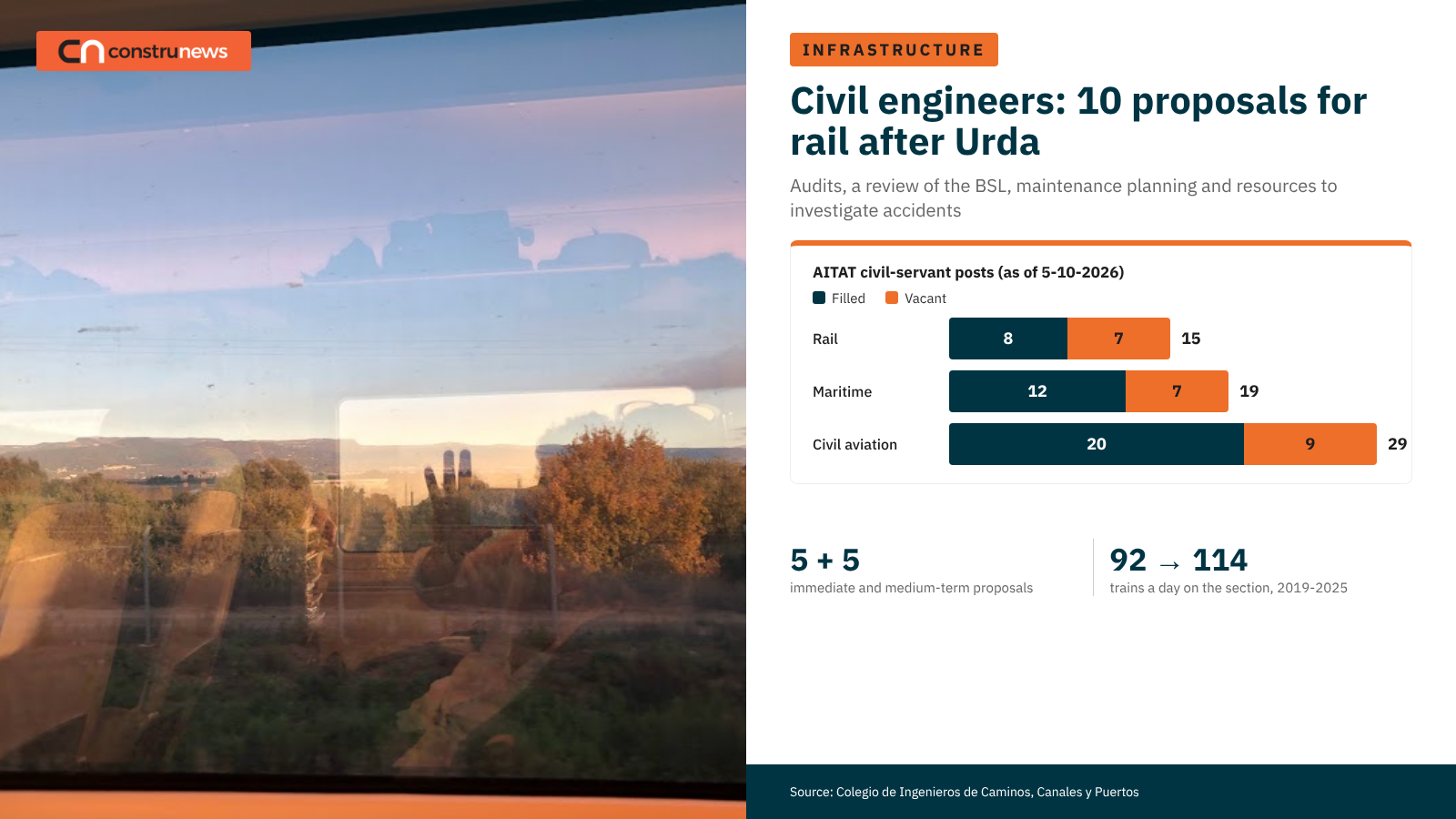


Two weeks after two high-speed trains collided at Urda (Toledo), the Colegio de Ingenieros de Caminos, Canales y Puertos (Spain’s Association of Civil Engineers) has presented the report «Diez claves técnicas y diez propuestas preliminares tras el accidente de Urda» (Ten technical keys and ten preliminary proposals after the Urda accident). It calls for an audit of the rail system, a review of the lateral signalling block (BSL) on the Madrid-Seville line, long-term planning of investment and maintenance, and adequate resources for accident investigators.
The report, dated 10 November and released on 11 November, was drawn up by the Comité de Seguimiento del Accidente Ferroviario de Urda, which the Colegio set up and convened on 28 October, the day of the accident. Its members are members of the Junta de Gobierno, deans of the Colegio’s regional branches (Demarcaciones) and rail sector experts, and it is led by the institution’s president and vice-president.
The proposals combine urgent measures with medium-term reforms and target the whole network, not just high-speed lines. The Committee explains that, although the accident happened on the high-speed network, “it cannot be separated from the network as a whole, and that is why many of them are generic in nature”.
The document includes a legal notice: its explanations do not constitute “technical conclusions, expert assessments, judgements of liability or institutional statements on the causes of the accident”, which are for the technical, administrative and judicial investigating bodies to establish.
The Committee’s first public assessment, led by Iñaki Barrón, portavoz del Comité de Seguimiento, and its estimate of €10 billion over ten years for high-speed maintenance have already been covered by Construnews. The report now published sets out that diagnosis in writing and organises it into specific proposals.
The ten proposals
The Colegio’s press release summarises the proposals as follows:
- Carry out a quality audit and a technical audit of the rail system and strengthen internal and external audits of the Traffic Safety Management System.
- Establish long-term rail planning and review investment priorities.
- Improve governance and coordination between the players in the rail system.
- Review working conditions, staffing levels and training of traffic control and driving staff.
- Strengthen the reliability of the equipment and supplies that support the safety systems.
- Develop a safe and redundant train positioning system.
- Ensure stable and predictable scheduling of renewals and maintenance.
- Ensure the quality of technical designs and rail procurement.
- Embed safety culture and continuous improvement at every level of rail organisations.
- Provide sufficient resources to the courts and the technical authority responsible for investigating accidents.
Investigating with resources: AITAT has vacancies
The first of the report’s immediate measures is to resource the courts and the Autoridad Administrativa Independiente para la Investigación Técnica de Accidentes e Incidentes ferroviarios, marítimos y de aviación civil (AITAT), the independent authority for the technical investigation of rail, maritime and civil aviation accidents created by Law 2/2024 of 1 August, which replaces the former CIAF. Its Board held its first meeting on 15 July 2026 in temporary premises in Madrid, while its permanent headquarters in Córdoba are being fitted out.
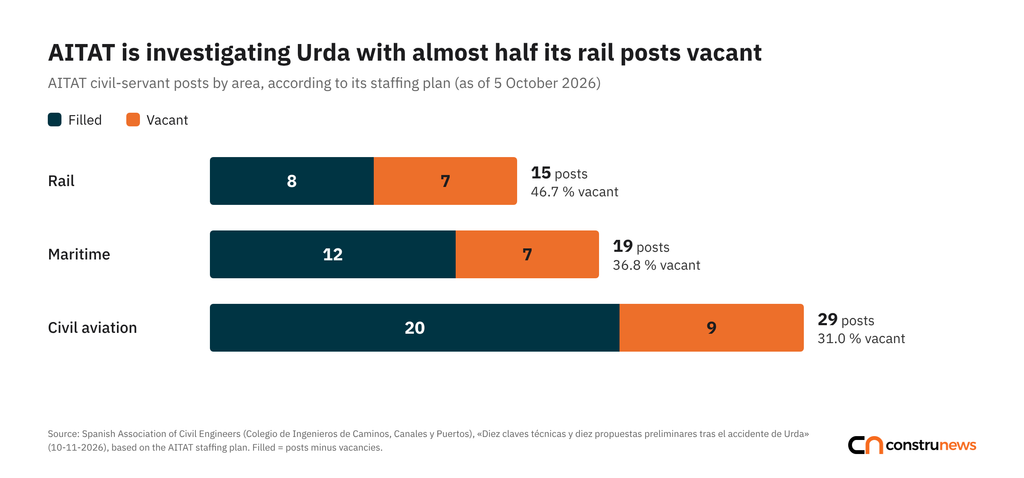
The report notes that AITAT is “in the midst of consolidating its structure”. According to its staffing plan, as of 5 October it had 15 civil-servant posts in rail, 19 in maritime and 29 in civil aviation, of which seven, seven and nine were vacant, respectively. In other words, almost half of its rail posts.
For the Committee, confidence in the system cannot be restored “unless the causes (direct, indirect and systemic)” of the accidents are known, not only at Urda but also at Adamuz, which has been under investigation for nine months.
AITAT had 7 of its 15 rail civil-servant posts vacant on 5 October, in the middle of the Adamuz investigation and before Urda
A system audit and a review of the BSL
The second immediate proposal is a thorough review of the rail system focusing on indirect and systemic causes. The report cites the Instituto de Estudios Económicos, which puts the network’s upkeep and maintenance deficit at more than €3.6 billion, and calls for a condition report on the components of each subsystem to prioritise decisions. It also asks for deeper audits of the Traffic Safety Management System, with a central role for the Agencia Estatal de Seguridad Ferroviaria (AESF), the national rail safety agency.
In relation to Urda, the Committee calls for specific actions:
- Study whether the BSL should be kept on high-speed lines, since it “complicates the installations and introduces more transition procedures”.
- If it is kept, strengthen the transition procedures between systems.
- In that case, add intermediate signals to the BSL on the Madrid-Seville line, with their balises, to shorten the block sections.
- Review “line-of-sight running” (“marcha a la vista”) so that it always includes a maximum numerical speed.
- Remove or reduce ambiguous references to speeds in the regulations, such as “normal speed”.
The report adds that Regulation (EU) 2024/1679 provides for the decommissioning of national class B systems, such as ASFA, by 2040 on the core network, but “provided that an adequate level of safety is guaranteed”. Until that level is demonstrated, including when the main system fails, the back-up must be maintained and, where necessary, reinforced.
People, equipment and train positioning
The third measure addresses the human factor, which remains decisive when incidents occur. The Committee calls for a review of the psychophysical and working conditions of traffic control and driving staff to detect overload or stress, and for checks on whether staffing levels are sufficient and whether the required training and experience are adequate. It proposes frequent training and simulations of incidents so that traffic controllers are familiar with them “and not because they occur with some frequency in normal service”.
The fourth calls for greater reliability and redundancy in the external equipment and supplies on which safety installations depend, such as power and communications, citing examples like redundant power feeds and uninterruptible power supplies (UPS).
The fifth proposes a redundant train positioning system, in addition to conventional track circuits, for example using GPS, to support remote train management when needed.
The engineers propose intermediate signals on the Madrid-Seville BSL and a maximum numerical speed for line-of-sight running
Medium term: planning and stable maintenance
As a starting point for medium-term reforms, the Committee proposes reviving the work of the 2014 technical-scientific commission, set up after the Angrois accident, whose document ran to more than 400 pages, and updating it with a new multidisciplinary committee that includes the Colegio.
On planning, the report notes that Spain has had no transport infrastructure plan in force since the PITVI 2014-2024, and cites Switzerland, which is already working with a proposed 2050 timetable. It calls for a review of an investment policy “perhaps too focused on new construction” and criticises the fact that the decision to keep the Iberian gauge, notified to the EU in July 2026, was not put to public consultation.
On maintenance, the Committee distinguishes between new build, renewal and upkeep, and notes that track components have a service life of 25 to 30 years. Its preliminary estimate matches the one already announced: at least €3.5 billion to maintain high-speed lines over ten years and a further €7 billion to reverse the deficit built up over the past 20 years. Without a stable framework, it warns, contractors cannot invest in equipment or staff.
Without a stable renewal and maintenance framework, the Committee warns, contractors cannot invest in equipment or staff
Governance, design quality and safety culture
The report calls for an assessment of the separation between Adif and Renfe introduced by Law 39/2003, an exercise that, according to the Committee, has never been carried out. It calls for a cross-party State pact with a 20 to 25-year vision, a review of the infrastructure manager’s organisational structure, more stable management and less political interference, and better management and transfer of knowledge, in the face of hasty early retirements and excessive outsourcing of inspection and maintenance.
On procurement, the Committee argues for high-quality technical designs, a proper valuation of engineering work and a balanced weighting of technical and economic criteria, and opposes the use of auctions in rail maintenance contracts.
Finally, it proposes restoring as a regulation a principle from the former Reglamento General de Circulación: staff who receive an order they consider compromises safety should say so and take the measures they consider appropriate. It also supports wider use of the common safety method in Implementing Regulation (EU) 402/2013 for risk assessment.
Ten technical keys to understanding the accident
The descriptive part of the report reproduces AITAT’s preliminary information: on 28 October at 8:53, at kilometre point 118+800 on track 2 of the Madrid-Seville line, Renfe AVE 2080 (379 passengers and 7 crew) ran into the back of Iryo train 6076 (147 passengers and 5 crew), which was stopped at the Urda entry signal, at an estimated speed of between 160 and 200 km/h. The provisional toll given in the document is 69 dead and more than 200 injured. The LZB system failure began at 8:31 and trains switched to running under the BSL.
The report explains how LZB, ETCS and the BSL with ASFA work. On the Madrid-Seville line, BSL signals are only located at station entries and exits, and the block section where the accident occurred ran from the exit of Mora y Orgaz to the entry to Urda. According to the document, AESF itself states that ASFA cannot be considered an automatic train protection system and, on a section with no intermediate signals like this one, it may be unable to protect a train stopped within the block section.
On traffic, the report states that the accident section went from about 92 trains a day in 2019 to about 114 in 2025 (up 24%), still far from the line’s capacity limit, although the increase does add to workloads during incidents and requires maintenance to be adapted. ETCS is still in verification and integration testing, expected to run until early 2027, and its roll-out is essentially driven by European interoperability. The Committee stresses that LZB is not an obsolete system: “it simply has not been chosen as the standard”.
The Colegio’s position
After the accident, Ricardo Martín de Bustamante, presidente del Colegio de Ingenieros de Caminos, Canales y Puertos, called for “an immediate improvement in the management of the rail system” and stressed that “our country has proven technical and professional capacity, so it cannot allow these tragic rail accidents to happen again”. The institution has stated that “Adif and Renfe hold technical capital that must be preserved” and has offered its cooperation to the Ministerio de Transportes y Movilidad Sostenible and Adif.
Construnews has followed the state of the network in pieces such as SEOPAN’s analysis of rail maintenance, the interview with Iñaki Barrón after Adamuz and “Rail infrastructure in Spain under strain”.