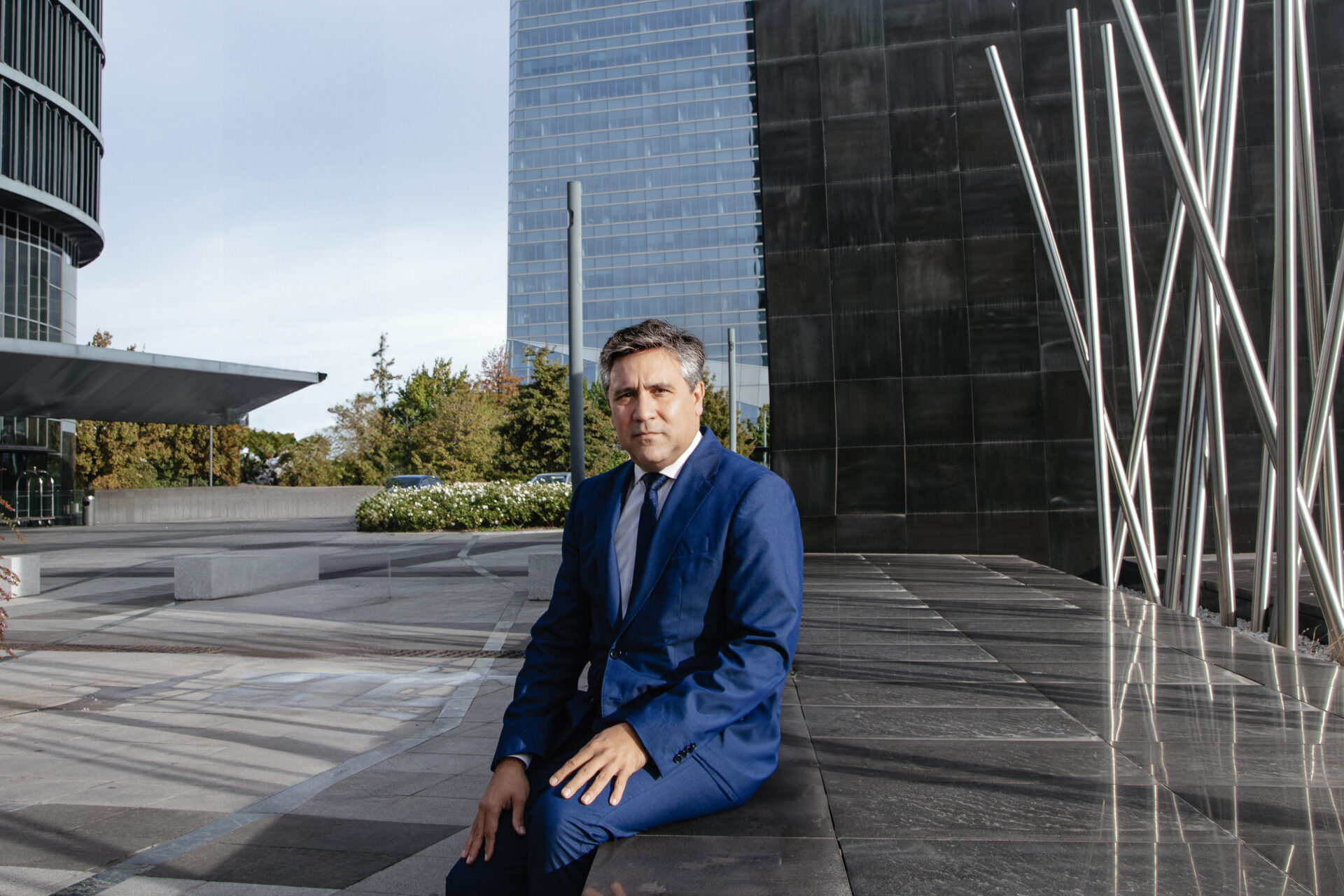


Following his recent appointment as Vice-President of the European Construction Industry Federation (FIEC) for the 2026-2028 term, heading the Economic and Legal Affairs area, Pedro Fernández Alén explains to Construnews his roadmap at a time shaped by the passage of the new EU Public Procurement Regulation, decarbonisation requirements, inflationary pressure and the need to attract skilled talent.
You take on the FIEC vice-presidency in charge of Economic and Legal Affairs at a key moment of legislative change. What are the three main strategic priorities that will shape your roadmap at the head of this department for the 2026-2028 period?
I take on the FIEC vice-presidency with great enthusiasm, because it is an extraordinary opportunity to strengthen the presence and influence of the Spanish construction sector at European level. I take on this responsibility at a particularly significant moment, when EU rules and policies are being defined that will shape the future of our companies over the coming years.
Our first major priority will be the new EU Public Procurement Regulation, which will replace the current framework of EU directives and establish common rules that Member States must apply without the need for transposition. It is therefore essential that the final text meets the real needs of the sector, guarantees fair competition conditions and encourages the participation of construction companies, particularly SMEs.
Secondly, we will pay particular attention to European housing policies, which have gained growing prominence on the EU agenda. The development of initiatives such as the European Affordable Housing Plan requires close monitoring, both because of its impact across Europe and because of the particular importance of access to housing in Spain.
The third priority will be monitoring environmental and energy efficiency regulation, which imposes increasingly demanding obligations on our companies and requires that they be able to adapt and implement changes under suitable conditions.
Added to these three lines of work are structural challenges we cannot ignore: the scarcity and rising cost of materials, as well as the shortage of skilled labour. We believe European policies can play a decisive role in helping to solve these problems and strengthening the competitiveness of our sector.
FIEC represents 33 business organisations from 28 countries. From your position, how do you balance the priorities of southern European markets with the needs of the economies of northern and central Europe?
FIEC’s main working tool is dialogue between its member organisations. We represent countries with different economic realities, productive structures and needs, but we share a clear willingness to understand one another and reach agreements that benefit European construction as a whole.
From my position, I consider it essential to listen to all sensitivities and work to identify the common interests that allow us to move forward. Differences between markets should not be an obstacle, but a starting point for building balanced proposals that respond to the challenges our companies share.
In this regard, I believe one of the major challenges for European construction lies not so much in the differences between EU countries as in competition from third-country operators that may work to environmental and labour standards different from those we require in Europe.
We must therefore strengthen cooperation between our organisations and defend a level playing field. The goal is for European companies to be able to compete on equal terms, regardless of the country in which they operate, and for EU policies to help strengthen the business fabric and employment throughout the Union.
One of the major challenges for European construction lies not so much in the differences between EU countries as in competition from third-country operators
Your appointment coincides with the crucial phase of negotiation between the European Parliament and the Council on the new Public Procurement Regulation. What critical aspects should be amended or strengthened in the final text to protect the competitiveness of EU construction companies?
The new Public Procurement Regulation is a decisive opportunity to correct some of the shortcomings we have been observing in European markets and to establish a more favourable framework for our companies. At FIEC we will pay particular attention to four issues. The first is limiting the abusive use of in-house procurement, or direct awards to public entities’ own instruments, by public administrations, a practice that can unjustifiably reduce opportunities for private companies, especially small and medium-sized ones.
The second is to make progress on so-called European preference, or Made in Europe, so that public procurement can help strengthen EU industry and protect Europe’s strategic interests.
The third is to establish mandatory mechanisms for price revision and for restoring the economic balance of contracts when significant cost variations occur that alter the conditions on which they were awarded.
Finally, we must gradually move away from awards based solely on price and give priority to the quality of bids, taking into account their sustainability, their technical value and their ability to meet the real needs of administrations and society.
These issues must be approached from a practical perspective, taking into account the difficulties companies face in tenders. FIEC will work to convey these concerns to the European institutions and help ensure that the final text includes effective solutions.
The sector has firmly called for prioritising “Community preference” and tackling unfair competition from third-country companies that do not meet European environmental or labour standards. What legal tools does FIEC propose to ensure a level playing field?
We must ensure that companies bidding for European public contracts compete on equal terms. We cannot ask our construction companies to comply with increasingly demanding labour, environmental and regulatory standards and, at the same time, allow them to compete with operators that benefit from very different conditions.
In some third countries, such as China or India, certain companies may receive state aid or operate under environmental and labour requirements different from European ones. These differences can translate into competitive advantages that do not necessarily reflect greater efficiency or productivity.
We therefore believe the new Regulation should be used to strengthen the legal instruments that allow these asymmetries to be taken into account and protect the competitiveness of European companies. In this context, the Made in Europe initiative could be a very important step forward in linking public procurement with strengthening EU industry.
At FIEC we will convey to the European Commission the difficulties these situations create in practice and the need for the regulatory framework to offer effective responses. This is about defending fair competition, not closing the European market: companies must be able to compete on quality, efficiency and innovation, without regulatory differences or state aid distorting the starting conditions.
Public procurement should reward the best bid, not simply the cheapest. In construction, an award based solely on price can push into the background essential aspects such as the quality of materials, the durability of infrastructure, innovation, sustainability or the conditions under which works are carried out.
The text under negotiation already provides for quality to account for at least 30% of the evaluation of bids, a percentage that rises to 50% for contracts requiring intensive use of labour. This is an important step towards a definition of the most economically advantageous tender that takes factors other than price into account.
As negotiations between the European institutions progress, it will be essential to specify these criteria and ensure they are applied effectively. We must properly value technical quality, innovative solutions, environmental performance and the social contribution of works.
We are aware that some countries believe auctions can speed up the award of contracts. That is why dialogue between the institutions and sector organisations will be essential to show that efficiency should not be measured solely by the speed of the award or the initial saving, but also by the final result and the value the work brings to society.
The text under negotiation already provides for quality to account for at least 30% of the evaluation of bids, a percentage that rises to 50% for contracts requiring intensive use of labour
Inflationary pressures and rising raw material costs have strained tenders throughout the Union. Is it feasible to establish a harmonised European framework for automatic, indexed price revision in public works?
Not only is it feasible, we consider it essential to establish a system that allows the economic balance of public contracts to be restored when cost variations are significant enough and affect both companies and administrations.
Public works contracts tend to run for long periods and are exposed to fluctuations in the prices of raw materials, energy and other essential components. Crises such as the pandemic, the war in Ukraine or in the Middle East have shown the extent to which these events can alter the economic conditions under which contracts are signed.
When extraordinary increases occur that companies cannot absorb, the viability of projects and the continuity of business activity can be compromised. Ultimately, employment and the ability to meet commitments made to the Administration are also at stake.
We therefore argue that European legislation should establish mandatory price revision and economic rebalancing mechanisms, subject to objective criteria and predefined thresholds. A common framework would provide greater legal certainty, reduce uncertainty and distribute risks more evenly between companies and public administrations.
The abuse of in-house awards by administrations and low competition in tenders are significant problems in markets such as Spain. What steps does FIEC plan to take to limit these practices and guarantee transparent access to public procurement, especially for SMEs?
At the Spanish National Construction Confederation (CNC) we will work to ensure that the new EU Regulation defines more precisely what should be understood as an in-house entity and sets clear limits on its use.
In Spain, entities in which the Administration may hold a merely token share of capital, even 0.01%, are being treated as in-house entities. In our view, that shareholding should not be enough; there should be effective power of direction and control over the entity to justify it being considered an in-house entity.
It is also necessary to define the circumstances in which this mechanism can be used. It may be justified in urgent or emergency situations, but it should not become a routine alternative to open public procurement, as happens in certain cases in Spain.
We must also establish requirements to demonstrate that the award meets a real need, that its use optimises public resources and that not going to the market is justified. Finally, limits and formalities must be set to prevent a disproportionate share of an administration’s procurement activity from being channelled through in-house awards.
The aim is to ensure a justified and transparent use of this mechanism, preserve competition and ensure that companies, particularly SMEs, have real opportunities to access public contracts. Open and competitive procurement makes better use of the capacity of the business fabric and helps public funds to be used more efficiently.
In the context of the green transition and the decarbonisation of the building stock by 2030/2050, do you think the European construction industry is receiving the funding and tax incentives needed to accelerate the renovation wave?
I believe we must move towards more flexible, agile and accessible funding mechanisms, accompanied by tax incentives that support both business activity and investment by private individuals.
The energy transition demands considerable effort and, for it to materialise, public policies must accompany regulatory obligations with appropriate economic instruments. It is not enough to set ambitious sustainability targets. We must create the conditions for households, businesses and administrations to achieve them.
In the case of housing, the tax burden represents a significant part of the final price. As a reference, it is estimated that taxes can account for around 30% of the cost of a home, which highlights the need to consider possible measures for tax simplification and relief that favour access to housing and the sector’s activity.
It is also essential to promote ambitious funding programmes so that owners can renovate the existing housing stock, improve its energy efficiency and reduce its environmental impact. Spain has an ageing housing stock whose upgrading is a challenge, but also a great opportunity to advance decarbonisation.
We must therefore combine regulation, funding and tax incentives. Only then will we make the green transition economically viable and ensure construction companies have the resources needed to carry out the work Europe needs.
The shortage of skilled labour and an ageing workforce are a structural challenge across the EU. How can the European institutions promote the attraction of young talent, the inclusion of women and training in industrialised construction and digitalisation?
The shortage of skilled labour is a major problem in Spain and across Europe. An ageing workforce, the difficulty of attracting young people and women, and the need for new skills mean talent must be placed at the centre of the sector’s policies.
Construction has historically shown its capacity to adapt and respond to society’s needs. We must now strengthen that capacity through a firm commitment to training, improving the image of the industry and bringing in new professional profiles prepared to work with industrialised techniques, digital tools and increasingly efficient and sustainable processes.
The European institutions can contribute by promoting training and reskilling programmes, encouraging collaboration between companies and educational centres and promoting initiatives that bring construction closer to new generations. We must also work so that more women find professional opportunities in the sector and so that society perceives construction as a modern, innovative industry with a future.
In this regard, I think it is particularly important to start talking about construction with names and faces. When a major piece of infrastructure is inaugurated or a project is presented, we tend to highlight who financed or promoted it, but we do not always give visibility to the company that built it or the professionals who made it possible.
Recognising that work would help generate a greater sense of pride in belonging to the sector. Construction not only transforms cities, homes and infrastructure: it also creates jobs, drives the economy and improves quality of life. We must convey that value in order to attract and retain the talent we need.
To conclude with a broad view: if you had to diagnose the general state of the construction industry in Europe at this moment, what do you consider its main strengths to remain the continent’s economic engine in the current macroeconomic and geopolitical scenario?
Spanish construction has internationally leading companies, and the sector plays an essential role in the European economy. Our main strength is the technical, business and professional capacity we have developed to take on complex projects, deliver major infrastructure and meet society’s needs.
We have experience, knowledge and companies capable of competing in international markets. Furthermore, construction is a strategic activity for Europe, both for its contribution to economic growth and employment and for its role in fundamental areas such as housing, infrastructure, the energy transition and the modernisation of our cities.
We therefore have the capabilities needed to remain an engine of the economy and of well-being. The challenge is to create a regulatory and economic framework that allows all that potential to be unlocked, especially in a scenario marked by geopolitical uncertainty, cost pressures and growing regulatory demands.
In this context, Europe has the opportunity to legislate and steer its policies through its institutions. We must seize it to strengthen the role of our companies, protect employment, improve their competitiveness and facilitate their activity in the single market.
That is why one of FIEC’s major responsibilities is to convey the reality of our companies to the European institutions and help ensure that EU decisions respond to their needs. If we can combine our business strength with an appropriate regulatory framework, we will have a solid foundation to face the challenges of the coming years and continue contributing to Europe’s economic and social development.
This is about defending fair competition, not closing the European market
Fernández Alén sets three priorities for his FIEC term (2026-2028): the Public Procurement Regulation, housing and environmental regulation. He calls for mandatory price revision and limits on in-house awards, and welcomes the draft’s provision for quality to weigh at least 30% in awards, 50% in labour-intensive contracts.