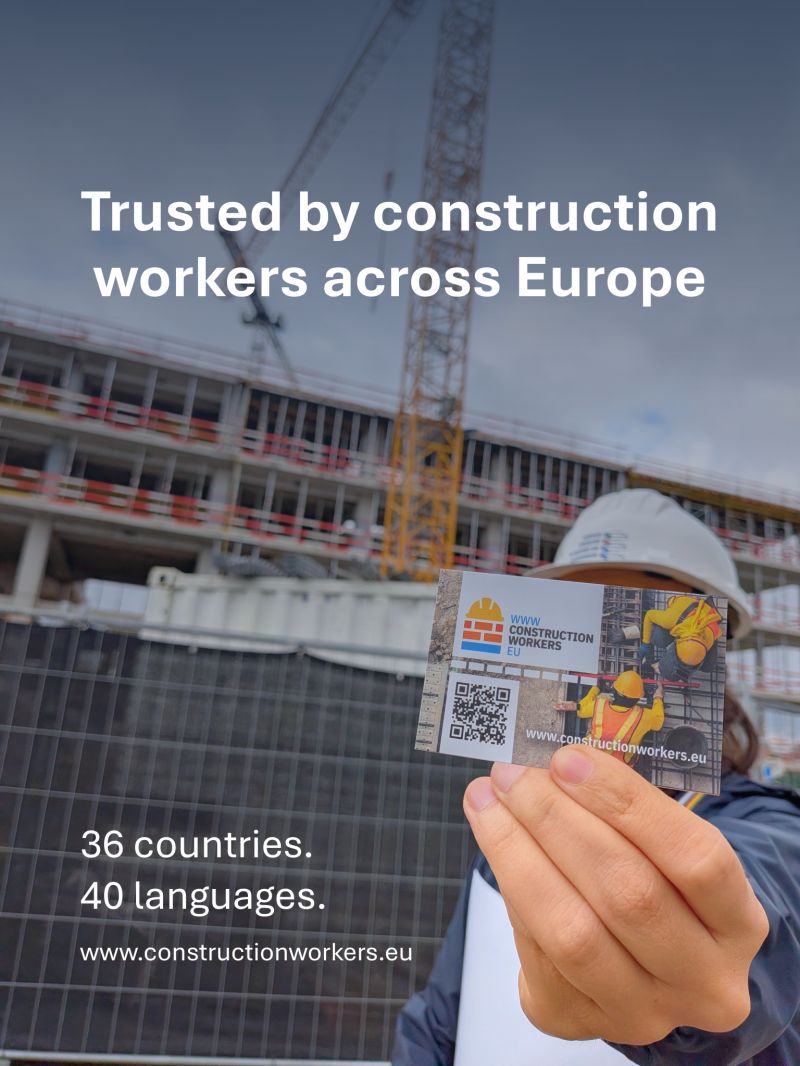
European portal constructionworkers.eu becomes the leading information resource for construction workers from third countries

Co-financed by the European Union, the platform provides verified information on wages, working hours, holidays, pensions and trade union contacts in 36 European countries and 40 languages

The Data
constructionworkers.eu informs third-country workers in 36 countries and 40 languages on wages, working hours, holidays and pensions

Labour mobility in European building and infrastructure is at a turning point. Against this backdrop, the www.constructionworkers.eu portal has become the main online information platform for construction workers from third countries entering the European labour market, in a sector that EU institutions identify as one of the most exposed to exploitation.

The European portal www.constructionworkers.eu has established itself as the main online information platform for construction workers from third countries entering the European labour market. Its growth comes at a key moment for labour mobility in the building and infrastructure sector across the continent, which is facing a turning point.

Thousands of construction workers use the platform every day before crossing a border to carry out their work. The portal provides direct access to accurate and verified information on wages, working hours, holiday entitlements, pensions and how to contact the relevant trade unions in each territory.

36 countries and 40 languages to understand labour rights

The website currently covers a total of 36 European countries and is available in 40 languages, allowing professionals to learn about their rights transparently both before and during their period of employment on European soil.

The platform offers coverage in 40 languages to construction workers carrying out their activity in 36 European countries.

The initiative is co-financed by the European Union, whose support has been key to consolidating the portal as an essential resource for the protection of mobile workers.

A sector flagged for its exposure to labour exploitation

EU institutions have repeatedly acknowledged that construction is one of the sectors most vulnerable to labour exploitation, social dumping and the activities of organised crime. European authorities therefore insist that, alongside stronger inspections and legal compliance, it is essential to ensure that workers themselves have direct channels of information on the legal framework protecting their activity.

Guaranteeing workers direct access to legal information has become a priority in the fight against fraud in the sector.

The debate on pay across the building value chain

This progress in the protection and transparency of working conditions coincides with the ongoing debate in Spain on pay within the building ecosystem. Construnews recently analysed the salary reality of architects following the meetings and conferences organised by the Superior Council of Architects’ Associations of Spain (CSCAE) and the Architects’ Association of Catalonia (COAC) within the framework of the International Union of Architects (UIA) Congress.

Those events highlighted the need to dignify economic and contractual conditions at every scale of the building value chain, from the design phase to physical execution on site. The wage gap, precariousness in the early stages of professional careers and the lack of standardised conditions across territories are common challenges affecting both technical profiles and on-site labour.

he wage gap, early-career precariousness and uneven conditions across territories affect technical staff and site workers alike.

Towards a more regulated and transparent construction market

The consolidation of EU tools such as www.constructionworkers.eu reinforces the trend towards a more regulated, transparent and safe construction market, in which training, knowledge of the regulatory environment and pay equity are decisive for attracting and retaining talent across Europe.

Newsletter

Recent posts

Oriol Güell: “Natural intelligence, the technician’s expertise, is unbeatable against artificial intelligence”

On 26 November, Barcelona's Recinte Modernista de Sant Pau will host the 1st Facility...

Land as infrastructure: CAdIC proposes 13 measures to unlock buildable land and speed up housing

The Consell Assessor d'Infraestructures de Catalunya (CAdIC) has published its document number 17, Land...

Renovating Barcelona: the barrier is no longer money but a culture of maintenance

On 10 November, Molins closed its Molins Talks: present and future of architecture series,...

COP31 puts numbers on buildings, but their emissions are still not falling a year after Belém

The 31st United Nations Climate Change Conference (COP31) is being held from 9 to...

Manuel Járrega: “The problem isn’t technology, it’s choosing the right technology for your problem”

On 26 November, Barcelona's Recinte Modernista de Sant Pau will host the 1st Facility...

Lluís Dalmau: “We need to position the facility manager as a strategic player in organisations”

On 26 November, Barcelona's Recinte Modernista de Sant Pau will host the 1st Facility...

Felip Neri Gordi: “Facility management is the second part of architecture, the part that begins on opening day”

On 26 November, Barcelona's Recinte Modernista de Sant Pau will host the 1st Facility...

Brussels to propose a 2027 simplification package to build and renovate more homes with less red tape

The European Commission has presented its 2027 work programme, in which it commits to...

Related posts

Malaga sets the roadmap for concrete pavements: greater durability, lower carbon and climate adaptation

For four days, Malaga was the international meeting point for concrete pavements. Researchers, engineers,...

Brussels unveils its Climate Resilience Framework as MEPs call for a directive on extreme heat at work

On 27 October the European Commission presented its EU Framework for Climate Resilience, following...

Pedro Fernández Alén: “Public procurement should reward the best bid, not simply the cheapest”

Following his recent appointment as Vice-President of the European Construction Industry Federation (FIEC) for...

FIEC demands urgent regulatory simplification from Brussels to unlock housing construction in Europe

The European Construction Industry Federation (FIEC) has submitted its formal response to the public...

Brussels proposes faster European standardisation and free access to 3,650 harmonised standards

The European Commission has proposed revising Regulation (EU) No 1025/2012 on standardisation. The aim...

Top Tier Impact maps over 100 startups to accelerate digitalization, decarbonization and affordable housing in construction

Construction continues to figure among the least digitized economic sectors on the planet, with...

The European construction sector demands the EU prioritize community preference and stop unfair competition in the new Public Procurement Act

The major employers' associations of the building and infrastructure sector in Europe have united...

Synthetic maps of heavy traffic in Europe: lights and shadows for electrical infrastructure planning

The design of the future ultra-fast charging infrastructure network for heavy vehicles in Europe...