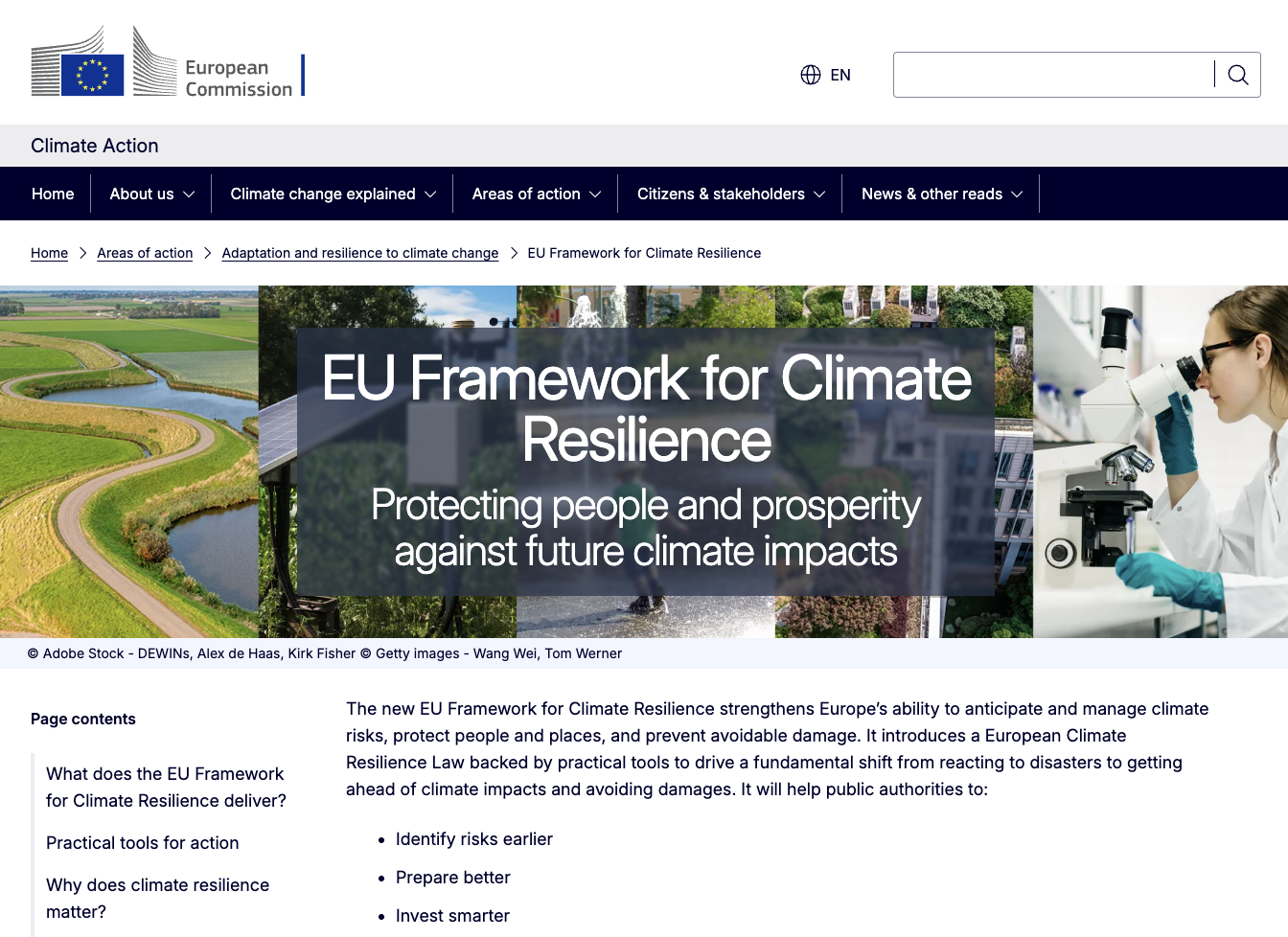


On 27 October the European Commission presented its EU Framework for Climate Resilience, following a summer in which heatwaves caused damage estimated at €113 billion, according to the European Construction Industry Federation (FIEC). At the same time, the European Parliament‘s Employment Committee has published a draft report calling for a dedicated directive on occupational heat stress, a risk that hits construction head-on.
The European Union is moving on two fronts that directly affect the construction sector: adapting Europe to climate risks and protecting workers from extreme temperatures. On 27 October, the European Commission (EC) presented its EU Framework for Climate Resilience, designed to strengthen Europe’s ability to anticipate, prepare for and manage climate risks. Meanwhile, the European Parliament’s Committee on Employment and Social Affairs (EMPL) has published a new draft report on the effect of extreme temperatures at the workplace on workers’ health and safety.
A package combining a law, digital tools and national plans
The Commission’s package combines a Communication with a proposal for a Regulation establishing a European Climate Resilience Law, alongside a set of practical tools and non-legislative initiatives.
The framework follows a particularly severe summer. As FIEC points out, heatwaves alone caused damage estimated at €113 billion. At the same time, private insurers cover on average only around a quarter of climate-related damage, leaving the remaining costs largely to public budgets.
Last summer’s heatwaves alone caused damage estimated at €113 billion, while private insurers cover on average only about a quarter of climate-related damage.
Rather than imposing binding adaptation measures, the framework focuses on clearer planning requirements and better tools for decision-makers. Its main elements are:
- New digital tools as possible starting points for investment decisions, including the European Climate Viewer, which lets users visualise the local impacts of warming scenarios of 1.5°C by 2030, 2°C by 2050 and 3°C by 2100.
- National climate resilience strategic plans, in which Member States must clearly identify the public authorities responsible for preventing and managing climate risks, to be drawn up by 31 December 2030 at the latest.
- A Climate Insurance Alliance, expected to implement a first set of measures by the end of 2027.
No new money: the next EU budget carries the weight
No additional EU funding is foreseen for the framework. Climate adaptation investments are instead expected to be supported through the 2028-2034 Multiannual Financial Framework (MFF), currently under negotiation, which includes a target of 35% of spending on climate and the environment.
No additional funding is planned: adaptation investments will rely on the 2028-2034 MFF, which targets 35% of spending on climate and the environment.
The legislative proposal will now be examined by the European Parliament and the Council of the EU. The full documentation is available on the European Commission’s EU Framework for Climate Resilience page.
MEPs turn the spotlight on heat and cold at work
In parallel, the European Parliament’s Committee on Employment and Social Affairs has published a new draft report on the effect of extreme temperatures at the workplace. The rapporteur is Maria Ohisalo (Finland, Greens/EFA).
The report focuses on heatwaves and extreme cold, and stresses that the workers most affected by extreme temperatures are those who work outdoors, in sectors such as construction.
The European Parliament’s draft report urges the Commission to propose a directive protecting workers from extreme temperatures and occupational heat stress.
The document underlines the need to strengthen EU legislation to ensure adequate harmonisation of protection across all Member States, and urges the European Commission to present a proposal for a Directive on the protection of workers from extreme temperatures and occupational heat stress. The draft will be discussed in the Committee on Employment and Social Affairs on 10 November.