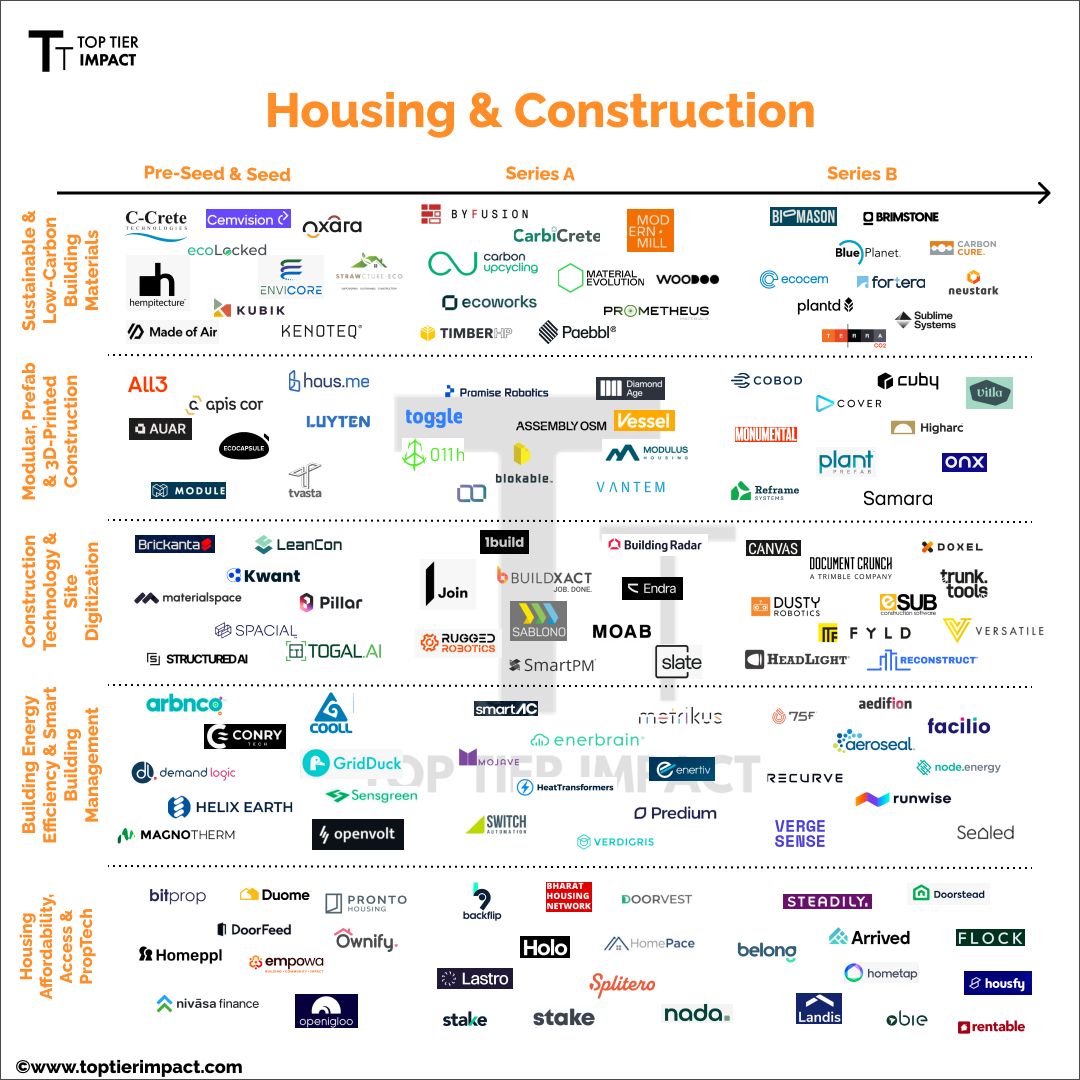


Construction continues to figure among the least digitized economic sectors on the planet, with average productivity growth of barely 0.4% a year since 2000. Faced with this structural paralysis and a global housing deficit approaching 300 million units, the Top Tier Impact network has mapped over a hundred venture capital-backed companies driving a faster, cleaner and more accessible productive model.
The building and public works industry faces a historic crossroads. Despite global economic dynamism, the construction sector remains one of the least digitized in the world economy, dragging an efficiency gap that conditions its capacity to respond to current social and environmental demands.
While the global housing deficit has risen to nearly 300 million homes, construction productivity has experienced annual growth of barely 0.4% since 2000, highlighting the urgent need for a systematic transformation.
To analyze the technological and innovative solutions seeking to reverse this scenario, the global network Top Tier Impact has identified and mapped over 100 venture capital-backed companies. These startups are deploying solutions across five strategic building segments, aimed at building faster, more affordably and with a lower environmental impact.
Construction productivity has only grown 0.4% annually since 2000, facing a deficit of 300 million homes.
The five technological pillars of sector transformation
The map created by Top Tier Impact divides the innovation ecosystem into five fundamental categories that cover the entire life cycle of the built asset:
- Modular construction, prefabrication and 3D printing: off-site manufacturing platforms and additive building designed to compress execution times and drastically reduce on-site waste generation.
- Construction technology and site digitalization: development of software, robotics and sensor platforms that bring real-time data and automation to traditionally analog work environments.
- Energy efficiency and smart building management: advanced systems aimed at optimizing energy consumption, HVAC performance and operational efficiency during the property’s useful life.
- Affordable housing, access and PropTech: housing access solutions and financing models that modernize the acquisition, construction and real estate management processes.
- Low-carbon building materials: sustainable alternatives such as cement-free binders, carbon-capturing concrete and biomass additives, aimed at mitigating the emissions of the materials with the highest carbon footprint.
A low-carbon material lacks real impact until it is prescribed and effectively integrated into a concrete project.
The decisive challenge: from innovation to real on-site adoption
The report highlights that one of the distinctive peculiarities of the building industry is its high dependence on effective adoption, going beyond mere technological development.
A low-carbon material lacks real impact until it is prescribed and integrated into a concrete project. Similarly, site digitalization only generates returns when operational workflows are actively modified.
A simultaneous deployment across the five segments
For this reason, the organization emphasizes that isolated advances in a single area are insufficient. True progress in the sector requires a simultaneous and transversal deployment across the five key segments, ensuring that efficiency gains make it possible to build affordably, scalably and sustainably on a global scale.
The transformation of the sector requires a balanced deployment in industrialization, digitalization, efficiency, accessibility and new materials.
The conclusion of Top Tier Impact’s map thus points to a transformation of construction that will depend on balanced progress in industrialization, digitalization, efficiency, accessibility and new materials.