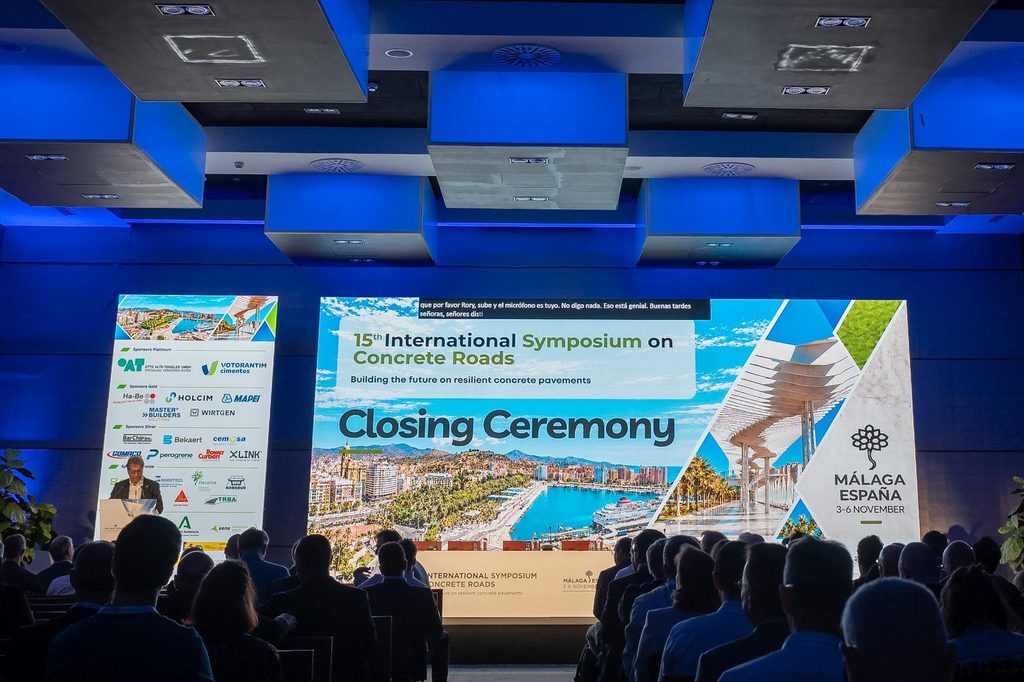


The 15th International Symposium on Concrete Pavements closed its training and discussion sessions in Malaga on 6 November with a clear roadmap for the future of the facilities that underpin mobility and community life. The main conclusion: concrete is one of the keys to achieving innovative and sustainable infrastructure that reduces its carbon footprint and adapts to climate change.
According to the organising bodies, the outcome could not have been more positive: more than 300 participants from 34 countries across five continents and over 120 technical contributions. These figures reflect the international reach that continues to strengthen Malaga as a meeting point for exchanging knowledge, projects and experience, in this case on the design, construction and maintenance of concrete pavements and their applications in infrastructure that serves society.
Four days of debate between research, industry and government
The symposium was organised by the Spanish Cement Manufacturers’ Association (Oficemen), the Spanish Institute of Cement and its Applications (IECA), the Andalusian Cement Manufacturers’ Association (AFCA) and the European Concrete Paving Association (EUPAVE). Over four days it brought together researchers, engineering professionals, construction companies, public authority representatives and materials industry specialists.
Under the motto “Building the future on resilient concrete pavements”, the papers, plenary sessions and specialist workshops covered the technological advances with the widest application, research findings on more sustainable and recyclable materials, decarbonisation, and how to make roads, ports, airports, logistics platforms and urban spaces more functional.
The Malaga symposium brought together more than 300 participants from 34 countries across five continents and over 120 technical contributions on concrete pavements.
The adaptation of this infrastructure to climate change, extreme weather events and natural disasters was one of the core themes of the discussions and training sessions held during the event.
Innovation and international collaboration to improve infrastructure
One of the symposium’s key messages was the importance of strengthening international collaboration and public-private cooperation to turn research advances into real projects and improve infrastructure performance for different communities.
Throughout the technical sessions and poster presentations, participants shared experience on:
- Developing lower-carbon materials.
- Reusing and recycling resources.
- Pavement durability.
- New digital technologies applied to design, construction and maintenance.
The direction set by the Malaga symposium is well defined: build more durable infrastructure capable of adapting to the effects of climate change, optimise the use of materials and reduce environmental and economic costs over its service life.
International and public-private collaboration is key to turning research advances into real infrastructure projects.
Recognising technical excellence
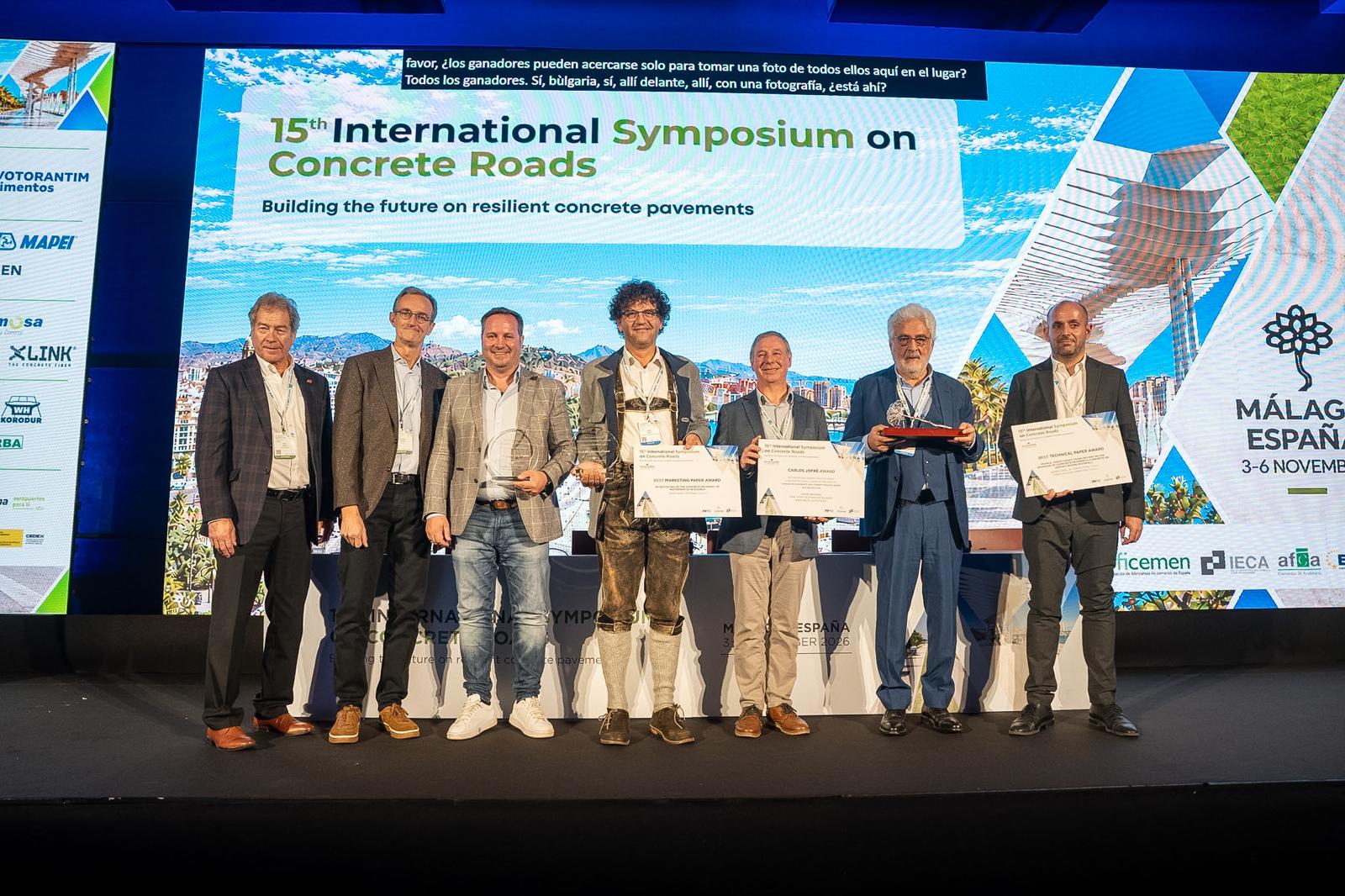
The closing ceremony, held at the Hotel Barceló Málaga, included awards to professionals in the sector:
- “Carlos Jofré” Lifetime Achievement Award. Presented by Luc Rens, Technical Director of EUPAVE, it went to French engineer Joseph Abdo of JA Consulting for his involvement in numerous major projects around the world.
- Best Technical Paper Award. Presented by Rory Keogh, Vice-President of EUPAVE, it also went to Abdo and his compatriot Cedris Le Gouil of Cimbeton for the paper “France: 28 years of analysis of the performance of composite pavements”.
- Best Marketing Paper Award. Presented by Stéphane Nicoud, President of EUPAVE, it recognised the work of Spalt Stefan, an engineer at Asifinag specialising in the management and dissemination of concrete recycling projects.
A message to society about infrastructure
The conclusions were delivered by César Bartolomé, Director of Technology and Promotion at IECA, who thanked “participants, speakers, technical committees, sponsors and partner organisations for their involvement, as well as the Regional Government of Andalusia and Malaga City Council for their institutional support”. Bartolomé also conveyed a message to society as a whole “on the importance of the infrastructure that underpins our daily lives”.
César Bartolomé (IECA) closed the symposium with a message on the importance of the infrastructure that underpins our daily lives.
Technical visits to Malaga’s infrastructure
The event concluded with three technical visits to Malaga infrastructure described by some participants as “world-class”, which showcased various innovative applications of concrete on site:
- The Port of Malaga.
- The slab track solutions of the Malaga Metro.
- The urban and industrial pavements at the Mayoral Logistics Centre.