

The European Commission has proposed revising Regulation (EU) No 1025/2012 on standardisation. The aim is to bring the development of technical standards into line with the pace of new technologies, reduce bureaucratic barriers for SMEs and strengthen the EU’s voice in international standardisation bodies.
The reform seeks to adapt the development of technical standards to the accelerated pace of new technologies, reduce bureaucratic barriers for small and medium-sized enterprises and consolidate the bloc’s strategic voice on the international stage in the face of pressure from other world powers.
The European standardisation system, based on public-private collaboration through the three recognised European Standardisation Organisations, CEN, CENELEC and ETSI, is facing a technical and legislative transformation. The Commission’s proposal would revise Regulation (EU) No 1025/2012 to streamline the processing of technical standards, guarantee compliance with EU law and provide rapid adaptation tools in key sectors such as clean technologies, batteries, cybersecurity, building and advanced manufacturing.
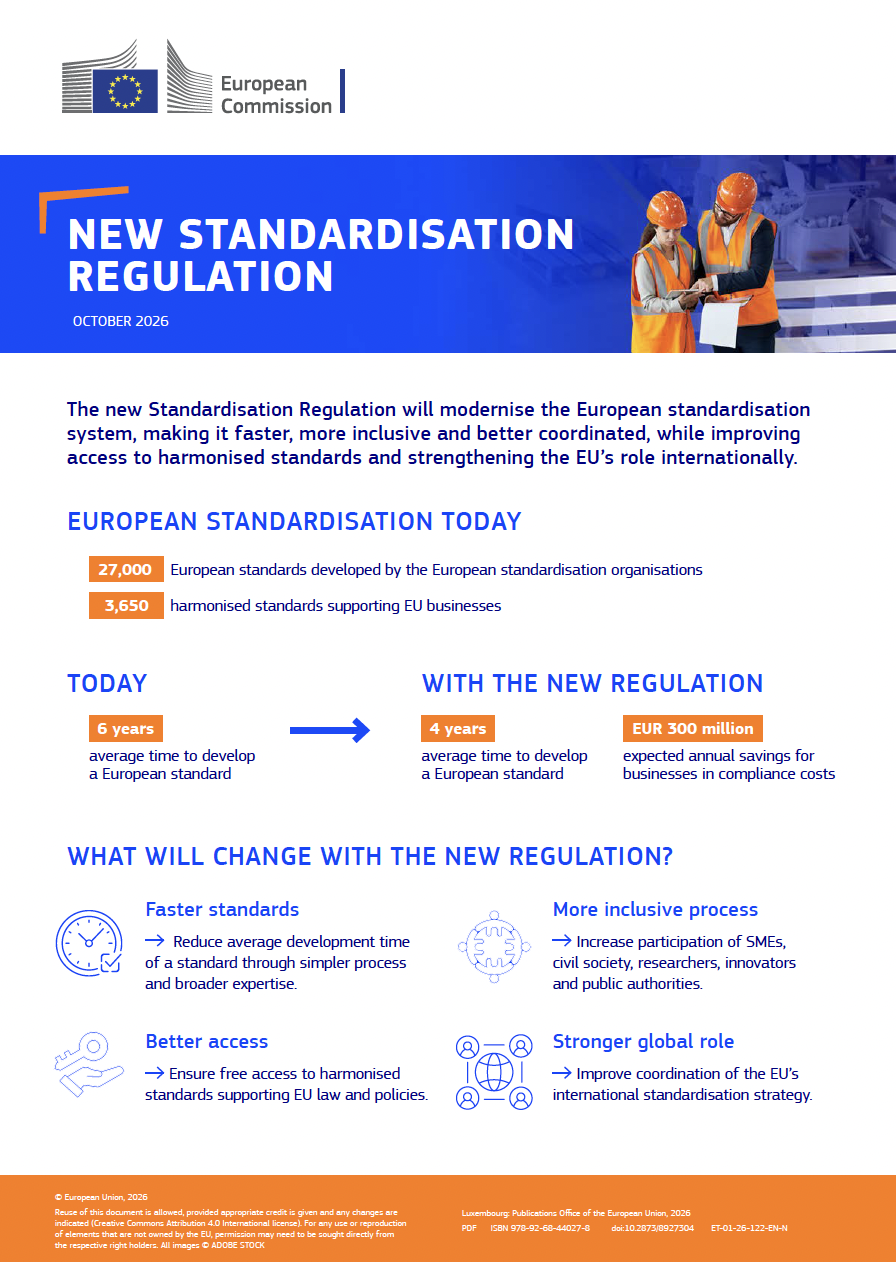
Developing a European standard currently takes six years on average. The reform sets binding deadlines and alternative mechanisms with the aim of cutting that average to four years, so that innovative solutions reach the single market sooner and obtain the presumption of legal conformity more quickly.
The European Commission’s proposal aims to cut the average development time for European technical standards from six years to four.
Innovation and speed in developing technical specifications
The new legal framework allows the Commission to assign the development of technical specifications to designated or specialised standardisation organisations when urgent or highly specialised technical needs arise. It also clarifies the use of common specifications and makes it possible to apply temporary deliverables that grant a provisional presumption of conformity while the final drafting of harmonised standards is completed.
To monitor progress, the Commission will introduce key performance indicators (KPIs) and a real-time digital monitoring platform. A European Standardisation Hub of Expertise will also be created to steer strategic planning and align the EU’s political priorities with sector-specific technical developments.
Free access to harmonised standards and support for SMEs
One of the pillars of the proposal is the codification of recent rulings by the Court of Justice of the European Union (CJEU). The regulation will establish free access to harmonised standards and to those expressly cited in European legislation. The measure will apply to a dedicated repository covering some 3,650 standards out of the overall catalogue of 27,000 standards managed by CEN, CENELEC and ETSI.
Some 3,650 harmonised standards linked to EU law will become freely accessible through dedicated repositories.
The legislative text sets guidelines for national standardisation bodies to reduce costs and enable the effective participation of SMEs, civil society, academia and workers’ representatives in technical committees. This opening is intended to prevent imbalances in standard-setting and lower regulatory compliance costs for smaller businesses.
Geopolitical dimension and international coordination
Internationally, the framework will maintain the long-standing cooperation established through the Vienna Agreement (between CEN and ISO) and the Frankfurt Agreement (between CENELEC and IEC), which allow standards to be adopted mutually and uphold the World Trade Organization (WTO) principles on technical barriers to trade.
However, given the slowness seen so far in adopting standards for strategic technologies such as artificial intelligence and cyberspace, the regulation strengthens coordination among Member States to project EU specifications and values in global standardisation bodies (ISO, IEC and ITU).
The reform strengthens the EU’s strategic position on the international committees that set standards for AI, cybersecurity and batteries.
Next steps: Parliament and Council
The legislative file now begins its passage through the European Parliament and the Council of the European Union, where it will be debated, may be amended and, if agreed, finally adopted. Details on application deadlines and transition periods will be set out in the final text of the regulation.
More information on the legislative proposal is available on the European Commission’s official website: single-market-economy.ec.europa.eu.