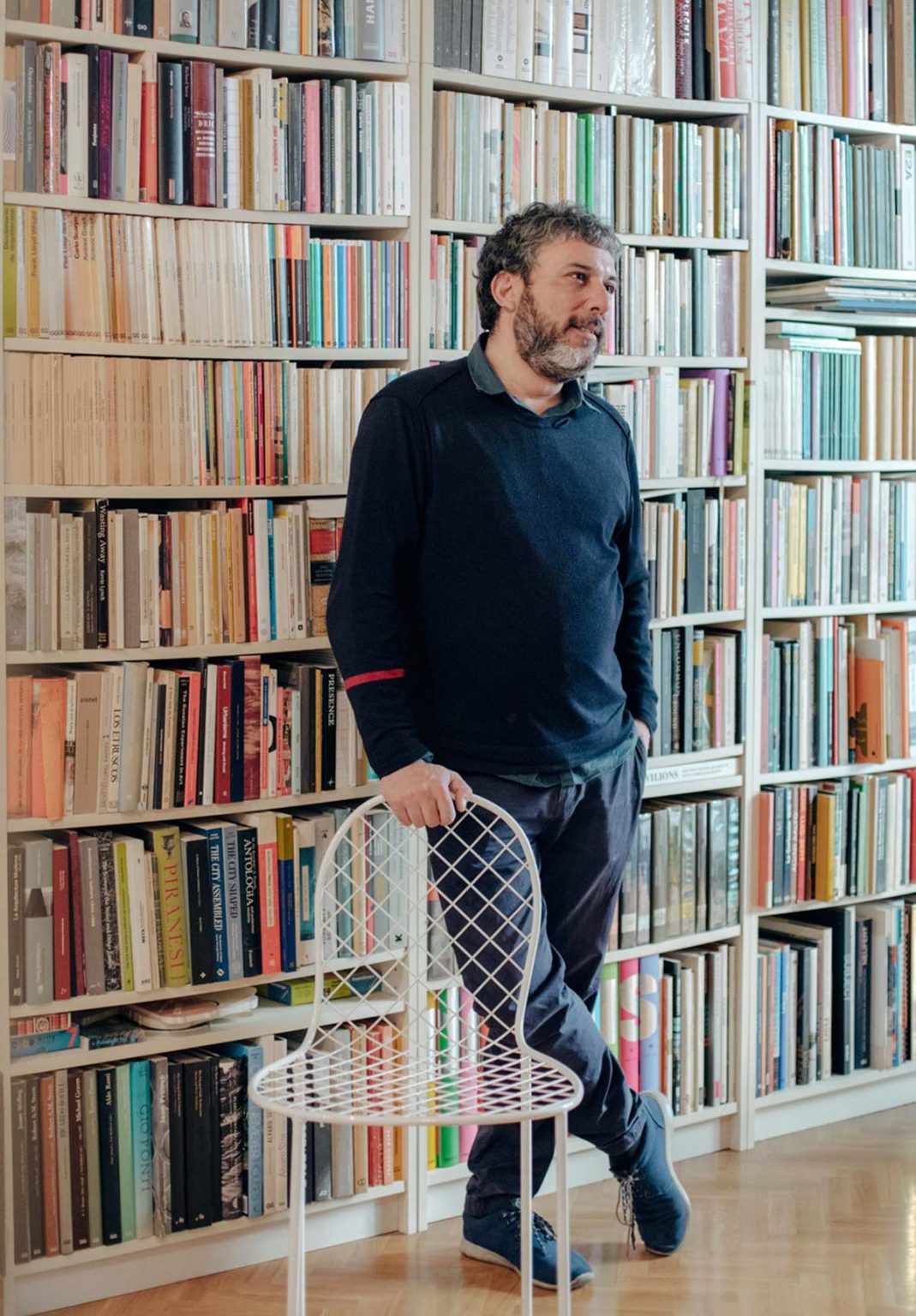


The theorist and publisher revisits the books that shaped architectural culture in the second half of the 20th century and the interventions through which Gordon Matta-Clark broadened the idea of built heritage
Lead: Between 1966 and 1978, three books were published: Aldo Rossi’s The Architecture of the City; Learning from Las Vegas, by Robert Venturi, Denise Scott Brown and Steven Izenour; and Rem Koolhaas’s Delirious New York. Moisés Puente examines how those three studies changed the way we look at the city and how, at the same time, Gordon Matta-Clark used his cuts into abandoned buildings to propose a new way of understanding what is built.
This text is part of a series of publications curated by Octavi Mestre under the title Other Architectures for Construnews, marking the launch of the publication’s English edition. Its author is Moisés Puente, architecture theorist and publisher, of Puente Editores.
Rossi: the architect in the robes of the historian
In 1966, Aldo Rossi published The Architecture of the City. In the intense years of post-war European reconstruction, the architects’ task consisted mainly of solving the housing problem in places razed by the destruction of war: devastated plots full of rubble where there was no memory to be rescued, but rather to be forgotten. The city was a mere tabula rasa.
Against the frenzy of reconstruction, Rossi proposed an analytical study of “urban facts”, a call to order after a period of excessive, albeit necessary, (re)construction. The architect needed to put on the robes of the historian.
Rossi proposed an analytical study of urban facts, a call to order after a period of excessive, albeit necessary, (re)construction
Las Vegas: legitimacy from the vernacular
Six years later, in 1972, another of the important books of the second half of the 20th century was published: Learning from Las Vegas, by Robert Venturi, Denise Scott Brown and Steven Izenour, which stopped looking at disciplinary history and instead sought in the vernacular tradition a certain legitimacy for contemporary architecture. The book explored the mechanisms by which a contemporary city is built, exemplified by Las Vegas, a city created practically out of nothing, in the middle of the Mojave Desert.
New York: Koolhaas’s delirium
Another six years later, in 1978, Delirious New York, by Rem Koolhaas, joined this saga of studies on the city. If Learning from Las Vegas tried to open up a new way of looking at a reality built by non-architects in search of its symbolic forms, Rem Koolhaas delved into the recent history of New York, indiscriminately mixing highbrow, popular, marginal and delirious references: from Coney Island to the Rockefeller Center, from Hugh Ferriss to Raymond Hood, from Diego Rivera to Salvador Dalí.
Within a dozen years, these three books would capture the attention of academia and shape the course of architectural culture over the following decades.
Within a dozen years, these three books would capture the attention of academia and shape the course of architectural culture over the following decades
Matta-Clark: cutting a building to give it a new life
And while academia was busy with exercises in inserting new pieces into the city, Gordon Matta-Clark began his first interventions on buildings in the early 1970s. The buildings targeted by his furtive interventions were ordinary structures, lacking any particular qualities, which, because they had been abandoned, could be intervened on without any kind of planning or museum regulation.
In his work Splitting (Englewood, New Jersey, 1974), Matta-Clark removes every trace of dwelling and makes an ordinary house in an ordinary neighbourhood take on the qualities of a sculptural object. What is built acquires a new life, far removed from any planning rules or museum classification, and becomes a new way of understanding built heritage.
Matta-Clark removes every trace of dwelling and makes an ordinary house in an ordinary neighbourhood take on the qualities of a sculptural object
To the three studies on the city cited here, Matta-Clark adds a broader notion of what had until then been understood as heritage. It is no longer solely a matter of inserting pieces into the historic fabric, or of disciplinary debates on typology; instead, the logics of the building itself, of its users and of the designer are allowed to act without too many constraints, so as to propose a new way of understanding what is built.
Moisés Puente is an architecture theorist and publisher, of Puente Editores