

A few days after the UIA 2026 World Congress in Barcelona, Eva Franch i Gilabert, former director of Storefront for Art and Architecture (New York) and the Architectural Association (London), talks to Construnews about the glocal, curatorial activism, sedimentary justice in the Ebro, the governance of the commons of air and water, and her proposal to create ministries of the future. A conversation of just over forty minutes, published here in a longer version than usual.
It is not every day that one has the opportunity to converse with someone who not only thinks clearly but is also capable of ordering complex ideas with uncommon naturalness and pedagogical ability. This is the case with Eva. The interview, lasting just over forty minutes, posed an unusual problem for the person who must later write it: how to summarize a discourse where practically every answer brings a new idea, where there are barely any repetitions, and where everything is part of the same solid and coherent narrative thread? Condensing it inevitably meant leaving out nuances that help understand the depth of her thought.
For this reason, we have chosen to publish a longer version than usual. We believe it is worth dwelling on concepts like the glocal, her proposal to imagine ministries of the future, or her way of understanding the relationship between society, territory, and architecture. Similarly, reading her latest book, 100 Words for Water. A Vocabulary, completes many of the reflections that appear in this conversation. Moreover, the timing could not be better. Only a few days have passed since the UIA World Congress was held in Barcelona, a gathering that has once again placed some of the great challenges of our time on the table. In a context marked by climate uncertainty, technological transformations, and profound social changes, architecture can no longer limit itself to building edifices: it must contribute to imagining new ways of inhabiting, relating to the territory, and projecting the future.
In this scenario, Eva’s perspective is especially valuable. She doesn’t offer recipes or closed answers, but perhaps something more important: a framework from which to think. Her reflections invite us to pause, question inertias, and contemplate the future with a mix of rigor, sensitivity, and optimism. And that, in these times, is no small thing.
Your professional career moves fluidly between Barcelona, Prague, and New York. How does this “global-local” scale of work influence how you approach architectural and research projects?
The truth is, I think I have always had a global and planetary perspective. Being from a place as specific and remote as the Ebro Delta, with such a present horizon, one always has that awareness between the planetary and the local. I currently teach in Prague and New York, while my practice is based in Barcelona. Over the last twenty-five years, I have been practicing from many places, especially New York and London, always on different projects and in different locations, understanding that we live in a time where this globality must always be understood from different local desires. Today, there is a word that explains very well how we are thinking about architecture and thought: not only in a situated way, but also from the bioregional, the ecosystemic, and the ecological. This is not something happening to me just now; I have actually been doing it for the last quarter of a century.
Your biography highlights the concepts of “curatorial activism” and “planetary pedagogies.” How do you define these terms, and how do you use them to change the traditional perception of architecture?
I’ll explain it with an example. Curatorial activism arises when you realize that within our discipline and the way we practice, there are gaps—spaces we are not occupying that we should be. A few years ago, when I lived in New York, Mayor Bill de Blasio made public statements saying he had a mission to produce more social housing and a more accessible city, but that he wasn’t really counting on architects because he saw them on the side of power structures and elites. That’s when I realized there was a real, and at the same time very mistaken, perception of what an architect can be, and that society doesn’t give us the opportunities to exercise our role of speaking on behalf of the public and collective good.
Curatorial activism arises when you realize that within our discipline there are gaps, spaces we are not occupying that we should be
As a curator and architect who understands exhibitions as a space for building new collectivities, I invented a project where I asked a hundred architects to write a letter to the mayor of their city. Many architects in New York tried not to talk about their own projects or practices—something we tend to do a lot when handed a microphone—but to express themselves for the common good, the future of the city, and the visions we should be bringing to the table. That project gained momentum, and we replicated it in twenty cities around the world: from Panama to Taipei, from Oslo to Buenos Aires, through Madrid and Barcelona. In each edition, we used spreadsheets to balance names, genders, ages, forms of practice, and ideologies, seeking real diversity. In the first New York edition, 98% of the guests were women. I only invited two men—both directors of architecture schools who that year had only invited men to give lectures—so that at the opening, they would understand the opportunities they were missing.
This project is political and activist on many levels. In Seoul, for the Architecture Biennale, the first local list proposed was 98% men. I asked them for balance. We still find today that architecture schools have 60% female students, but neither the people teaching nor those with visibility in cultural production reflect that gender. The project claimed the architect as a thinker of the collective. Juan Herreros told me that the most beautiful part wasn’t what was written in the letter, but what he had discussed with his colleagues during the month and a half he had to draft it, because it makes you reflect on what we must think about when we speak on behalf of everyone. As an architect who accidentally found herself in positions of institutional leadership, I dedicated myself to producing spaces to make architects work and think in a way that elevates the profession and places us side by side, not against each other.
You have led world-renowned institutions like the Storefront for Art and Architecture in New York and the Architectural Association (AA) in London. What key lessons did leading these spaces teach you, and how do you apply that experience today in your teaching role at UMPRUM (Prague) and Columbia University (New York)?
There is something fascinating about institutions like Storefront or the AA, which have a global and planetary perspective. Connecting with the responsibility of educational and cultural institutions towards global issues, at the AA in London, we had students of 98 nationalities, and at Storefront, I developed projects in more than thirty countries. A key lesson is the need to understand that diversity in the face of the inability that often exists to think outside the hegemonic, which consists of always looking at the canon, understanding spaces of power, and trying to imitate them.
At the AA, I started a project called “Architectures in Translation” where we invited students to speak in their native language with simultaneous translation. We often evaluate people by the quality of their speech and rhetoric, but architecture is about drawings, plans, and those materials capable of producing value—something the educational space sometimes sidelines. This approach produces what I call the “untranslatables.” For example, the word zaguán, which comes from Arabic, passed through Spanish, and developed its full potential in Mexico; it defines a space within the home that is neither public nor private, neither interior nor exterior, but both. In English, no one knows what a zaguán is, but they should. In all languages, there is typological, spatial, and urban knowledge that should be part of a contemporary global vocabulary to learn from one another, rather than homogenizing ourselves through English, a transactional language that is simplifying the complexities of situated thought.
In collaboration with TAKK, you presented the Monusediment installation at the Tres Xemeneies, described as a “liturgical prototype.” Why choose the word “liturgical” (both altar and laboratory) to talk about the sedimentary crisis of the Ebro River?
I think one of the challenges we have as a society is inventing new rituals. We come from a society that was forcedly Catholic for a long time, where the rituals inscribed in our life experiences are linked to religious spaces. It’s a shame because we all want to celebrate life, love, and death, but we need other spaces. In Plaza de la Mercè in Barcelona (where the interview took place), we see a liturgical space where people get married, and the architecture accompanies them iconically and emotionally. However, on the side of bureaucratic spaces that allow weddings without religious liturgy, a space with the liturgical dignity it deserves is still not offered. We must produce new rituals because we are also facing new tragedies linked to ecology, sustainability, and territories.
We must produce new rituals because we also face new tragedies linked to ecology, sustainability, and territories
The Ebro River is a basin that over the last hundred years has suffered atomization and brutal ecosystemic violence to benefit specific industries and private interests. The big question is how to make this project visible in a way that people feel addressed, first through fascination and aesthetics, which for me comes before politics. If you are attracted to a space, you start to reflect; there is the sound of water and images that, in this case, are not saints or martyrs, but rocks, sediments, and pollutants. You create a mystical space where you might not directly understand the history, but you become interested and search. For us, it was important to generate that moment within the framework of the UIA Congress at the Tres Chimeneas, a highly powerful aesthetic industrial space. We wanted to bring the ecosystemic issue of the Ebro through vegetation and water as protagonists of this climate that transforms us, explaining the story through eight human and non-human narratives, from the expropriation archive to the zebra mussel. This invasive species, capable of coating pipes and water infrastructures, makes visible a water reality that we have caused ourselves by producing the habitat for its colonization. The Ebro Delta suffers from a historical sediment debt, and we have to ask ourselves when it will be returned.
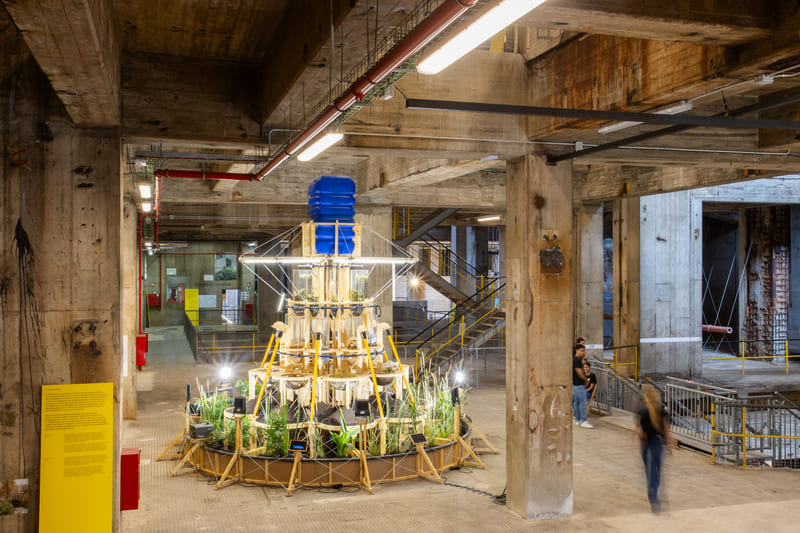
The upper part of the piece’s structure starts with an opaque blue space. You understand that there is water and sediment there, but it represents the common vision we have of a river: something we don’t know what’s inside. From there, we studied eight of the most significant reservoirs, not only for having the largest siltation but for having registered toxic or epidemic problems.
In the piece, we represent the level of siltation and saturation of these reservoirs. It’s fascinating because, although we have data on the sediment saturation levels of some, there is no information on others, and the drought has allowed us to see that they are completely saturated, which nullifies their function of preventing floods or inundations.
Monusediment incorporates eight stories of repair, giving voice to “more-than-human” entities (like the zebra mussel, the European mink, the black fly, or the Delta flamingo) and even bureaucratic ones (the expropriation file). What was the design process like to translate these biological, political, and toxic realities into the different material levels and retention vessels of the structure?
Through those eight reservoirs, the structure operates on a higher indexical level. It then enters a metaphorical space that addresses toxicities and geographies of repair, developed in detail in the eight films located at the base of the structure. That is why we define the piece as a liturgical space for meditation and, at the same time, as a laboratory. We sought to be precise: to bring the sediments, understand the pollutants, and analyze the necessary processes so that those sediments can be returned to the delta with non-toxic qualities, free of plastics or historically accumulated polluting compounds. It’s not just about opening floodgates or dismantling reservoirs; it is a highly complex multi-species process. To materialize this sedimentation through the retention vessels, we need the collaboration of science. Scientists from Eurecat and the Ebro Delta Natural Park have advised the administration and the Ebro Hydrographic Confederation, but they are being ignored due to a lack of pressure and political will. The Delta and the Ebro River have historically been the destination for factories, polluting industries, and nuclear power plants, without the awareness that they are inserted into one of the richest bioregions in Europe. The piece acts as activism from a situated place, but it dialogues with a planetary problem: almost all rivers on Earth are victims of this same water violence.
You state, along with TAKK, that “sediments are not inert matter, they are the body of the river.” What exactly does the concept of “sedimentary justice” mean to you?
Water governance and sedimentary justice are compound figures. We know what a sediment is and what justice is, but we had never put them together. In Greek, the word metaphor means bus; it’s something that transports you from one place to another. Compound words and poetic mappings generate new linguistic, social, and legal realities that correspond to an ecosocial reality that the people in the territory understand perfectly. When they ask me if this is architecture, I answer: if architecture is the discipline responsible for articulating the social, the political, the economic, the material, and the technological into a collective aspiration, all of this is architecture.
In Prague, I direct a studio where I accept students to follow a five-year process with me, in addition to PhD students. It’s a unique system where students of all levels coexist, forming a family mentoring structure. In the projects, we identify different annual strategies. This past semester, we designed “observatories in natural parks in danger of disappearing” to establish spaces of stewardship and conservation, assuming that architecture always represents an invasion.
The previous semester, I proposed the concept of “architecture between classes.” It wasn’t about conventional social housing; the students set up a speculative real estate company to propose housing intended for different socioeconomic strata. Upon graduating, architects enter an economic market subordinated to the developer, land value, and the upper-middle class. Here I proposed they be entrepreneurs of new models where, for being poorer, you didn’t have smaller spaces, but everyone shared the same typologies paying prices proportional to their income. We know that people live better in diverse neighborhoods, with mixed socioeconomic classes and languages—a social value that demands a radical change in value production in our society.
Right before this focus on natural parks, you explored the socio-political aspect of the profession. What did this concept of “architecture between classes” consist of, and how is this entire pedagogical and water-workshop ecosystem captured in the project’s book?
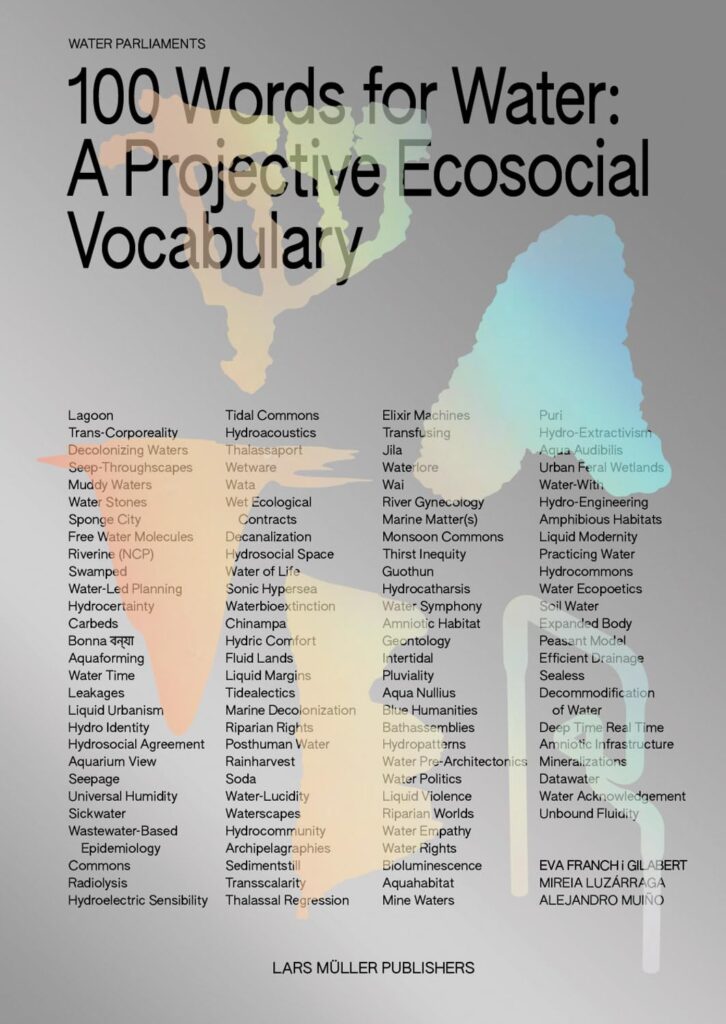
Specifically, the book compiles the work of the Water Parliaments in 2025, a project by the Institut Ramon Llull for Catalonia in Venice. We carried out territorial studies through future workshops with people from specific water contexts in Lleida, Girona, Barcelona, Valencia, after the DANA, the Balearic Islands, and the Ebro Delta. We developed speculative architectures like aquifer plaques made with artisans, which make visible which specific aquifer a house drinks from. We asked a hundred people around the world to give us a neologism or compound word to expand the ecosocial vocabulary. For example, biologist Carles Ibáñez created the term sediment still to differentiate it from fluid sediment in reservoirs. We need to expand language to be able to think differently through water.
Through the FAST platform, and alongside José Luis de Vicente, you present at UIA 2026 the audiovisual piece La Tempesta: Arquitectures de Geoenginyeria Vernacular, focusing on the “coeters” of the Ebro Delta. What lessons can these traditional technologies and infrastructures teach us regarding climate change and atmosphere modification?
We are aware of the ownership of the land and, to a lesser extent, the subsoil or the seabed, but not the atmosphere. With emissions, we understand carbon credits, but we must ask ourselves who owns the domain of the atmosphere and how it is designed. In 1945, farmers in the Ebro Delta could not get insurance against hail. Historically, they used sound cannons, and during the dictatorship, this practice was legalized along with the use of silver iodide. Scientist Chris Vonnegut discovered that spreading silver iodide in cumulonimbus condensed the water before it froze and fell as hail. A farmers’ cooperative was organized in the Delta which, together with the Ebro Observatory, strategically distributed a vernacular infrastructure for atmospheric defense. The rocket launchers (coeters) watched the clouds at the end of August, launched the rockets, and wrote forensic reports of the explosions and the resulting rain.
We must ask ourselves who owns the domain of the atmosphere and how it is designed
This generated tensions with dryland and mountain areas, who believed that modifying the climate harmed them. The big question is who has the right to modify the atmosphere and how the commons of the air are governed. We face an extreme climate situation, and the solution cannot be to install air conditioners that many people cannot afford. Buckminster Fuller already proposed domes like the Dome over Manhattan to control the climate. Our thirty-minute audiovisual piece is not a conventional documentary, but a journey that opens questions about the governance of the commons, from the atmosphere to water. These vernacular infrastructures must operate as pedagogical spaces and reminders in a world where we check the weather on our phones but have lost the ability to read the immediate clouds. In the Delta, I work on a project that situates regeneration, from agriculture to tourism and architecture, as a vector for the future. It’s not enough to be sustainable; we must regenerate territories from the hyper-local with a planetary consciousness.
FAST operates at the intersection of environmental imagination, technology, and civic engagement. How do you imagine the role of these transdisciplinary tools in the cities and administrations of the future?
With José Luis de Vicente, we talk about the legal instruments, governmental spaces, and new rituals necessary to become aware of water and climate urgencies. He, along with writer Kim Stanley Robinson, conceived the idea of the Ministry of the Future during “After the End of the World,” an exhibition at the CCCB. Ministries of the Future would be a good idea to govern the commons. Considering that the most innovative project for a world capital of architecture consists of reinventing the city’s party walls falls a bit short for us. We need people with more vision and ambition in politics, giving opportunities to people who have things to say. Iñaki Carnicero has done impeccable work with the Casa de la Arquitectura, but more initiatives are needed that put architecture in dialogue with other experts to rethink cities from scratch. We manage obsolete urban plans with uses and functions disconnected from contemporary technological, ecological, or emotional realities. I hope politicians are up to these challenges.
You were co-founder and artistic director of the MODEL Barcelona Architectures Festival in 2022. Seeing the city’s projection in this year 2026, how do you assess the impact of these experimental public platforms in connecting citizens with contemporary architectural debates?
It was a fascinating commission from the City Council. I was coming back from New York to take a sabbatical year, and they called me three days later. They understood very well that, just as the Llum BCN festival managed to massively attract citizens to understand the transformation of public space through light, that was only the tip of the iceberg of what architecture can do. The Model festival was conceived under that transversal perspective and served to promote pioneering prototypes with local architects. We developed projects like Mamífera (with Equal Saree), a public breastfeeding space that allowed nursing, hand washing, or using a public fridge—needs usually alien to urban space designers. We also proposed urban shades that absorbed pollution instead of solving a single problem at a time, or urban kitchens in Plaza Catalunya (with Cooking Sections and MAIO), and the Arka installation (with TAKK and LEA), which generated pollination habitats for species expelled from the city.
It was beautiful to see how the residents of Sant Antoni or Meridiana went from initial surprise to asking us for the prototypes to stay permanently. They understood that they were not a whim of “starchitects,” but necessary tools to articulate everyday problems. The festival positioned Barcelona as a space for radical urban experimentation, and it is a pity that it disappeared due to a political decision. Nevertheless, Model’s legacy forced other festivals to adopt more social, ecological, and political agendas, giving a voice to young creators through impartial and meritocratic juries, breaking invisible barriers in a society where family surnames often occupy spaces of power.
You participated in the “Becoming More-Than-Human” plenary session of UIA 2026. In the face of immense challenges such as coastal regression, biodiversity loss, and the global ecological crisis, what should be the main civic and spatial responsibility of the new generations of architects you are training today?
I always ask my students to be the ones to identify the problem, not to wait for someone to ask them for a project or a commission. They must take charge of creating the economic, legal, and political context, because that is also part of architecture. From there, the formal design will have a choral character, and new aesthetics will emerge. Today, architectural design necessarily involves designing the legal, economic, and political space; otherwise, we are castaways of an extractivist society with obsolete structures.
This 2026 UIA Congress was a great opportunity. Although there has been an evident split between the success of the congress and the capital’s inability to generate a moment of true global contribution, the scientific gathering has been impeccable thanks to the work of the curators. At the time, I proposed to Guim Costa that the congress’s direction be decided through an open and democratic international competition. He listened to me, the competition was called and, although I did not apply, I helped the winning team by providing international contacts to break the inertia of a format that had historically been stale and closed. We have had a plural congress where the ocean of the corporate and bureaucratic profession met that of intellectual, activist, and radical academia. That encounter has sparked many things and leaves us with infinite gratitude towards the curators, who provided initiative, vision, and talent far beyond their political or salary obligations.
Eva Franch i Gilabert claims architecture as a transversal tool for political and ecosystemic intervention in the face of crises such as the Ebro’s sedimentary retention or climate governance. Her defense of disciplinary plurality and an educational model based on the proactive management of legal and socioeconomic frameworks redraws the role of new generations against extractivist urbanism. The UIA 2026 Congress confirms the viability of an architectural debate linked to collective rights and bioregional balance.