
ANDIMAT and UNE, in collaboration with AENOR, held a technical session to analyse the timetable of the new DB HSA, the role of EPDs and the contribution of thermal insulation to cutting emissions over the whole life cycle of a building.
The forthcoming Basic Document on Environmental Sustainability (DB HSA) of Spain’s Technical Building Code (CTE) will make it mandatory to calculate the carbon footprint of buildings from 2028 and will later set binding regulatory limits. In this scenario, Environmental Product Declarations (EPDs, DAP in Spanish) prepared under standard UNE-EN 15804+A2, and the assessment of the building’s footprint under the new standard UNE-EN 15978, will be key tools to advance the decarbonisation of the building stock.
This was the message of the technical session “Cálculo de la huella de carbono en edificios. El impacto del aislamiento” (Calculating the carbon footprint of buildings. The impact of insulation), organised by the Spanish National Association of Insulation Materials Manufacturers (ANDIMAT) and the Spanish Association for Standardisation (UNE), in collaboration with AENOR. The session highlighted the strategic role of thermal insulation products in cutting emissions over the whole life cycle of a building, and the need to assess them through UNE standards and to have sector-wide or individual EPDs.
Sustainability and energy efficiency, hand in hand
David Molina, director Técnico de ANDIMAT, opened the session with an overview of the sector. In his view, in this new reality sustainability and energy efficiency are “strongly linked and must be addressed in a coordinated way to decarbonise the building stock by 2050“.
Molina stressed that thermal insulation solutions are decisive for the overall carbon footprint. By significantly reducing operational energy demand during the use phase of the building, insulation more than offsets the impact of manufacturing the materials and becomes a source of net emission reductions over the full life cycle.
Insulation more than offsets the impact of manufacturing the materials and delivers net emission reductions over the building’s life cycle.
The new DB HSA: timetable and correction factors
The session examined the transposition of the Energy Performance of Buildings Directive (EPBD 2024/1275) into Spanish law, which will be implemented through the new DB HSA. Its section HSA-1 will regulate the declaration of the Global Warming Potential (GWP, PCG in Spanish).
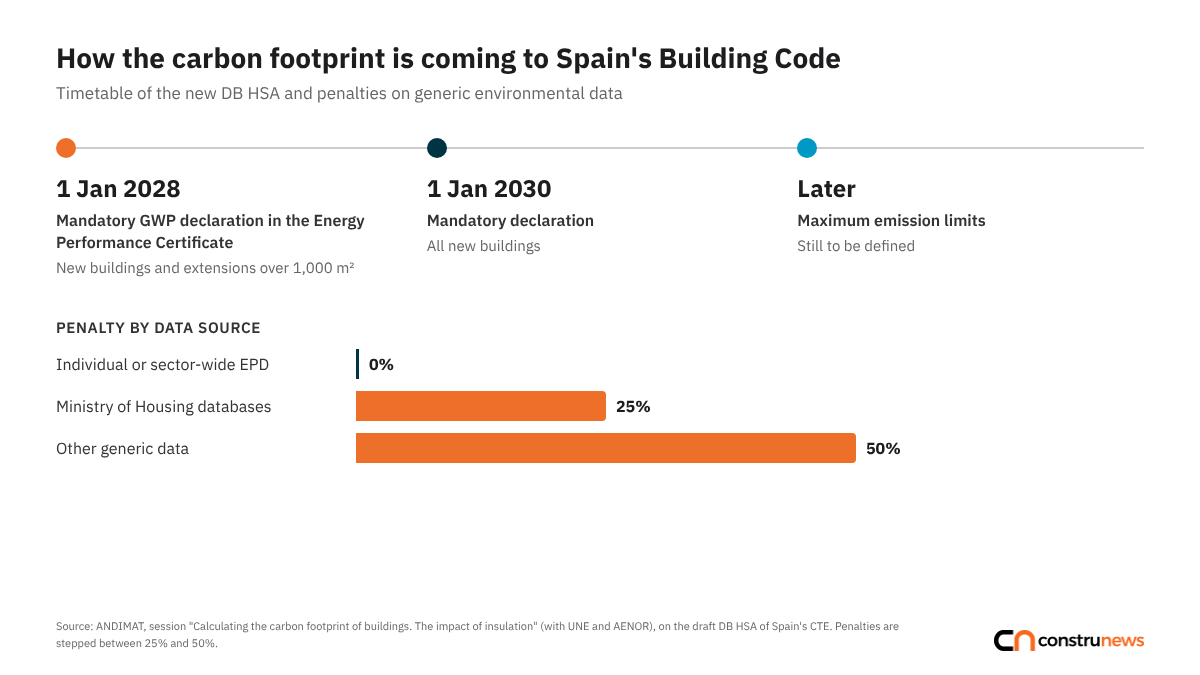
The timetable sets the obligation to calculate and declare the carbon footprint in the Energy Performance Certificate:
- From 1 January 2028, for new buildings and extensions of more than 1,000 m².
- From 1 January 2030, for all new buildings.
Maximum carbon emission limits that projects will have to meet will be introduced later, “although they are still to be defined“, Molina said. These milestones match those presented by the Spanish Ministry of Housing and Urban Agenda in its public presentations of the draft, which was open to public consultation until 9 December 2025.
Calculations will follow the methodology of standard UNE-EN 15978. The draft DB HSA also includes correction factors that penalise generic environmental information compared with specific data. Data from individual or sector-wide EPDs will carry no penalty. By contrast, generic values will face stepped penalties, ranging from 25% for the Ministry of Housing databases to 50% for other generic data.
Data from individual or sector-wide EPDs will carry no penalty; generic data will be penalised by between 25% and 50%.
“It is important for designers to know that, when calculating the GWP, they can rely on the information manufacturers will provide on their products through the EPD. The information will be available, and the Digital Product Passport and EPDs will be essential tools,” ANDIMAT’s technical director explained.
Standardisation as a common language
Aitor Aragón, responsable de Construcción Sostenible y BIM en UNE, presented the European standardisation framework that underpins environmental assessment. He highlighted the importance of UNE-EN 15804+A2 for preparing EPDs and developing complementary Product Category Rules (c-PCR), with particular attention to UNE-EN 16783, which applies to insulation products.
The session also addressed the convergence between the Construction Products Regulation (Regulation (EU) 2024/3110) and the need to digitalise environmental information. “Given the massive volume of data projects will require, we need structured, machine-readable data formats that can be integrated into BIM environments and feed the future Digital Product Passport (DPP), avoiding the inefficient handling of PDF documents,” Aragón said. “Standardisation is the common language that brings technical consistency between the product and the building. Anticipating and taking part in drafting these standards is the most effective way to secure the industry’s competitiveness in the face of regulatory change.”
Technical assurance of EPDs and preventing greenwashing
Carlos Alonso, responsable del Programa GlobalEPD en AENOR, focused on the requirements for preparing and independently verifying Type III EPDs under standard UNE-EN ISO 14025. Alonso stressed that “an EPD provides quantified, verifiable data from a Life Cycle Assessment (LCA), offering the transparency that design and building professionals need”.
He also linked the demand for rigorous data with the application of Directive (EU) 2024/825 (EmpCo) on empowering consumers against misleading advertising or greenwashing. This directive bans generic environmental claims and labels not backed by independent third-party certification.
An EPD does not label a product as green or eco-friendly: it certifies objective figures verified by a third party.
“An EPD does not describe a product with adjectives such as ‘green’ or ‘eco-friendly’; it certifies objective figures verified by a third party. It is the independent technical proof that the market and legislation require,” Alonso explained.
The whole value chain must prepare now
The session concluded that the framework introduced by the new DB HSA will require immediate preparation across the entire building value chain. Designers, contractors and manufacturers must become familiar with carbon footprint calculation under UNE-EN 15978 and UNE-EN 15804+A2 before the declaration obligations take effect in 2028 and the future limits are set.
“In this process, the insulation manufacturers that are members of ANDIMAT will keep promoting the development of individual and sector-wide EPDs to ensure the sector has verified, accurate and non-penalised data,” Molina concluded.

