

A market split by project type
The report, published on 17 November by Michelle Meisels (US engineering and construction sector leader, Principal, Deloitte Services LP), Victor Reyes, Kate Hardin and Scott Welch, starts from one observation: in 2026, engineering and construction activity diverged by project type. Total construction spending in the US stood at $2.2 trillion in August, 1.7% below a year earlier, and the first eight months of 2026 trailed the same period of 2025 by 2.9%, according to the Census Bureau. The decline is driven mainly by manufacturing construction, down 19.2% year on year, alongside softness in housing and commercial building.
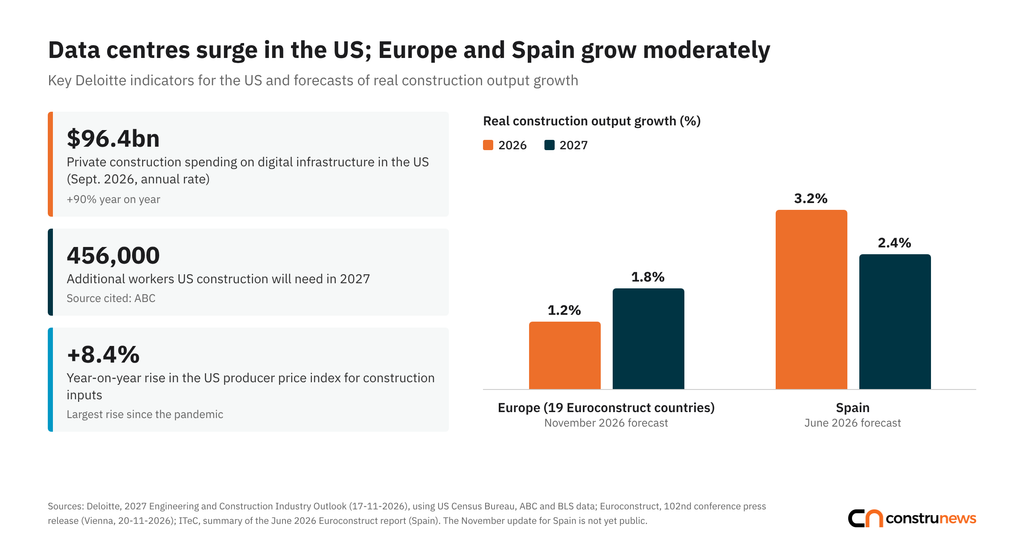
At the other end, private construction spending on digital infrastructure reached an annual rate of $96.4 billion in September, up 90% from $50.7 billion twelve months earlier. Deloitte’s economists estimate that announced plans point to growth of about 40% in 2027, to more than $1.1 trillion, compared with roughly 75% growth expected in 2026.
Private construction spending on digital infrastructure in the US reached an annual rate of $96.4 billion, up 90% in one year
Deloitte’s five trends for 2027
1. Delivery certainty amid workforce and procurement constraints. The US industry will need 456,000 additional workers in 2027, according to Associated Builders and Contractors, and more than half of them will replace retirees. Developing qualified craft labour takes 18 to 24 months, some critical equipment takes roughly 150 weeks to procure, and the producer price index for construction inputs has risen 8.4% year on year, the largest increase since the pandemic. “This workforce gap is structural, not cyclical,” the report warns, concluding that contractors may no longer be able to win work on capacity alone.
2. AI expands in operations. 61% of firms use AI or plan to increase their investment, up from 44% the previous year, according to the AGC of America and Sage survey. Use is concentrated in administrative tasks (45%), estimating (23%) and design and preconstruction (20%). Among architecture and engineering firms, adoption rose from 53% to 70% in one year, according to Deltek‘s Clarity study. Deloitte stresses that expansion must come with stronger oversight.
3. Industrialised construction moves from pilot to standard practice. Highly modularised projects are completed 30% to 50% faster, with timelines cut from 24-36 months to 16-20 months. 73% of North American practitioners are familiar with these methods, according to Dodge Construction Network and Autodesk, and at least three-quarters expect them to become standard. The report also notes the trade-offs: a 10% to 20% cost premium over conventional construction, the need for factory technicians, and contracts that do not settle who is liable for a module before it reaches the site.
Highly modularised projects are completed 30% to 50% faster, cutting timelines from 24-36 months to 16-20 months
4. Project selectivity. The largest firms and those with power, electrical and mission-critical capabilities face more digital demand than they can finance, permit and build. A data centre takes two to three years to build, but the grid needed to energise it can take four to eight years, according to the IEA. “Project selection has become a capacity allocation decision,” Deloitte sums up.
5. Strategic repositioning. Backlog size is no longer the yardstick of growth. Firms are shifting from fixed-price contracts towards collaborative models such as integrated project delivery, progressive design-build and cost-reimbursable contracts, which share risk more evenly, and are strengthening liquidity by reducing debt and building reserves.
From the US case to the global map
The pattern repeats beyond the US. In its presentation Powering the Digital Economy (June 2026), the IEA notes that data centre electricity demand grew by almost 20% in 2025 and that capital spending by five large technology companies is now larger than global investment in oil and gas production. It is the same phenomenon Construnews examined in its analysis of how data centres are redrawing the energy and economic map of construction (in Spanish).
In its Construction Key Themes 2026 report, published in January, Oxford Economics forecast a 2.9% rebound in global activity in 2026, after a decline in 2025 caused by China’s real estate downturn and tariffs. The consultancy named Asia’s emerging economies as the engine of growth, anticipated a shift in infrastructure investment from transport to utilities (energy and water) and described labour shortages as a structural challenge, in line with Deloitte.
Europe: 1.8% in 2027
Europe is moving with less momentum. Euroconstruct, which held its 102nd conference in Vienna on 20 November, has cut to 1.2% its forecast for real construction growth across its 19 countries in 2026, from 2.0% in June, and expects 1.8% in 2027. Through 2029 the sector will grow at an average of 1.6% a year, faster than GDP (1.3%), and in 2027 it will regain its 2023 level. Eastern Europe (3.0% a year) will double the pace of Western Europe (1.5%), led by Ireland, Czechia, Portugal and Sweden, while Germany, France and Italy may still be below their 2023 volume in 2029.
Euroconstruct expects European construction to grow 1.8% in 2027 and to exceed its 2023 level that year
Spain: housing holds up, civil engineering slows
For Spain, the latest public figures are the June forecast from ITeC, Euroconstruct’s Spanish member: after growing 4.3% in 2025, output would rise 3.2% in 2026 and ease to 2.4% in 2027 and 1.8% in 2028. Housing is the main driver, with 5% a year in 2026 and 2027; non-residential building would be limited to 1.5% in 2026, with scope to reach 2% in 2027-2028, and renovation would slow from 2.9% to 1.3%. Civil engineering, by contrast, would grow 2.0% in 2026, stall in 2027 (0%) and could contract by 1.9% in 2028. The Vienna press release does not yet include the country-by-country update.
Deloitte’s underlying message also applies to the Spanish market, where Construnews has documented the rise of industrialised construction (in Spanish) and investment in data centres (in Spanish): with labour a persistent constraint, “success in 2027 may depend less on how much work a firm can win and more on how reliably it can deliver.”

