
Infrastructure maintenance cannot depend on tragedies. That was the message delivered by the Confederación Nacional de la Construcción (CNC) at the infrastructure conference organised by Molins with the Colegio de Ingenieros de Caminos, Canales y Puertos, where its president linked the future of public investment to a procurement reform now being negotiated in Brussels.
CNC is calling for the maintenance and conservation of infrastructure to hold a permanent place on the political agenda, and not only after tragedies such as the recent railway accidents. This was stated by its presidente, Pedro Fernández Alén, during his speech at the conference, held in Madrid on 20 November 2026.
Fernández Alén stressed the urgency of drawing up and approving updated General State Budgets that reflect infrastructure investment needs, needs which, in his view, could also be addressed, for example, through public-private partnership.
The CNC president believes that both new infrastructure works and maintenance and conservation works are constrained by the poor health of public procurement, and warned that, unless the system improves, the investment increases set out in the electoral programmes will hardly be delivered on time and in the proper manner.
Unless the procurement system improves, the investment increases in the electoral programmes will hardly be delivered
Looking to Europe for solutions
Fernández Alén, who is also vicepresidente of the European Construction Industry Federation (FIEC), regretted that, after so many years of warning in Spain about the most pressing problems and calling for reforms to improve the procurement system, it is now necessary to look to Europe for solutions.
In this context, he pointed to the negotiation between the European Parliament and the Council of the EU of the new public procurement regulation, which will replace the current regulatory framework and will be binding on Member States. For CNC, this process is an opportunity to correct practices that harm competition and improve the quality of public investment. Construnews has already covered the sector’s demands in the Luxembourg Manifesto (in Spanish), and Fernández Alén himself set out his FIEC roadmap in an interview with Construnews.
Limits on in-house awards and price revision
His main proposals include limits on the abusive use of in-house procurement and assignments to in-house entities by public administrations, which can unjustifiably reduce opportunities for private companies, especially small and medium-sized ones.
He also supports progress on so-called European preference or Made in Europe, so that public procurement helps strengthen EU industry and protect Europe’s strategic interests.
He adds the need for mandatory price revision and economic rebalancing mechanisms in contracts when significant cost variations alter the conditions under which they were awarded.
CNC calls for mandatory price revision mechanisms when costs alter the conditions of the award
More quality, fewer lowest-bid awards
But one of the changes he considers most urgent is to progressively abandon a procurement model based exclusively on price in order to reward the best offer, not simply the cheapest.
The CNC president believes that awarding a maintenance or conservation contract solely on the basis of initial cost can sideline decisive aspects such as the quality of materials, the durability of infrastructure, innovation, sustainability or the conditions of execution.
Against auctions
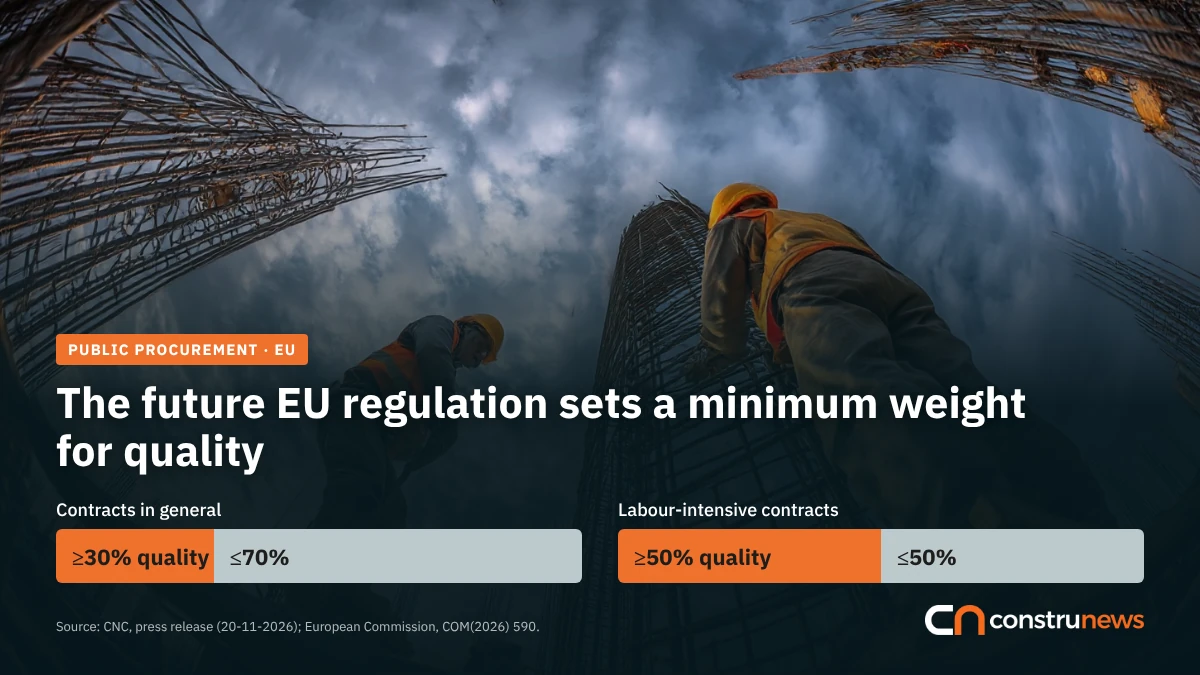
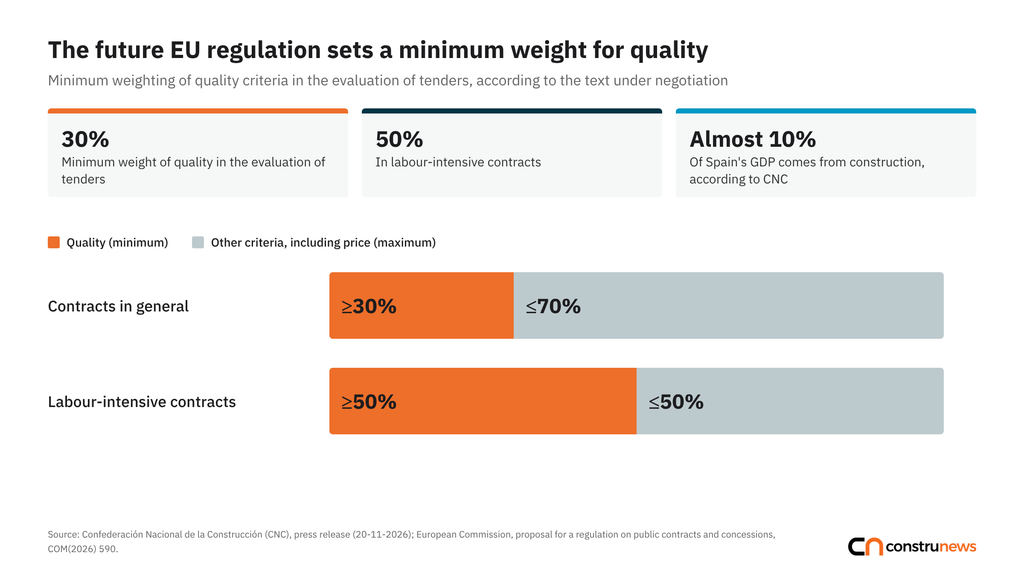
Fernández Alén explained that the European text under negotiation already provides for quality to account for at least 30% of the evaluation of tenders, a percentage that rises to 50% in contracts requiring intensive use of labour. He therefore considers this approach a step towards a definition of the most economically advantageous tender that takes into account factors other than price, and stressed that conserving infrastructure, ensuring its safety and extending its service life requires investing better, not simply spending less.
An opportunity not to be missed
For Fernández Alén, the coincidence of the new political cycle in Spain with the negotiation of the future European regulation opens an opportunity that should not be missed.
“We have a unique opportunity ahead of us to drive changes that allow us to procure better and ensure that public investment translates into safer, more sustainable and more durable infrastructure. If infrastructure goes well, Spain will go well. And the state of our infrastructure is also an essential element for citizens’ trust in institutions and for the very health of our democratic system,” he concluded.
Technical diagnosis and preventive conservation
CNC was not the only voice calling for a change of approach at the conference. At the same event, Leonardo Benatov, director general of Euroconsult Nuevas Tecnologías, proposed allocating €20,400 million over the next decade to diagnosing the real condition of infrastructure, 5% of the €407,341 million that SEOPAN estimates must be invested in that period, and also argued that price should not be the decisive factor in procuring engineering services. Both also agreed that the next Budgets must reflect real investment needs and that public-private partnership should be used.
Other participants included Carlos Granell, presidente of the Comité Nacional Español de Grandes Presas; Javier León González, director técnico of Fhecor Ingenieros Consultores; David de Paz, coordinador del programa Europe’s Rail para ACCIONA; and Rosalía Gil-Albarellos, presidenta of Tecniberia.

