
Eleven days before Spain’s general election on 29 November, the Colegio de Ingenieros de Caminos, Canales y Puertos (Spanish Association of Civil Engineers) has sent the four main national parties its proposed National Infrastructure Strategy 2027-2031. The document sets out 85 measures to guide the next Government and proposes a ten-year Strategic Infrastructure Investment Plan worth €413 billion.
A ten-year plan worth €413bn
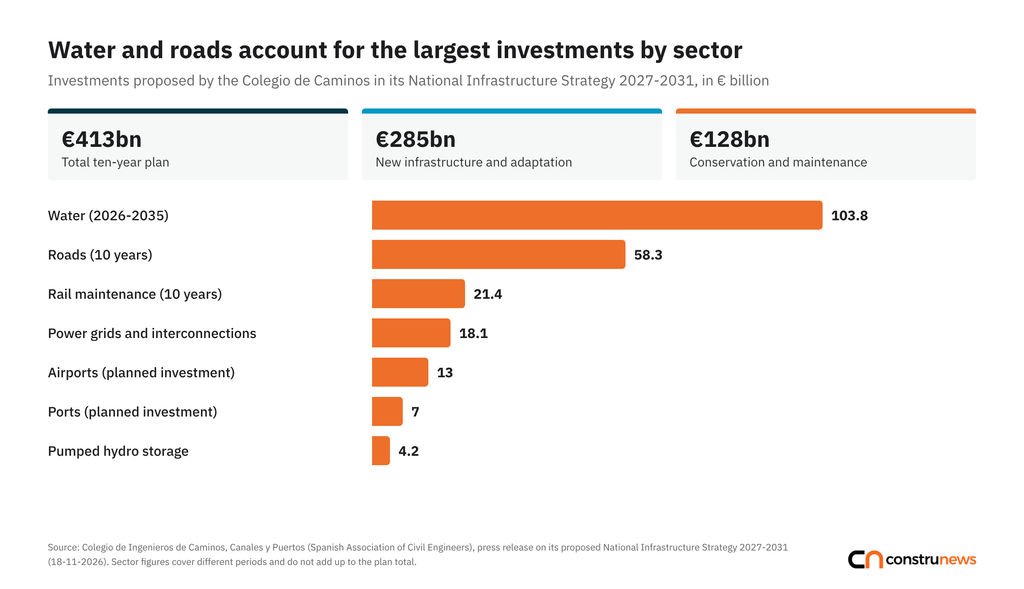
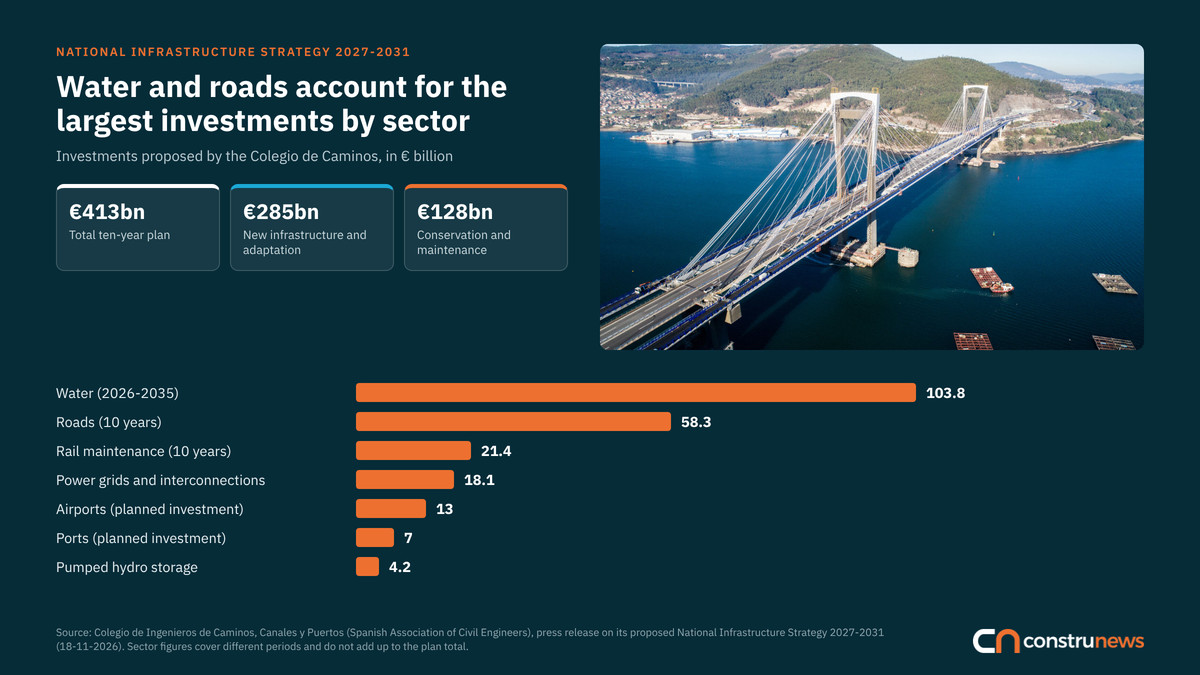
The proposal, released in Madrid on 18 November, splits the programme into two main blocks: €285 billion for new infrastructure and adaptation and €128 billion for conservation and maintenance. To fund it, the Colegio warns that it will be necessary to assess concessions and other public-private partnership formulas, as well as the user-pays model where appropriate.
The measures cover planning and financing, public procurement and technical employment, together with specific actions on water management, roads, rail, ports, airports, energy and housing.
The institution argues for a sustained investment policy based on technical criteria to preserve existing assets and tackle four challenges: ageing infrastructure, extreme weather events, decarbonisation and housing demand. The document calls for priorities, responsibilities, funding and deadlines to be identified, and for an annual public report on implementation and results.
Of the plan’s €413bn, €285bn would go to new infrastructure and adaptation and €128bn to conservation and maintenance
Conservation: closing the gap before services fail
One of the report’s priorities is to close the conservation deficit so that it does not turn into service failures and higher costs. The Colegio proposes scheduling inspections, preventive maintenance and renewals according to the service life and use of each asset, with particular attention to railways, roads, dams, river channels and urban infrastructure damaged by the DANA (the October 2024 Valencia floods).
It is a line that Miguel Ángel Carrillo, then president of the Colegio, already defended in Construnews in December 2025 when he called for a State pact and a new engineering culture (in Spanish) based on conservation, resilience and digitalisation.
Water: €103.8bn and a new National Hydrological Plan
On water, the Strategy proposes a programme of €103.8 billion between 2026 and 2035 and urgently tripling the annual budget of the responsible ministry. It also proposes a new National Hydrological Plan to coordinate action against droughts and floods, network renewal and improved resource availability, as well as a Dams Act and specific funding for dam safety and conservation.
Roads: €58.3bn and user charges on high-capacity routes
For roads, the Colegio calls for around €58.3 billion over ten years: €43.7 billion for conservation and €14.6 billion for replacement and restoring the condition of the network. The document also proposes assessing a user-pays system on high-capacity roads and promoting their digitalisation and the rollout of ultra-fast charging.
Rail: €21.4bn for maintenance and renewing the Madrid-Barcelona line
In rail, the proposal earmarks €21.4 billion over the next decade for maintaining the state network and renewing the Madrid-Barcelona high-speed line. Of that amount, €10 billion is for high-speed rail and €11.4 billion for maintaining the conventional network. The Colegio also argues for modernising Cercanías commuter services, completing the Mediterranean and Atlantic corridors and boosting rail freight.
The report includes actions to restore safety and confidence in the rail system, including quality and technical audits, stable scheduling of renewals and maintenance, and improvements in governance, coordination and safety systems.
For ports and airports, the institution proposes carrying out the planned investments of €7 billion and €13 billion respectively and strengthening their rail connections.
For rail, the Colegio is asking for €21.4bn over ten years: €10bn for high-speed lines and €11.4bn for the conventional network
Energy: grids, interconnections and pumped hydro storage
The proposal includes €18.1 billion to adapt electricity grids and strengthen international interconnections, plus €4.2 billion for new hydroelectric storage facilities. According to the document, these actions should accompany the growth of renewables and electrification, make it easier to connect new industrial consumers and strengthen security of supply.
Housing: 300,000 homes a year and industrialisation
On housing, the Colegio proposes a ten-year National Plan to reach 300,000 homes a year and create a stable public stock of affordable rental housing. To increase supply, it proposes mobilising public land through public-private partnership, speeding up permitting and promoting industrialised construction, along with rebuilding business capacity and skilled labour.
The Colegio proposes a ten-year National Housing Plan to reach 300,000 homes a year and a stable public stock of affordable rental housing
Public procurement and the technical capacity of public administrations
On the regulatory front, the document proposes an Infrastructure Quality and Sustainability Act covering the whole life cycle, and a reform of the Public Sector Contracts Act to remove disproportionate requirements, simplify procedures and establish effective dispute resolution mechanisms. It also calls for greater weight for technical quality when contracting engineering and consultancy services.
The institution argues for strengthening the technical teams of public administrations, improving public employment conditions and ensuring generational renewal. It also proposes distinguishing between civil service subgroups A1 and A2 and requiring a master’s-level qualification for engineering bodies and grades in subgroup A1, in line with their responsibilities.
The Colegio, which has regulated the civil engineering profession in Spain since 1954-55 and has more than 25,000 members, presents these proposals under the principle of public service that defines the profession. Construnews examined many of these challenges in its special report on infrastructure in Spain (in Spanish).