
The past two weeks have shown a two-speed Middle East: Saudi Arabia is starting infrastructure linked to Expo 2030 and to pilgrim travel in Makkah while cancelling contracts it had already awarded; the UAE keeps adding high-end housing; and the United Kingdom has sanctioned eight Israeli construction companies. Meanwhile, the latest official data confirm that the construction market of the United States and Canada is larger than that of the European Union.
Riyadh starts the Expo 2030 metro station
The Royal Commission for Riyadh City (RCRC) has begun building Expo Station, a new stop on the Yellow Line (Line 4) of the Riyadh Metro that will serve the Expo 2030 site, open from 1 October 2030 to 31 March 2031. The station will span King Salman Road, between the Expo site to the east and future developments to the west, and will connect to King Khalid International Airport.
The project covers some 70,000 m² and will handle up to 19,000 passengers per hour. Its most visible feature will be a 134-metre steel dome resting on eight branching columns, with around 44,000 m² of green space and a solar installation designed to meet about 25% of its energy needs. The works were tendered in February 2026 and must be completed before the Expo opens. Neither the contractor nor the contract value has been disclosed.
In the same city, German practice JSWD has won the invited international competition to design the RIYMAR Towers, a mixed-use complex (residential, hospitality, offices, retail and leisure) near King Fahd Road and Olaya Street, ahead of a shortlist that included Aedas, AtkinsRéalis, Mesura and Zaha Hadid Architects. The competition, promoted by RIYMAR Real Estate, was run by Malcolm Reading Consultants, and the winning team includes schlaich bergermann partner for structures and Buro Happold for MEP. Floor area, heights and schedule have not yet been announced.
Riyadh is building a 70,000 m² station with a 134-metre dome to handle 19,000 passengers per hour at Expo 2030
Makkah awards $1.51 billion in transport PPP deals
The General Transport Centre (GTC), the executive arm of the Royal Commission for Makkah City and Holy Sites, signed contracts worth SAR 5.664 billion ($1.51 billion) at the sixth Hajj Conference and Exhibition for the Wasel Al-Haram project, which will improve access to the Grand Mosque. All three packages will be fully financed by private capital under a public-private partnership model.
The programme includes 19 stations and car parks across seven corridors, covering some 3.1 million m², and a fleet of 3,200 buses, to carry up to 205 million passengers a year. Packages 1 and 3 went to a consortium of Saudi Alqaid, Spain’s Moventis and Indonesia’s Waskita, and package 2 to the Mawgif consortium. Investment periods range from seven to ten years.
Rail, power and a bridge in Bahrain
Saudi Arabia Railways (SAR) has awarded a joint venture of Saudi Alomaier Trading & Contracting and China Civil Engineering Construction Corporation (CCECC) an estimated SAR 640 million ($170 million) contract to double the track of the phosphate railway between the Waad Al-Shamal mines and Ras Al-Khair, in the Eastern Province. The section is more than 150 kilometres long and includes civil works, bridges, culverts and signalling and telecoms upgrades, with a four-year delivery period. It is the second section of the programme: the first, of about 100 kilometres, had already gone to Alomaier for more than SAR 4 billion.
In the power sector, Saudi Energy has also awarded a 115/13.8 kV substation in Al-Aqiq, in Al-Bahah province, as part of its grid reinforcement programme.
Outside the kingdom but with Saudi money, Bahrain has signed the contracts for the fourth phase of the Busaiteen Bridge, the 8-kilometre northern corridor that will link Muharraq Island with Manama. The Saudi Fund for Development is financing all phases of the project with a grant of more than SAR 937 million ($250 million).
Diriyah and the Saudi Water Authority cancel contracts
The other side of the Saudi market is cancellations. Diriyah Company has scrapped the main construction contract for the One Hotel, in the Diriyah Two area, worth SAR 717 million ($191 million). The four-storey building, with about 325 rooms on a 31,000 m² plot, had been awarded in February 2026 to a joint venture of BEC Arabia Contracting and the Saudi subsidiary of India’s Ashoka Buildcon, which holds 49%. According to Ashoka’s filing with the Bombay Stock Exchange on 19 November, the developer cited “internal reasons attributable to the employer”, without further detail.
Five days earlier, India’s VA Tech Wabag told its stock exchanges that the Saudi Water Authority had cancelled the tender for the Yanbu desalination plant, a 300,000 m³/day seawater reverse osmosis facility on the Red Sea coast worth SAR 1.019 billion ($272 million). According to Wabag’s filing, the client notified all bidders through the Etimad procurement portal, citing “internal reasons”. It is the second time Wabag has lost the project: the first award, worth $317 million, was cancelled in December 2024.
The cancellations add to the review of Saudi giga-projects that Construnews has already examined in the case of NEOM and The Line (in Spanish).
Diriyah and the Saudi Water Authority have cancelled two contracts worth a combined $463 million in a single week
UAE: luxury housing with international signatures
In Abu Dhabi, developer MERED has appointed Dutco Construction as main contractor for the first phase of Riviera Residences on Al Reem Island, a project designed by Herzog & de Meuron with Dar Al-Handasah as consultant. It comprises 456 apartments, 11 villas and a penthouse, plus about 6,000 m² of wellness amenities. The contract covers main works, fit-out and landscaping over 33 months, with completion due in the third quarter of 2029. The value has not been disclosed.
In Dubai, the Global Partners fund has awarded the enabling works for Dubai Creek Gardens as a single package worth AED 100 million. The community, in Phase 2 of Dubai Healthcare City, covers 127,000 m² and represents a total investment of AED 3 billion for more than 1,420 homes, including the first Westin Residences and Renaissance Residences in the country, with handover in 2030.
The activity also extends to investment: Arada, through its fund manager Arada Capital, and Alya, a residential platform backed by Brookfield and Lunate, have signed a co-investment memorandum for developments in the UAE and Saudi Arabia. The first two projects have an anticipated gross development value of AED 6 billion ($1.6 billion), subject to due diligence and approvals.
London sanctions West Bank settlement builders
On 17 November, the UK government imposed asset freezes and director disqualifications on eight Israeli construction, property and architecture firms building in West Bank settlements: Har Hevron Development Company, Hemdat Shomron, S.A.G. (Velvel) Construction and Development, Lev HaHar Yazamut, Harey Zahav, Ariel Residential Judea & Samaria, Ami Gvirtzman Architects 2021 and Z.F. Building Company. The measure, which also targets the Tzav 9 group for blocking aid convoys to Gaza, comes shortly before the tender deadlines for the E1 project. Foreign Secretary Ed Miliband warned companies: “do not bid, do not build, and do not profit from the destruction of the two-state solution.”
North America versus Europe: more volume, a different cycle
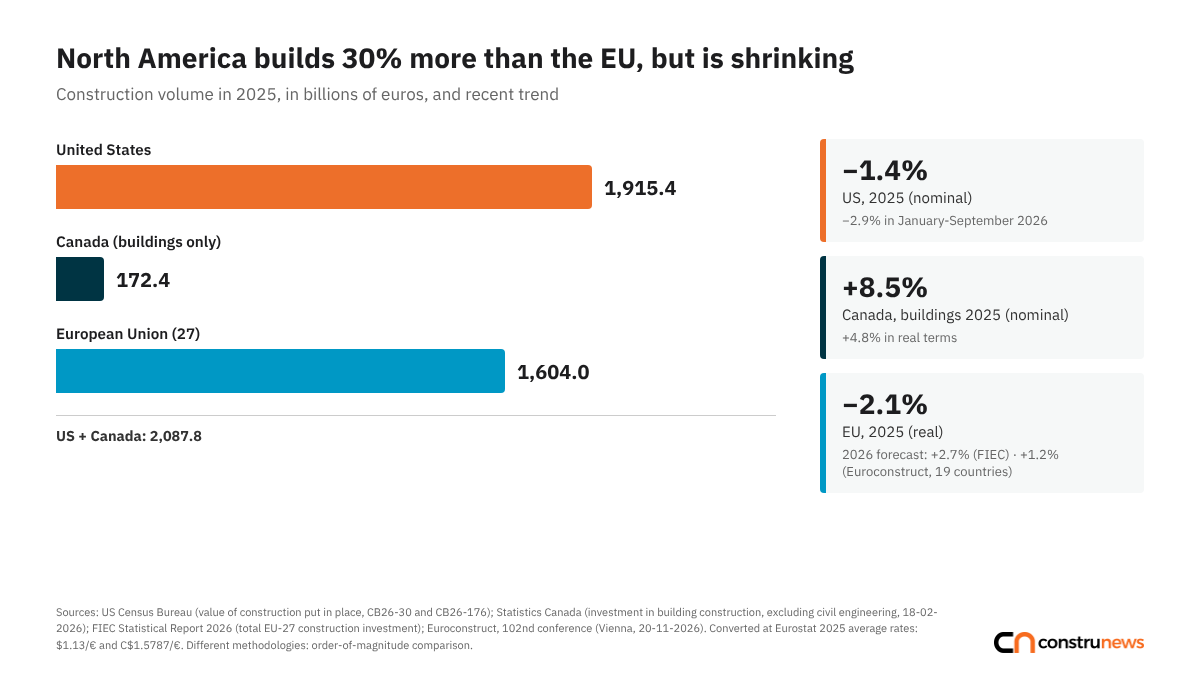
On the latest official data, the North American construction market is larger than Europe’s. According to the US Census Bureau, the value of construction put in place in the United States in 2025 was $2.16 trillion, 1.4% less than in 2024: private construction fell 2.9%, while public construction grew 3.6% to $516.8 billion. In the first nine months of 2026, cumulative spending reached $1.65 trillion, 2.9% less than a year earlier.
In Canada, investment in building construction (excluding civil engineering) reached C$272.1 billion in 2025, up 8.5% in current dollars and 4.8% in real terms, according to Statistics Canada data, driven by multi-unit housing.
In the European Union, total construction investment was €1.6 trillion in 2025, according to the FIEC Statistical Report 2026, after falling 2.1% in real terms, a second consecutive decline. Housing renovation accounts for 30.1% of the total, non-residential building for 29.9%, civil engineering for 20.6% and new housebuilding for 19.4%.
Converted into euros at the 2025 average exchange rates published by Eurostat ($1.13 and C$1.5787 per euro), the United States equals about €1.92 trillion and Canadian building construction €172.4 billion. Together they reach €2.09 trillion, 30% more than the EU, even without Canadian civil engineering. The figures come from statistics with different methodologies (value put in place in the US, building investment in Canada and total investment in the EU), so the comparison is one of order of magnitude.
The US and Canada add up to €2.09 trillion in construction, 30% more than the EU, but their cycles run in opposite directions
The trend, however, is reversed. While the United States has posted two years of decline, Europe expects a recovery: FIEC forecasts EU construction investment to grow 2.7% in 2026, led by civil engineering (+4.1%) and new housebuilding (+5.1%). Euroconstruct, which presented its forecasts for 19 European countries in Vienna on 20 November, is more cautious: it has cut real growth for 2026 to 1.2%, from the 2.0% it expected in June, and expects 1.8% in 2027.
The Gulf combines large awards linked to Expo 2030 and religious travel with cancellations worth $463 million in a single week. Meanwhile, North America remains a market 30% larger than Europe’s but is shrinking, while the EU is set to grow by between 1.2% and 2.7% in 2026.

