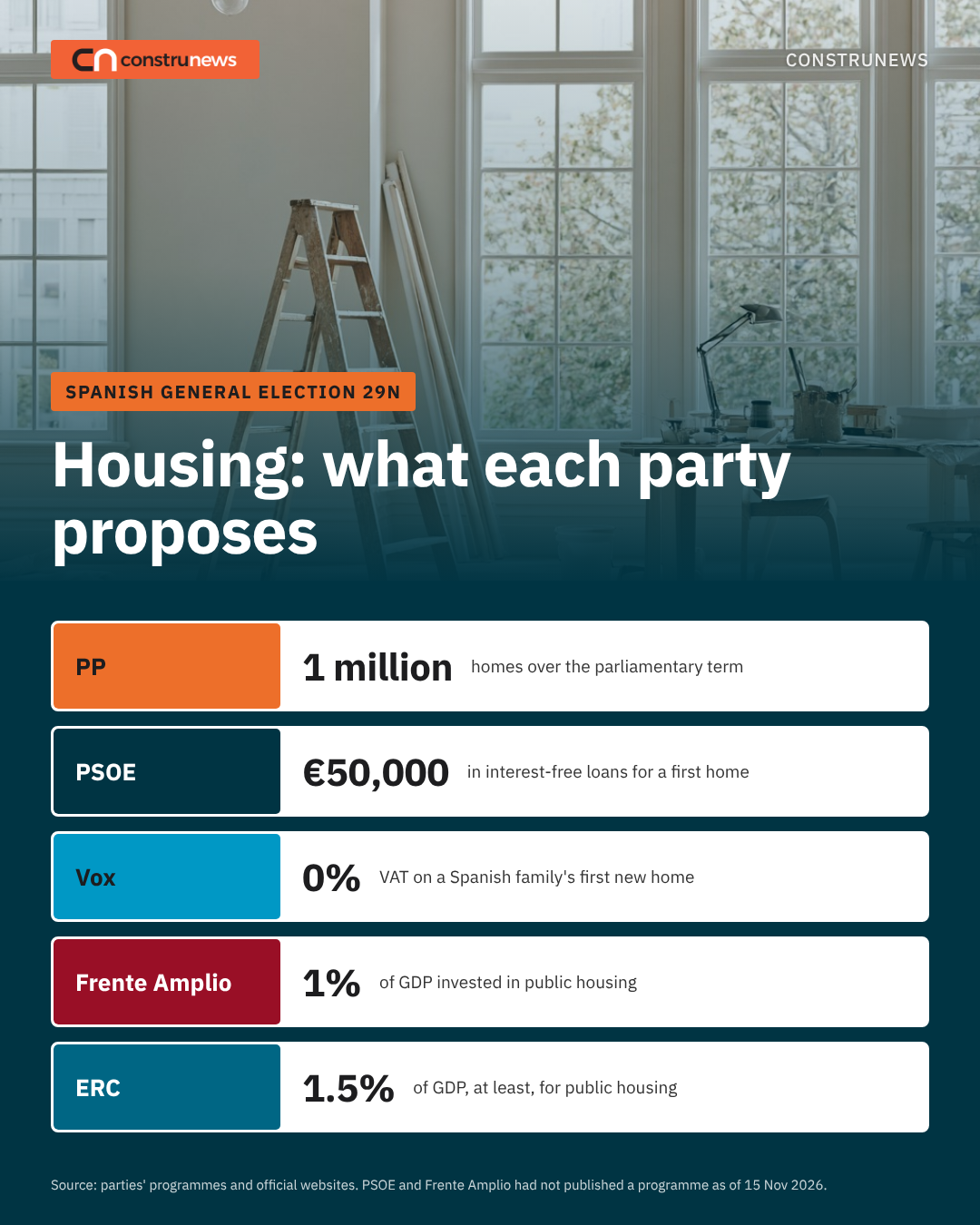

Just days before the general election on 29 November, with housing at the heart of the campaign, Construnews’ Special Report on Housing Data in Spain puts figures on what the parties are debating on the campaign trail. The picture is clear: the country completes around 94,000 homes a year when it would need 146,000, and the problem is no longer explained by a lack of land but by everything that happens between the zoning plan and the handover of keys.
A country building a fraction of what it used to
In 2025, building permits were approved for 59,301 residential buildings, 77% fewer than at the 2005 peak, and new-build has collapsed from 209,752 buildings in 2006 to 32,137. Some 80,792 free-market homes were completed, 13.5% of the record year, although starts, at 121,827, were the highest since 2008. Against this, Spain’s National Statistics Institute (INE) forecasts 2.2 million more households by 2041, 94% of them with one or two people, which requires completing 146,000 homes every year. Spain has fallen to 22nd out of 27 in the EU for residential building permits.
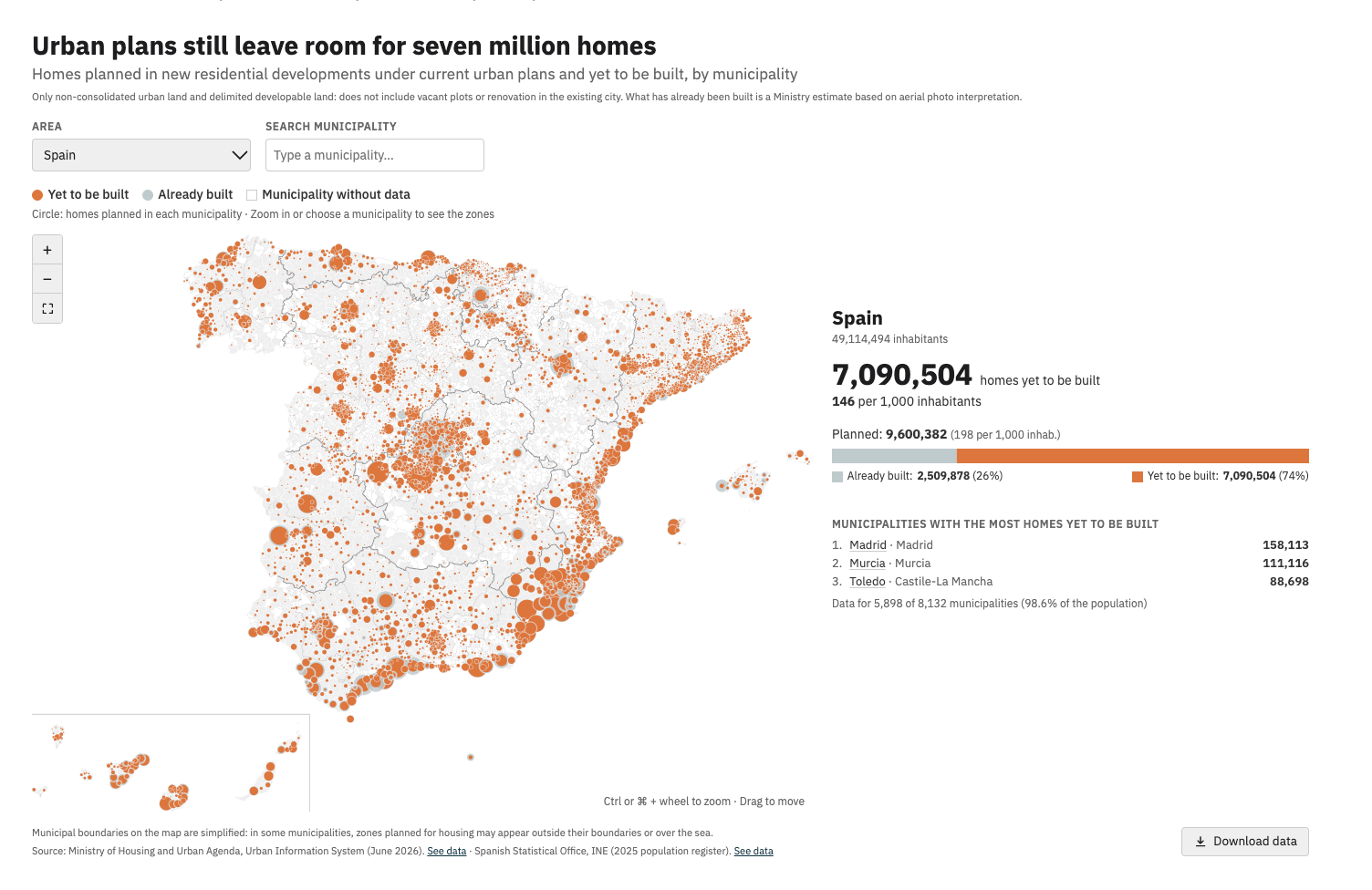
On paper, land is not the bottleneck: zoning plans still have 7.1 million homes pending, more than three times what is needed, but the ratio drops to 62 per 1,000 inhabitants in Madrid and 65 in Catalonia, compared with over 400 in Murcia or Castilla-La Mancha. Building is 57% more expensive than in 2005, above inflation (52%), driven mainly by materials (+66%). And protected housing, which reached 85,028 completed units in 1997, stood at just 12,858 in 2025.
There is planned land for 7.1 million homes, more than three times what is needed by 2041, but it is scarce where demand is tightest
Permits, the first bottleneck
The two interviews in the special report agree on the diagnosis. Marta Vall-llossera, presidenta del Consejo Superior de los Colegios de Arquitectos de España (CSCAE), places the first bottleneck in building permits that exceed the legal three months and take around twelve, according to Asprima. Her immediate measure is to clear the permit applications for projects that have already been approved by the architects’ associations, because it “does not require zoning land, planning or urbanisation”, and every year of delay adds some €13,000 to the cost of a home.
Xavier Vilajoana, presidente de APCEspaña, calls for permits to be granted within the 2-3 months set by law rather than 12-18, asks for €7 billion a year for protected housing and warns that “the Administration alone does not have the capacity to take on the challenge of expanding the housing stock”. They differ on renovation: for Vall-llossera “it is half of the solution”; for Vilajoana, its contribution is limited because it does not create new homes.
Every year of delay in granting a permit adds around €13,000 to the cost of a home, according to Asprima data cited by CSCAE
Brussels, design and voters: the context of the special report
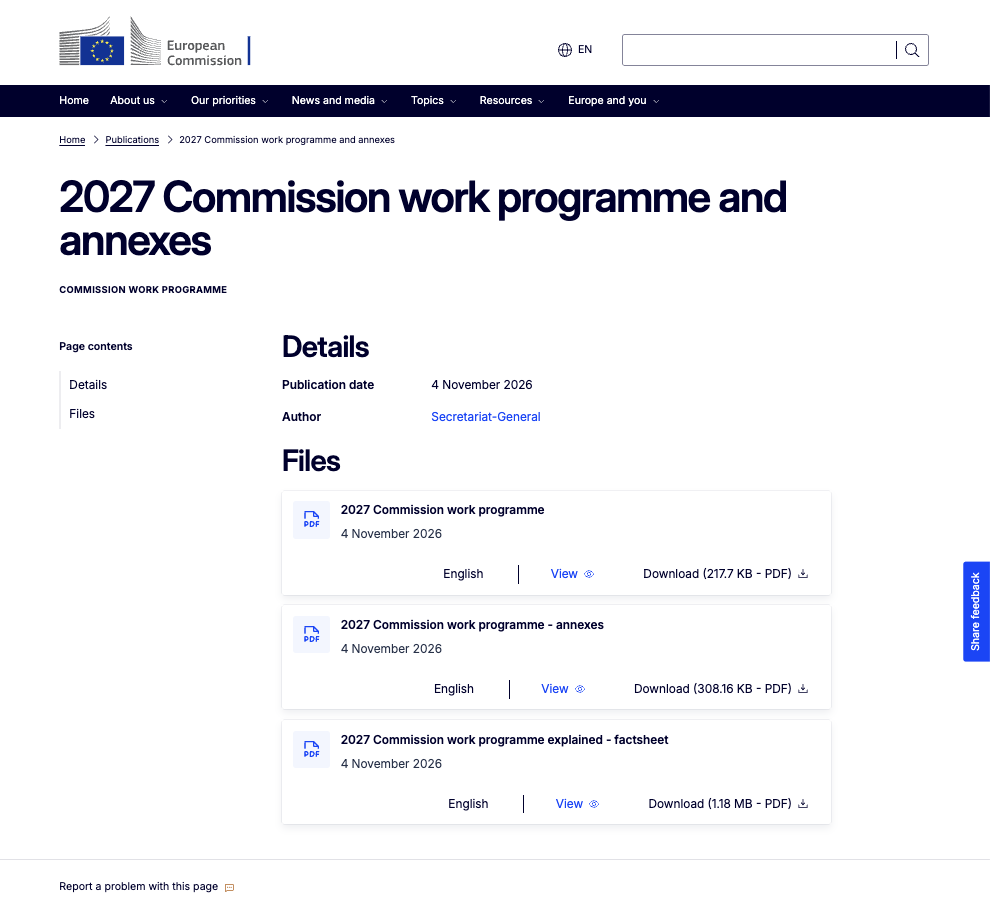
The diagnosis matches what Construnews has published in recent weeks. The European Commission, in its autumn forecast, flags the housing shortage as the main risk to Spain’s growth, with a shortfall of 750,000 homes since 2021 according to the Bank of Spain. Meanwhile, FIEC and Build Europe call for predictable permitting for affordable housing as the EU closes a €199.7 billion budget for 2027, and the Commission will propose a simplification package in 2027 to build and renovate with less red tape: it estimates the EU needs more than two million homes a year.
The debate is not only about numbers. The CSCAE Observatory proposes designing housing around people rather than typologies (in Spanish), and the demographic challenge already has a figure in care: Spain faces a shortfall of nearly 100,000 residential care places for older people (in Spanish). Citizens feel it: according to the III Barómetro de Vivienda y Dignidad by CGATE and GAD3, 54% of Spaniards now rank housing among their main concerns (in Spanish), 12 points more than in 2025. The parties have responded with manifestos outlining two opposing models.
54% of Spaniards now rank housing among their main concerns, ahead of healthcare and the political situation
A year after calling for a state pact
In July 2025, Construnews’ previous special report, La vivienda en España, un reto estructural (in Spanish), brought together Housing Minister Isabel Rodríguez and a dozen voices from the sector, including Vall-llossera and Vilajoana, around one point of agreement: the urgency of a state pact. At the time, the figures cited were a shortfall of 450,000 homes and 80,000 built a year against 150,000 needed. Today the Bank of Spain puts the accumulated shortfall at 750,000, and APCEspaña is once again calling for that pact between administrations, parties and the sector.
The data leave little room for interpretation: Spain completes 52,000 fewer homes a year than it needs, has more than enough planned land but in the wrong places, and protected housing has not recovered its pre-2008 pace. The sector’s proposals focus on permits on time, stable funding and public-private partnership. Whoever governs after 29N will inherit a shortfall that, if left uncorrected, could approach one million homes between 2026 and 2028, according to the Bank of Spain estimates cited by CSCAE.
Data feature by Roger Tugas and the Construnews team
-
The price of building new homes in the EU rises 4.6% in a year as quarterly growth slows

Building a new home in the European Union now costs almost 30% more than in 2021. The latest Eurostat data, updated on 19 November, show that quarterly growth eased over the summer, but the annual rate accelerated to 4.6%, the highest since at least 2024, in a year in which prices have come under renewed…
-
Brussels flags the housing shortage as the main risk to Spain’s growth

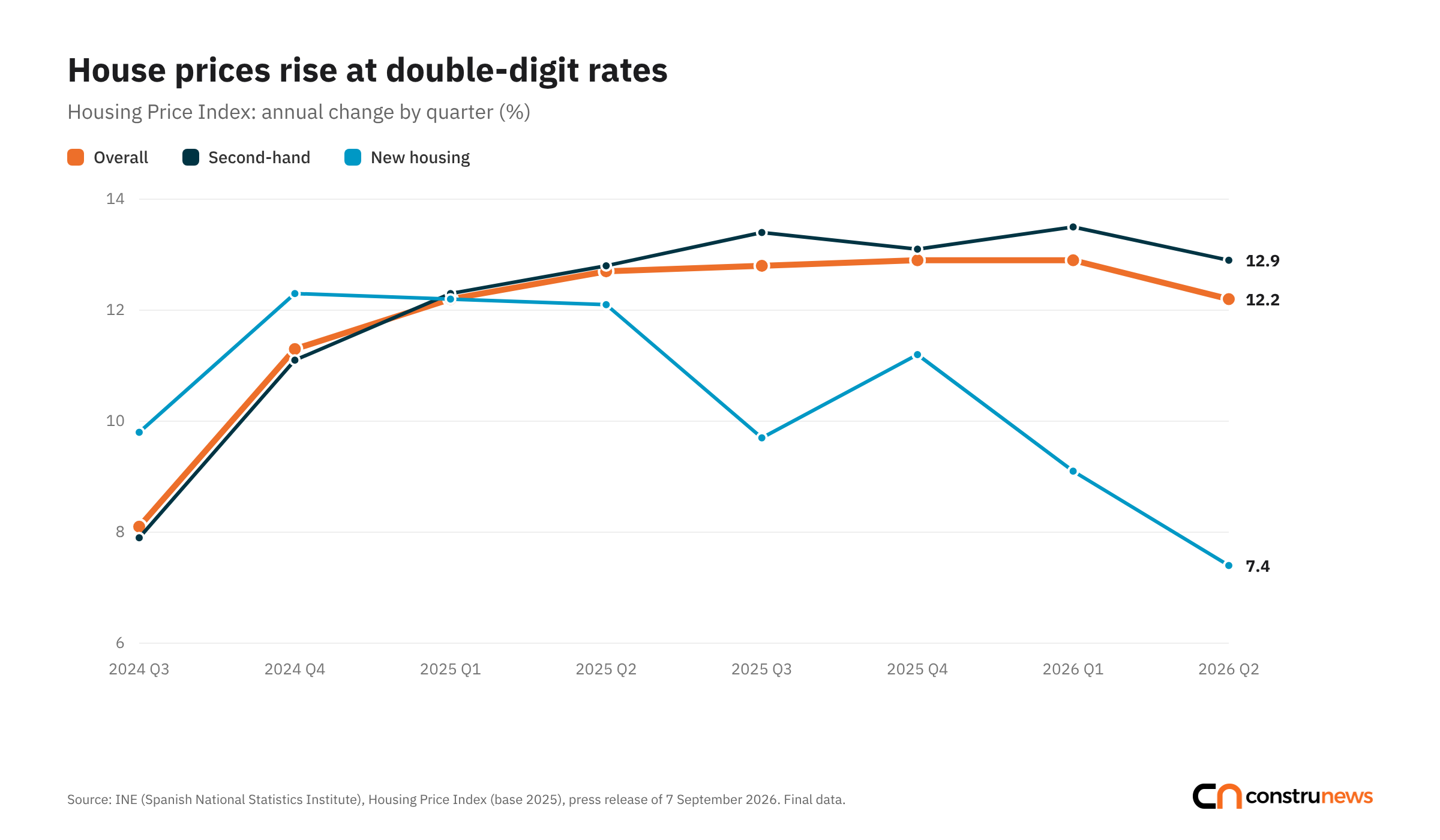
The European Commission’s Autumn 2026 Economic Forecast, published on 17 November, improves the growth outlook for Spain but singles out bottlenecks in the housing market as the main risk to the scenario. Data from INE and the Banco de España back up the diagnosis: prices are rising at double-digit rates, and a shortfall of 750,000…
-
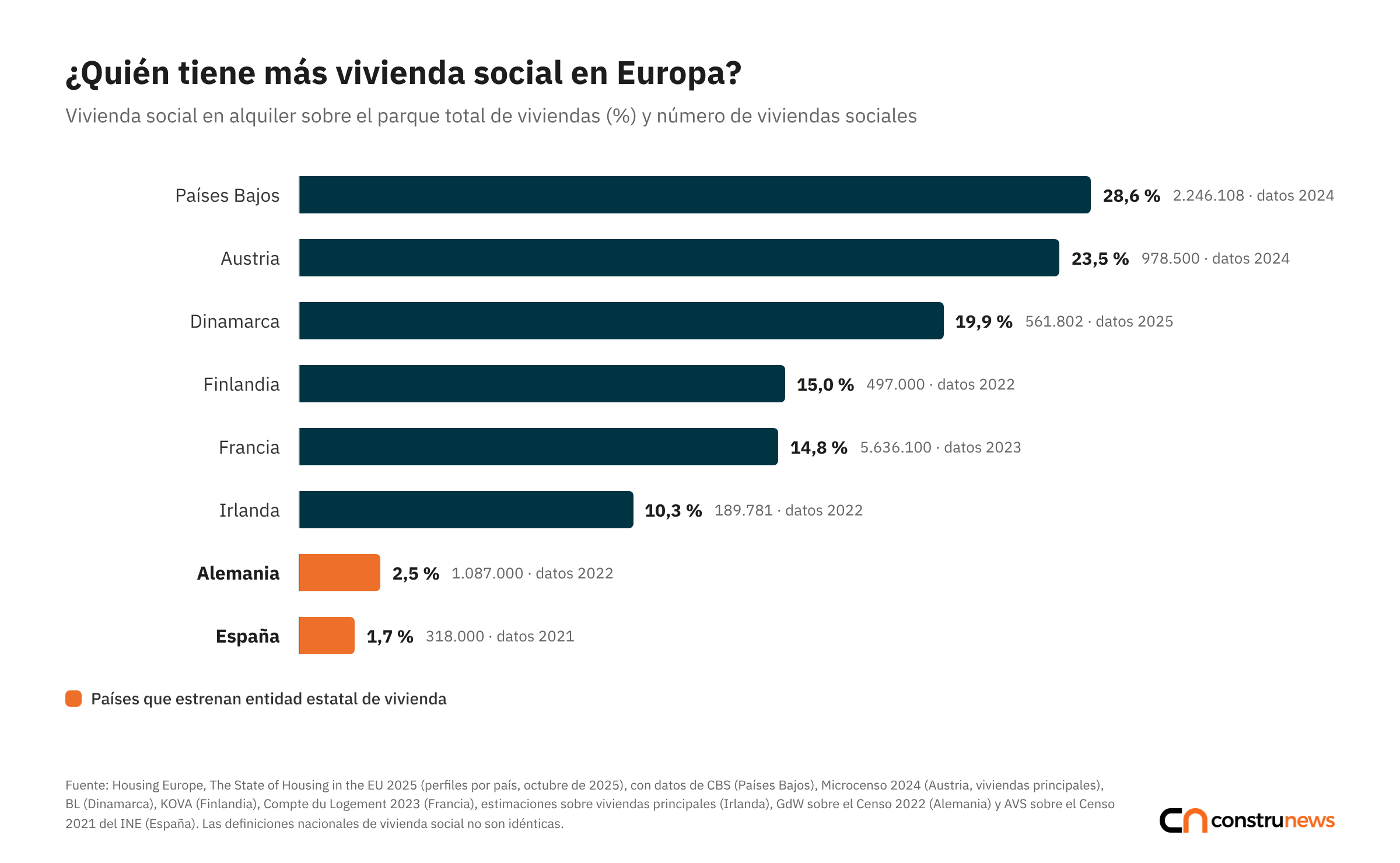
Germany creates a federal affordable housing company: which European countries are best prepared for the housing crisis?

Germany wants a federal affordable housing company up and running in 2027, according to the business daily Handelsblatt on 13 November, citing a document from the Construction and Finance ministries. The move comes as much of Europe looks for public tools to curb soaring prices. Data from Housing Europe and the OECD help answer the…
-
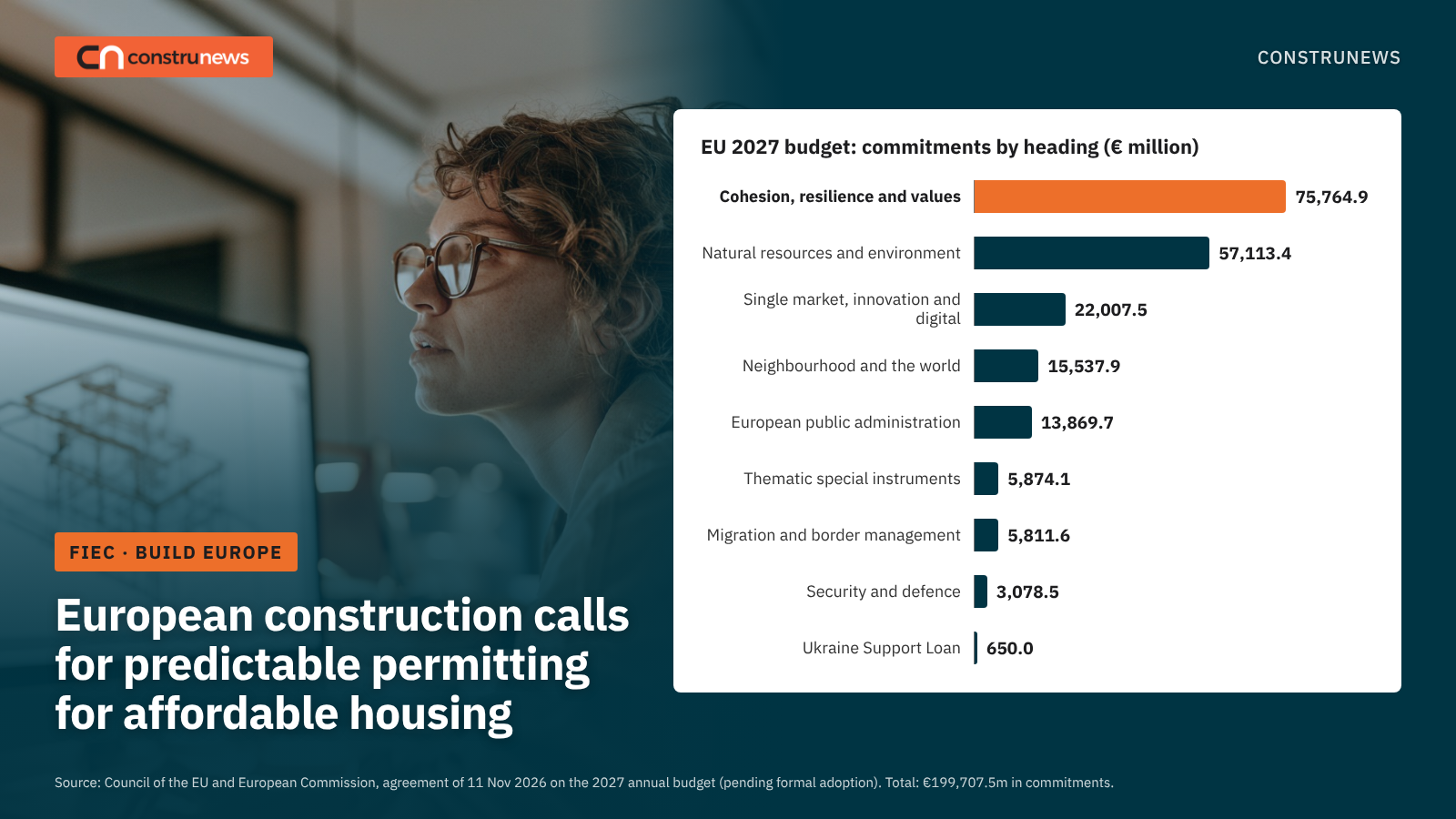
European construction calls for predictable permitting for affordable housing as the EU closes a €199.7 billion budget for 2027

Brussels faces a decisive week for construction. The European Construction Industry Federation (FIEC) and Build Europe have sent an open letter to MEPs ahead of the plenary vote on the Regulation on speeding up environmental assessments, while the Council of the EU and the European Parliament have reached agreement on the 2027 annual budget, the…
-
Xavier Vilajoana: “The Administration alone does not have the capacity to take on the challenge of expanding the housing stock”

As part of Construnews’ housing monograph, built on a ten-question survey based on data from the INE, building permits, Eurostat, the Urban Information System, protected housing certifications, public spending, costs, the Land Registry and prices, Xavier Vilajoana, presidente de APCEspaña, analyses the housing shortage, the administrative bottlenecks and the role that private development and public-private…
-
Marta Vall-llossera: “Renovation is not a complement to housing policy. It is half of the solution”

As part of Construnews’ housing monograph, built on a ten-question survey based on data from the INE, building permits, Eurostat, the Urban Information System, protected housing certifications, public spending, costs, the Land Registry and prices, Marta Vall-llossera Ferran, presidenta del Consejo Superior de los Colegios de Arquitectos de España (CSCAE), answers every question one by…
-
Housing and the 29N election: what Spain’s parties propose on rent, land, taxes and construction

Two weeks before Spain’s general election on 29 November, called after Congress rejected the Government’s housing decrees, housing has become the central issue of the campaign. Construnews has reviewed the election programmes and official statements published by the parties on their own websites to compare their proposals on housing, land, taxation and construction. Not every…
-
Brussels to propose a 2027 simplification package to build and renovate more homes with less red tape

The European Commission has presented its 2027 work programme, in which it commits to proposing a housing simplification package. The initiative builds on the European Affordable Housing Plan and responds to the Commission’s own estimate that the EU needs more than two million homes a year to meet current demand. On 4 November, the European…
-
Brussels legally shields regulation of stressed housing markets and bets on industrialisation with the Affordable Housing Act

The European Commission has presented an affordable housing package made up of two pieces: the proposed Affordable Housing Act Regulation (COM(2026) 599 final) and a Recommendation on Supply and Affordable Housing. Housing remains a competence of the Member States and their regional and local administrations, but for the first time EU law creates a unified…