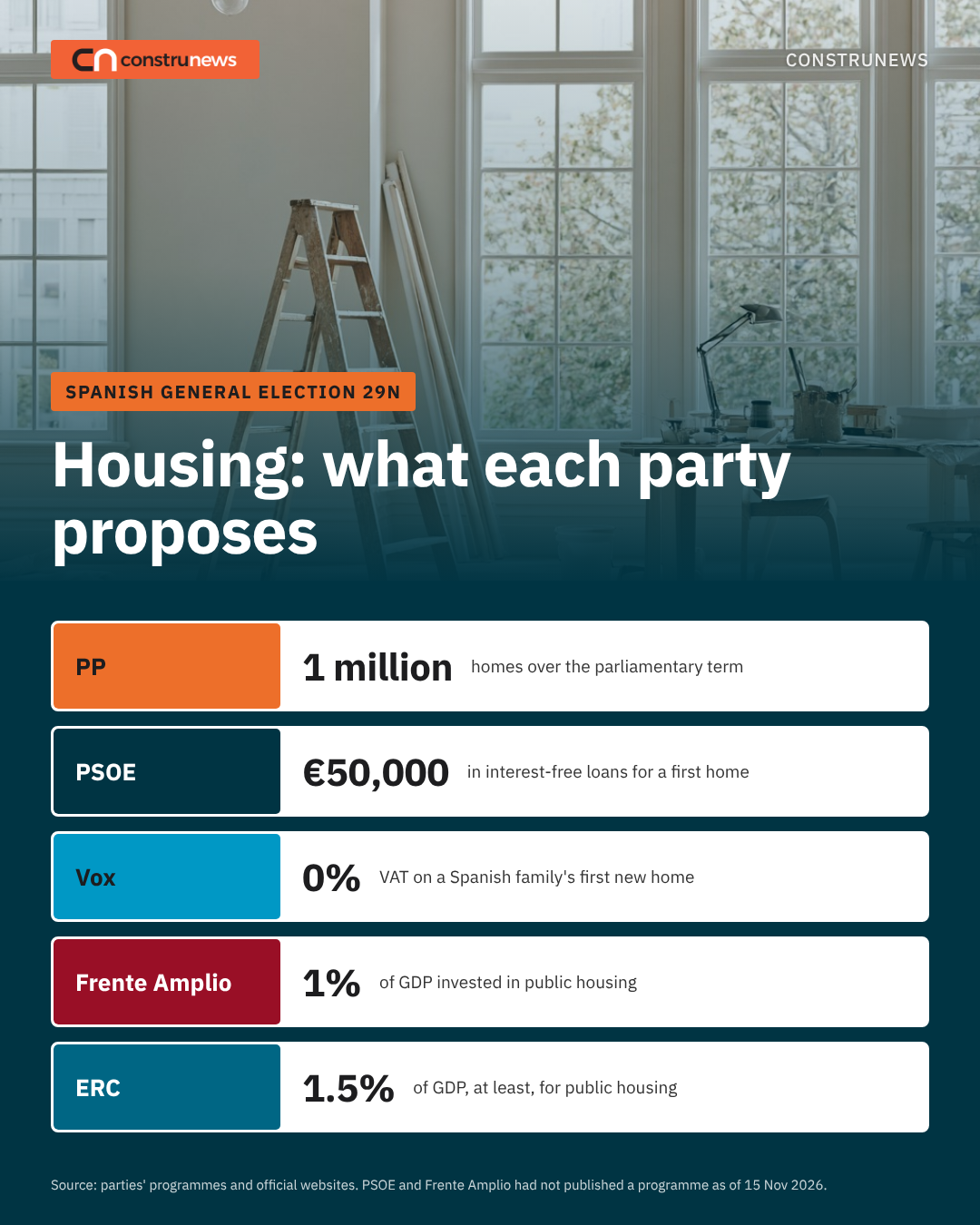


Two weeks before Spain’s general election on 29 November, called after Congress rejected the Government’s housing decrees, housing has become the central issue of the campaign. Construnews has reviewed the election programmes and official statements published by the parties on their own websites to compare their proposals on housing, land, taxation and construction. Not every party has yet presented a programme.
The latest move came from Alberto Núñez Feijóo. As reported by idealista/news (in Spanish), the PP candidate has announced that, if he wins, he will abolish the Ministry of Housing and fold the policy area into a vice-presidency, while acknowledging that housing is the country’s main problem. The move is in line with the pledge in his programme, La Reconstrucción Nacional (National Reconstruction), to govern with “fewer ministries, senior officials and advisers”.
The PSOE, by contrast, wants to keep the decrees the Government approved in October, while Vox combines deregulation with “national priority” in access to social housing. To the left of the PSOE, Ada Colau‘s Frente Amplio proposes expropriating homes from large investment funds. The result is a map of proposals built on two diagnoses: a shortage of supply for some, too much market for others.
PP: one million homes, a new Land Act and building permits in three months
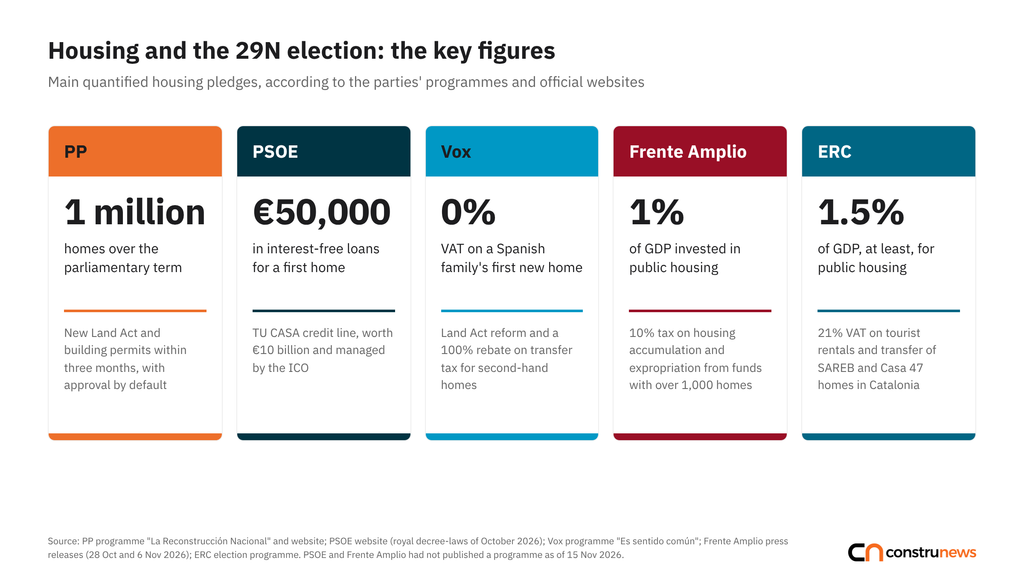
The Partido Popular (in Spanish) presented its election programme (in Spanish) in Madrid on 10 November. It sets the goal of driving the construction of one million homes, with a new Land Act and building permits decided within three months, with approval by default if the authority does not respond. On taxation, it proposes 4% VAT on the first home of buyers under 40, compared with the current 10%, payable in instalments in step with the mortgage, and the Hucha Hogar Joven (Young Home Savings Box): up to €2,000 a year in savings towards a first home, with a 20% tax deduction and a guarantee of up to €40,000.
According to idealista, the programme also includes repealing the Housing Act and the stressed residential market zones, a public guarantee of up to 20% of the home’s value, a super-reduced 4% VAT rate for renovating a main residence, social housing on land reserved for public facilities, conversion of offices and commercial premises, support for industrialised housing, greater flexibility in urban regeneration, and a training and employment plan to address the shortage of construction workers.
These lines were already part of the 15-measure plan (in Spanish) Feijóo presented in January, when he put Spain’s housing shortfall at 700,000 homes, growing by 160,000 a year. That plan included 90-day approval by default, releasing land at 30% below the average market price, a Strategic Residential Plan to cut construction lead times from 10 to 4 years, and an anti-squatting law with evictions within 48 hours. The programme adds a National Infrastructure Plan worth more than €300 billion over 15 years, mobilised with the private sector.
The PP sets a target of one million homes over the term, with building permits decided in three months and approval by default
PSOE: keep the decrees, interest-free loans and permanently protected housing
As of 15 November, the PSOE had not published its programme on its website. Its offer builds on the two royal decree-laws the Government approved in October, after Congress voted down the previous ones with the votes of PP, Vox and Junts. According to the PSOE (in Spanish), the decrees contain 21 measures, including the TU CASA credit line, endowed with €10 billion and managed by the ICO, offering interest-free loans of up to €50,000 to buy a first home. Homes bought this way will be permanently subject to a maximum resale price.
The decrees also include income tax deductions for tenants, extensions of up to two years for tenants who are up to date with payments, caps on rent increases, €280 million in guarantees for industrialised housing construction and €400 million for social housing providers. The public company Casa 47 will acquire Social Security properties for housing, purchases by investment funds are restricted and tourist flats will be taxed as businesses. For the next term, the party pledges in El Socialista (in Spanish) “more public and protected housing, forever”, wider purchase aid, stable rents and a ban on speculative buying.
The PSOE proposes interest-free loans of up to €50,000 for a first home and €280 million in guarantees for industrialised construction
Vox: 0% VAT, Land Act reform and national priority
Vox (in Spanish) presented its programme on 12 November under the slogan Es sentido común (It’s common sense). On housing, it proposes reforming the Land Act, increasing investment in social housing, repealing the Housing Act and applying national priority to access to social housing and rent support. A Spanish family’s first home would carry 0% VAT if newly built and a 100% rebate on transfer tax (ITP) if second-hand. It also calls for evicting squatters in under 24 hours, requiring legal residence to rent, and tougher taxation of speculative funds and non-EU buyers.
On construction, the programme includes a “drastic reduction” of the taxes levied on the building process, approval by default and self-certification (declaración responsable) as the general rule, an end to Low Emission Zones, and a national infrastructure plan including a National Water Plan linking all river basins.
Frente Amplio: expropriation from large funds and a tax on housing accumulation
The Frente Amplio (in Spanish), the coalition of IU, Comuns, Más Madrid and other forces led by Ada Colau, has not yet published its programme but has set out its measures in official statements. The flagship is a Law on the Expropriation of Homes from Private Corporate Owners (in Spanish), to be applied in three phases: first to entities with more than 1,000 homes, then to holders of more than 700 and finally to companies owning more than 50 properties. All urban properties and residential land held by SAREB would pass into the public housing stock.
The coalition also proposes a tax on housing accumulation (in Spanish) of 10% of the value of each home, applying to companies from the first home and to individuals from the fourth where the combined value exceeds €800,000, unless the homes are let at affordable and stable rents. Part of the revenue would fund public investment in housing of up to 1% of GDP to build, buy and renovate permanently protected affordable homes. It also proposes legal recognition of tenants’ unions (in Spanish) and regulating rent strikes.
The Frente Amplio proposes expropriating homes from funds with more than 1,000 flats and a 10% tax on housing accumulation
ERC, PNV and the other lists
Among the regional parties, ERC has published its programme (in Catalan), which calls for delegating powers over urban leases to the Generalitat, allocating at least 1.5% of GDP to public housing, transferring SAREB and Casa 47 properties in Catalonia, and 21% VAT on tourist rentals. The PNV (in Spanish) proposes speeding up planning procedures, mobilising empty homes, renovating buildings and regulating seasonal and tourist rentals, without specific figures, as well as updating the Technical Building Code to encourage energy renovation.
Podemos, Junts and EH Bildu had not published a programme for the 29N election on their websites as of 15 November.