
Artificial intelligence raises high expectations in the construction industry, but its real use is still at an early stage: most professionals use it to ask questions or generate content, and only a minority has incorporated it into automated workflows.
Only 19% of construction professionals use artificial intelligence through automated workflows or AI agents. 54% limit their use to queries or content generation, and another 27% do not use it yet. These are the main findings of the Global Construction AI Confidence Index 2026, produced by PlanRadar from the responses of 2,330 industry professionals in 20 international markets, Spain among them.
The study highlights the gap between confidence in the capabilities of artificial intelligence and its actual adoption on projects, in an industry facing major challenges in productivity, team coordination and meeting deadlines.
Autonomy, not complexity, sets the limit
According to the report, professionals are comfortable entrusting complex tasks to AI as long as the final decision stays with a person. Internationally, the confidence index averages +43 points when the technology prepares information or advises, but falls to +20 when it makes decisions autonomously. The main limit, therefore, lies less in the complexity of the tasks than in the degree of autonomy given to the technology.
The confidence index falls from +43 to +20 points when AI stops preparing or advising and starts deciding on its own
This gap between confidence and adoption is particularly significant given that more than a third of respondents spend more than one working day a week on administrative tasks, such as writing reports or managing documentation. In addition, 65% believe AI could reduce or streamline the workload linked to their main day-to-day difficulties, up from 58% nine months earlier.
81% of Spanish professionals expect efficiency gains
In Spain, expectations about artificial intelligence are tied above all to productivity. 81% of respondents expect AI to reduce repetitive tasks, streamline work processes or both, three points above the international average (78%).
Better quality is the second major expectation, cited by 56% of Spanish participants, compared with 54% globally. By contrast, only 18% point to scaling up their activity as one of the main benefits, suggesting that professionals prioritise AI to optimise daily work rather than as a tool for expansion.
The report also identifies the industry’s main operational problems internationally: managing project changes (43%), coordination between stakeholders (40%) and meeting deadlines (35%), areas where automation and data analysis can ease workloads. Yet adoption is slow: even among those already managing their projects on centralised digital platforms, the share with built-in AI features has only risen from 36% to 41% in nine months.
65% believe AI could ease their main daily difficulties, seven points more than nine months earlier
Spain ahead of Germany, the UK and Italy in delegating decisions
Spain stands out from other European markets: its professionals show greater relative confidence in AI making certain decisions autonomously. On tasks where AI decides without human intervention, Spain scores +29 points, against an international average of +20, ahead of Germany (+22), the United Kingdom (+17) and Italy (+3). It is the European market with the highest confidence in this category among those with a separate breakdown in the report.
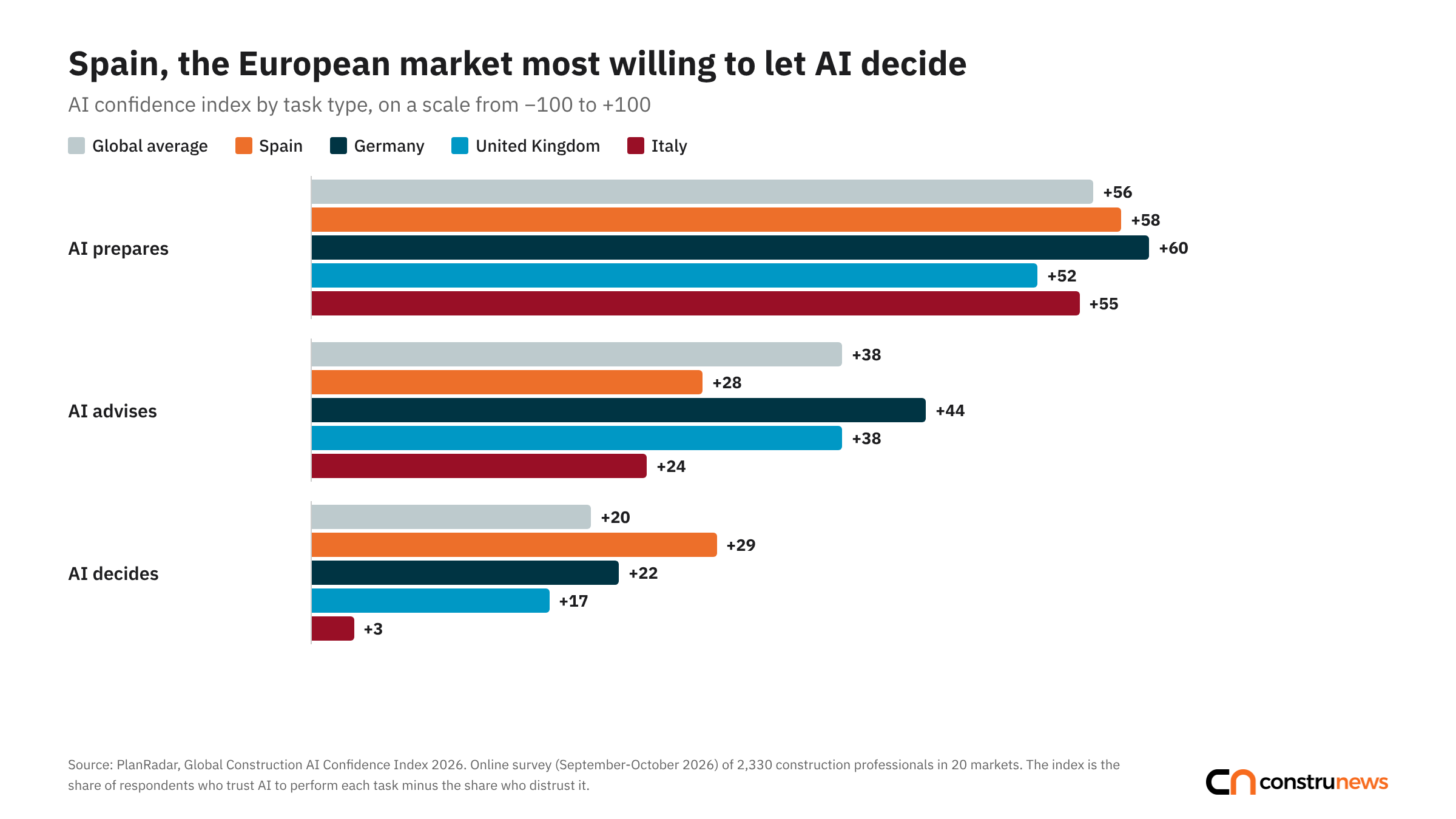
The contrast is striking: while internationally confidence falls from +38 to +20 points when AI moves from offering recommendations to making the final decision, in Spain it remains virtually stable, at +28 and +29 points respectively.
This willingness coexists with certain reservations. 68% of Spanish professionals cite the reliability of results or the need to keep human judgement as factors that condition their trust. On the other hand, only 22% mention data privacy and security, compared with an international average of 31%.
“To earn a place on a construction project, artificial intelligence must understand the project as it really is, not just the documents it receives. That means knowing the drawings, what is happening on site and the company and industry standards that must be met. An AI with that context can take care of tracking tasks as the project progresses,” says Álvaro Vega, director regional de PlanRadar en España, adding that the company develops its AI with this approach, “ensuring that decisions remain in the hands of the teams”.
Spain scores +29 confidence points when AI decides, against +22 in Germany, +17 in the UK and +3 in Italy
For Ibrahim Imam, co-CEO of PlanRadar Group, “the line they draw is about who makes the decision, not how hard the work is. AI should take on the preparatory work so that their years of experience and judgement are applied to the decisions only they can make”. And he warns: “In an industry where experienced professionals are increasingly hard to find, organisations that do not use AI this way are having their best people spend time on tasks AI could take on”.
Reliability of results, not fear of replacement, holds trust back
Across the markets analysed, the main concerns relate to the accuracy of results and possible AI errors, cited by 53%, and to the need to keep human judgement, mentioned by 45%. Overall, 70% point to trust in AI outputs as a brake.
By contrast, only 3% cite fear of being replaced by artificial intelligence. The industry’s reservations, the report concludes, have more to do with the reliability of the tools and responsibility for their decisions than with the risk of job replacement, a debate Construnews has already covered in specific fields such as hospital design and construction.
About the report
The Global Construction AI Confidence Index 2026 is based on an online survey carried out between September and October 2026 among 2,330 construction professionals in 20 markets across Europe, the Middle East, the Americas and Asia-Pacific, and analyses confidence in AI to carry out 18 common project tasks. The index uses a scale from −100 to +100 and is calculated as the share of respondents who trust AI to perform a task minus the share who distrust it. Market results are shown where there are at least 25 responses.
PlanRadar is a SaaS platform for construction, facility management and real estate project management, headquartered in Vienna (Austria), with 13 offices worldwide and more than 200,000 users in over 75 markets.

