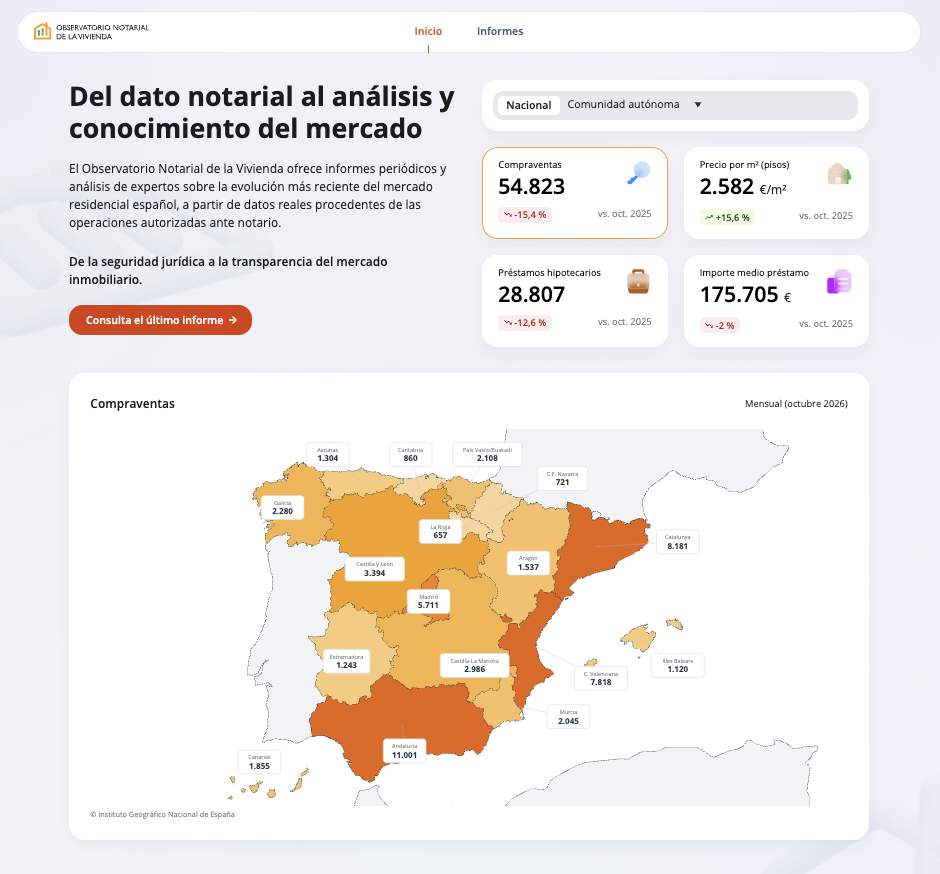

Spain’s General Council of Notaries has presented its first Notarial Housing Observatory, a tool that turns data from public deeds into regular reports. Its first reading, with advance data for October, confirms the diagnosis of Construnews’ Special report on housing data in Spain: fewer homes are being sold, buyers are paying more and supply is not keeping up with demand.
Home sales fell 15.4% year on year in October, to an estimated 54,823 transactions, the largest drop so far this year and the tenth consecutive month of decline. At the same time, flat prices rose 15.6%, to €2,582 per square metre. The figures come from the press release issued by the General Council of Notaries (in Spanish) on 26 November, marking the launch of the Observatorio Notarial de la Vivienda.
A shortage that almost doubles in five years
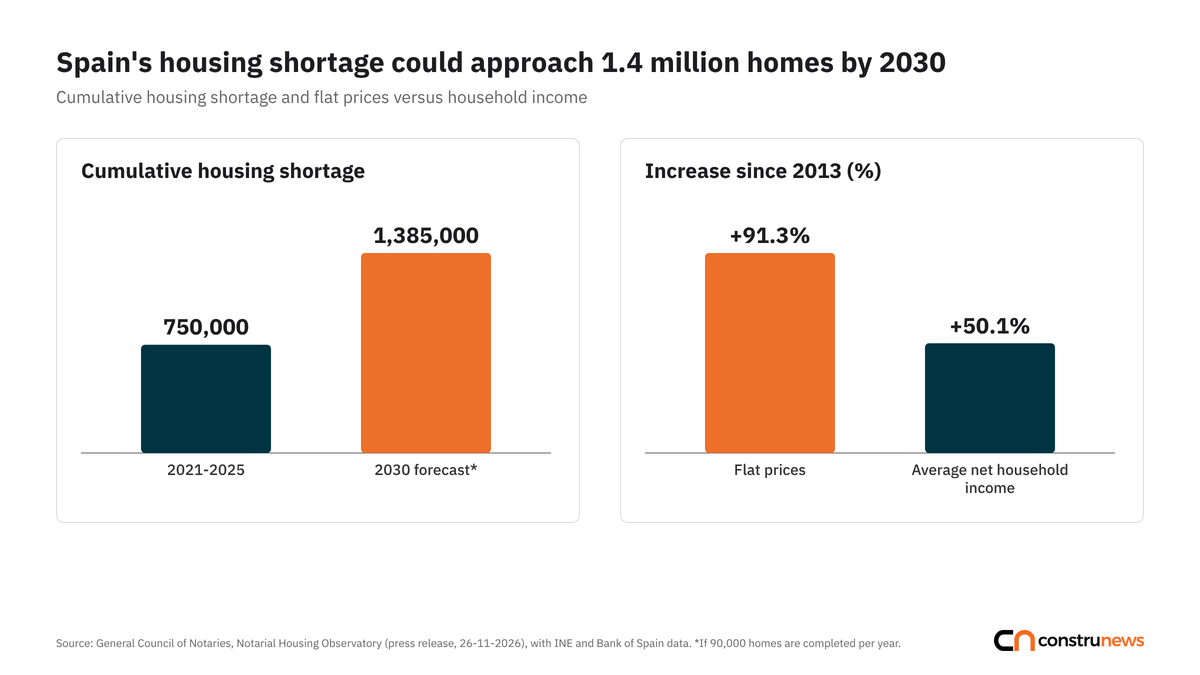
The most striking forecast came from Alberto Martínez Lacambra, director del Centro Tecnológico del Notariado (CTNotariado): the market is heading towards “a shortage of close to 1.4 million homes in 2030“. According to the notaries’ release, which cites data from the INE (National Statistics Institute) and the Bank of Spain, the cumulative shortage reached 750,000 homes between 2021 and 2025 and could rise to 1,385,000 in 2030 if 90,000 homes are completed each year. Since 2011, more households have been formed every year than homes have been completed.
The starting figure matches the one used by the European Commission, which in its autumn forecast flags the housing shortage as the main risk to Spain’s growth. And the output rate assumed in the notaries’ calculation is in line with Construnews’ data report: Spain completes around 94,000 homes a year when it would need 146,000 to absorb the 2.2 million additional households the INE projects up to 2041.
The cumulative housing shortage reached 750,000 units between 2021 and 2025 and could hit 1,385,000 in 2030 if only 90,000 homes are completed a year
683,000 sales: the year will close lower
Martínez Lacambra also anticipated the full-year figure: “2026 will close with around 683,000 sales, 9% fewer than last year.” Between January and October, 560,511 home sales were signed, 9% fewer than in the same period of 2025.
Official registry data point the same way. The INE’s Property Rights Transfer Statistics (ETDP) recorded 54,548 registered home sales in September, 13.4% fewer than a year earlier, the largest annual fall of 2026, with declines in 16 of the 17 autonomous communities. The INE counts transactions entered in the land registries, which may relate to deeds signed in previous months, whereas the Observatory gives an early reading of what was signed before a notary in the previous month.
October’s decline reached 16 of the 17 autonomous communities. The sharpest falls were in the Balearic Islands (-19.5%), Catalonia (-19.2%) and Galicia (-19.0%); only La Rioja grew, by 20.0%. By volume, Andalusia led the month (11,001 sales), followed by Catalonia (8,181), the Valencian Community (7,818) and Madrid (5,711).
October marks ten straight months of decline: 54,823 sales, 15.4% fewer, while the price per square metre rose 15.6%
Prices rise in every region
Price rises are widespread: the price per square metre increased in all 17 communities, led by Castile-La Mancha (+32.8%), the Balearic Islands (+32.5%) and La Rioja (+32.0%). From January to October, the average price was up 14.7% on the same period of 2025. Among cities with more than 500,000 inhabitants, Seville (+29.2%) and Málaga (+28.4%) stand out, compared with Madrid (+11.7%) and Barcelona (+12.1%).
The long view explains the affordability problem: since 2013, flat prices have risen 91.3%, while average net household income has grown 50.1%. “Fewer homes are sold and more is paid, the sign of a market in which supply does not meet demand,” summed up José García Montalvo, catedrático de Economía Aplicada at Universitat Pompeu Fabra and adviser to the Observatory.
Since 2013, flat prices have risen 91.3%, while average net household income has grown by only 50.1%
Lending is also cooling. In October, 28,807 mortgage loans were signed for home purchases, 12.6% fewer, the largest fall since November 2023. However, 52.5% of sales were financed with a mortgage, 1.7 points more than a year earlier. The average loan fell 2% to €175,705, and loan-to-price stood at 72.2%, unchanged from October 2025.
Looking beyond the big cities
Among the solutions, Martínez Lacambra proposed looking beyond the big cities: “Less than an hour from Madrid and Barcelona by public transport, the square metre of a flat costs between 44% and 65% less.”
Advance data to anticipate the market
Concepción Pilar Barrio Del Olmo, presidenta del Consejo General del Notariado, recalled that “for years, notaries have shared their data with public administrations” and said the new Observatory, headed by notary Carlos Castaño Bahlsen, aims to go beyond the data to explain the market. It uses actual sale prices signed before a notary, not asking prices, and will publish monthly, quarterly and annual reports, with series dating back to 2007. For economist José Carlos Díez, also an adviser, “in housing, timing matters. Data that arrive late only serve to explain the past.”
Spain’s notaries put the housing shortage at almost 1.4 million homes by 2030 if completions stay at 90,000 a year, against the 146,000 that would be needed. With 683,000 sales forecast for 2026, down 9%, and prices up 15.6% in October, the market is losing activity while continuing to get more expensive.

