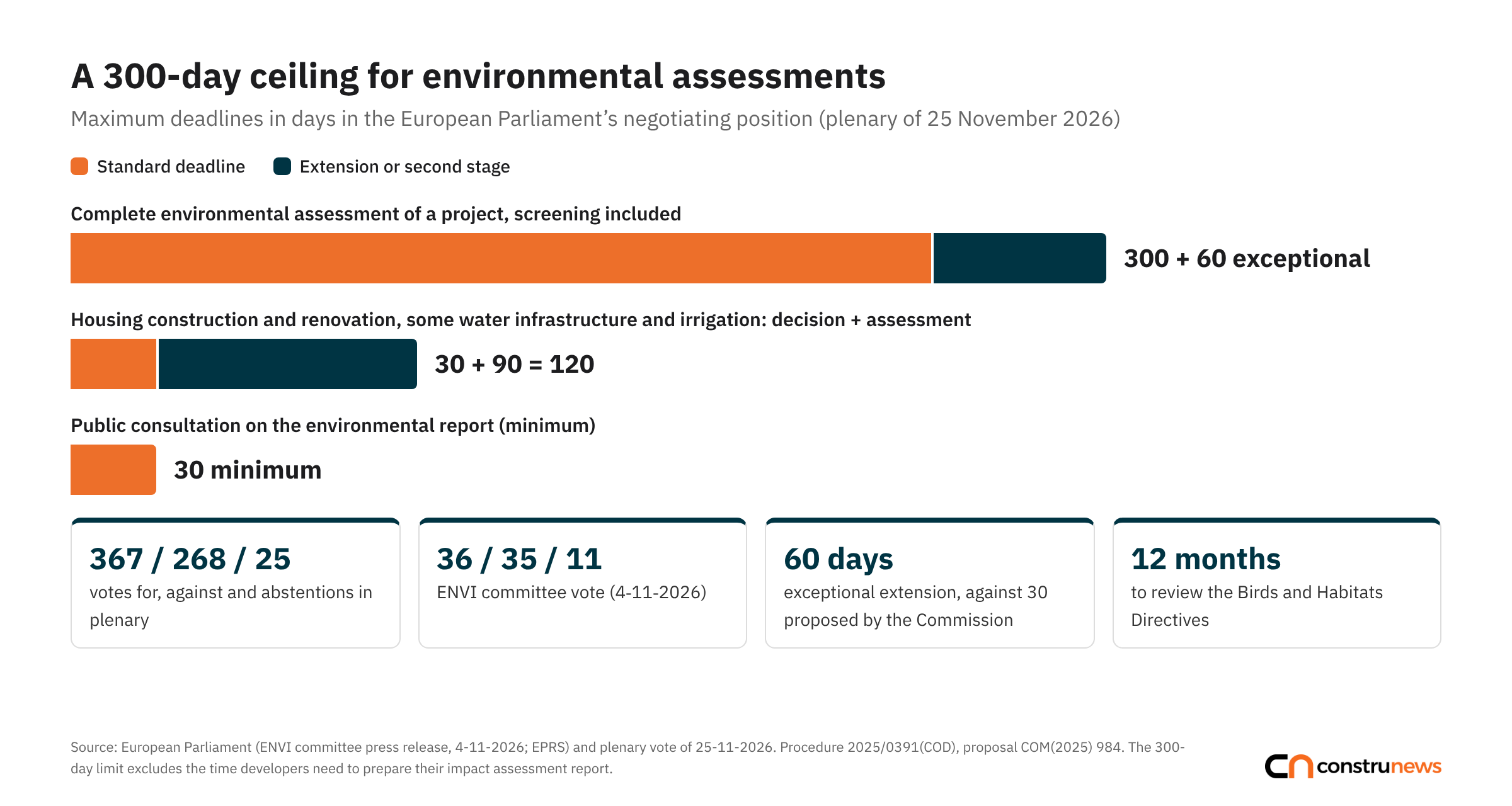

The text sets a maximum of 300 days to complete a project’s environmental assessment and, for housing construction and renovation, a shorter procedure: 30 days to decide whether an assessment is needed and, if so, no more than 90 days to carry it out.
The vote took place on Wednesday 25 November in the Strasbourg plenary, a day later than planned: on Tuesday 24 November the House postponed the vote at the request of the European People’s Party (EPP), by 390 votes to 258, with 15 abstentions. The amended proposal was finally adopted by 367 votes to 268, with 25 abstentions, and the report was referred back to committee by 422 votes to 225, with 10 abstentions, to open negotiations with the Council of the EU.
The file, procedure 2025/0391(COD), is based on proposal COM(2025) 984 and was handled by the Committee on the Environment, Climate and Food Safety (ENVI), with Swedish MEP Emma Ytterell (Renew Europe) as rapporteur.
A 300-day limit for the whole assessment
Parliament’s main contribution is an overall limit. According to the European Parliament press release issued after the committee vote, the complete environmental assessment of a project, including screening (the stage that decides whether a project needs an assessment), should take no more than 300 days. That count does not include the time developers need to prepare their environmental impact assessment report.
In exceptional cases linked to the nature, complexity, location or size of the project, authorities could extend the deadline by up to 60 days, compared with the 30 days proposed by the Commission. For plans and programmes, the 300-day limit would replace the Commission’s deadlines for individual steps. The public would also have at least 30 days to comment on a project’s environmental report.
The complete environmental assessment of a project, screening included, should take no more than 300 days, extendable by up to 60 in exceptional cases
In the position adopted in committee, screening had to be completed within 45 days, rather than the 60 proposed by the Commission.
Housing: 30 days to decide and 90 to assess
According to information released after the vote, the text adopted in plenary includes a fast-track procedure for housing construction and renovation, which would also apply to certain water infrastructure and to the modernisation of farms and irrigation. In these cases, the competent authority would have 30 days to decide whether the project needs an environmental assessment and, if it does, a further 90 days at most to carry it out.
If the authority does not rule within those 30 days, the project would be deemed not to require an assessment, unless there is a demonstrable and significant risk to residents’ safety.
To build or renovate homes, the authority would have 30 days to decide whether an assessment is needed and no more than 90 days to carry it out
The plenary also proposes exemptions for river maintenance, irrigation canals, flood protection and forest fire prevention.
Parliament strengthens the environmental single point of contact as the developer’s sole interlocutor, so that developers do not have to resubmit documents and information already provided. Member States would have to assess the staffing needs of their competent authorities within 12 months and publish the results, and the Commission would report every five years on whether those authorities have adequate staff and resources.
In the ENVI committee position, MEPs keep overriding public interest and faster court procedures for certain strategic projects but drop tacit approval. This toolbox is limited to sectors such as net-zero technology, critical raw materials, critical medicines, semiconductors and key ports, inland waterways and railways on the trans-European transport network, provided that the projects contribute to decarbonisation, resource efficiency or defence.
“Ineffective and slow permits are a troublesome bottleneck that dampens European competitiveness,” said rapporteur Emma Ytterell after the committee vote. “Faster permitting and high environmental standards can go hand in hand.”
A split vote and the Birds and Habitats review
The vote divided the House. In committee, the report was adopted on 4 November by a single vote: 36 in favour, 35 against and 11 abstentions. In plenary, an amendment tabled by the European Conservatives and Reformists (ECR) and supported by the EPP, the ECR and Patriots for Europe was adopted by 357 votes to 284, with 21 abstentions. It asks the Commission to present, within 12 months of the Regulation’s entry into force, a review of the Habitats Directive (92/43/EEC) and the Birds Directive (2009/147/EC) as they affect the plans and projects covered by the Regulation, together with a legislative proposal to reduce administrative burdens and delays.
An amendment asks the Commission to review the Birds and Habitats Directives within 12 months and propose changes to cut red tape and delays
The Socialists opposed that amendment. Their negotiator, Annalisa Corrado (S&D), argued that it breaks the compromise reached and pre-empts the conclusions of the fitness check of environmental legislation. Organisations such as BirdLife Europe, ClientEarth, the European Environmental Bureau (EEB) and WWF have also criticised the outcome.
The text also amends Article 8 on protected species: accidental killing or disturbance of protected species, or damage to nests and eggs, would not be considered intentional if the plan or project includes appropriate and proportionate mitigation measures, takes account of best available techniques and assesses cumulative effects, without causing deterioration in the conservation status of the species.
Next step: negotiations with the Council
The Council of the EU agreed its negotiating mandate on 30 September 2026, according to the European Parliamentary Research Service (EPRS) briefing. With the plenary position adopted, the two institutions can begin trilogues, with the Commission, to agree on a common text. The Regulation will only apply once Parliament and Council close that deal.
For the construction sector, the vote follows the open letter from FIEC and Build Europe to MEPs, which called for predictable environmental assessments to unlock affordable housing, and comes ahead of the simplification package to build and renovate more homes that Brussels plans to propose in 2027.

